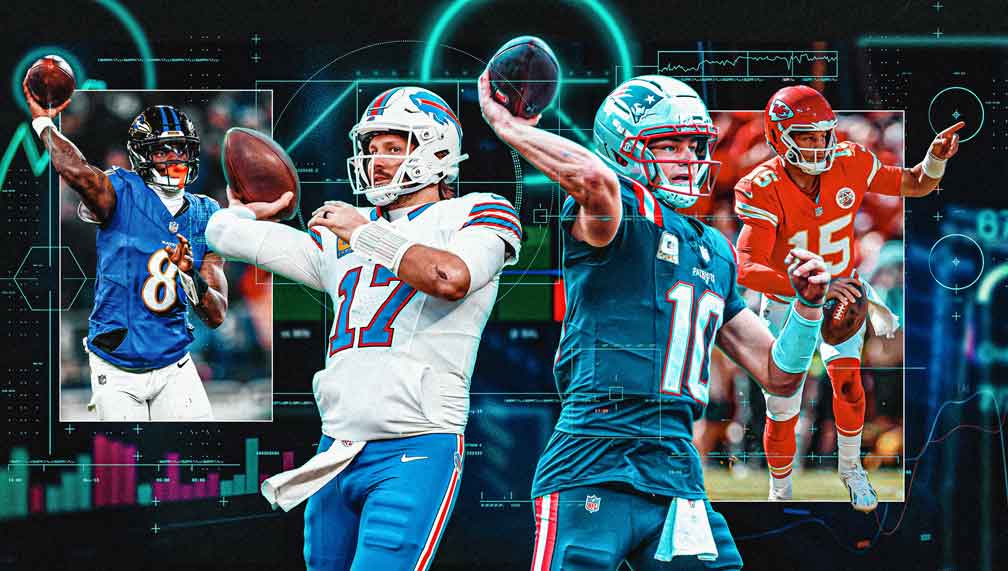
Every qualifying quarterback. Every metric that matters. PFF grades, passing splits, EPA per dropback, clutch performance, interception luck and more — all in one interactive guide built on the same data trusted by all 32 NFL teams.
Read the QB Annual (opens in new tab)Get PFF+ (opens in new tab)The 2026 PFF QB Annual brings together every aspect of quarterback evaluation into one interactive resource, combining PFF grading with quarterback charting, advanced metrics and brand-new data points and visuals.
After exploring every qualifying quarterback's 2025 season — from ball placement and interception luck to performance under pressure and rushing production — these are the 10 findings that stood out most.
1. Matthew Stafford led the league in PFF grade and interception luck
Stafford finished the 2025 season with a league-best 91.7 PFF passing grade, powered by a 7.7% big-time throw rate that ranked first in the NFL and tied for the 15th-highest mark recorded since 2006.
It was a brilliant season, one defined by elite quarterback play across virtually every situation. He topped the league in passing grade from a clean pocket, against non-blitzes, on play action and on early downs, while finishing near the top of almost every other situational split. There is, however, one tiny asterisk.
The Rams quarterback also benefited from the most favorable interception luck of any qualifying quarterback in 2025, finishing with 6.81 fewer interceptions than expected based on the quality of his throws. He threw 21 turnover-worthy passes across 716 dropbacks but finished the campaign with only nine interceptions against an expected total of 15.8. Nine of his throws were dropped by defenders, seven of them on genuine turnover-worthy plays.
None of that makes the season any less legitimate. Stafford's underlying grading profile is the product of elite quarterback play that he made look almost effortless at times in 2025, routinely producing throws that few other quarterbacks can. That said, the interception total doesn't tell the full story.
2. Joe Burrow‘s limited sample still points to elite quarterback play
Burrow was limited to just eight games due to a severe turf toe injury that required surgery. In all, he dropped back just 259 times, but the quality of his play was impossible to ignore.
His PFF passing grade of 91.3 ranked second in the league. Maybe more impressively, his 0.7% turnover-worthy play rate was the lowest among qualifying quarterbacks in 2025 and the best single-season rate recorded by any quarterback with at least 250 dropbacks since 2006. Among 688 qualifying quarterback seasons over that span, Burrow's ball security stands alone.
Of the six passing metrics PFF identifies as most strongly correlated with future performance, Burrow graded above the 95th percentile in four of them, including the 98th percentile in standard-dropback grade, 98th percentile in grade on plays with no play-action and 97th percentile in grade on throws at or beyond the first-down marker.
3. Lamar Jackson‘s play-action split is unlike any other quarterback's
Lamar Jackson earned a 69.0 passing grade in 2025, his lowest mark since 2021. The play-action split offers one explanation for why the overall number landed where it did. Jackson earned an elite 87.9 passing grade on play-action dropbacks, the third-highest mark in the NFL behind only Matthew Stafford and Sam Darnold. Without play action, that grade fell to 58.2, which ranked 37th among qualifying quarterbacks, between Geno Smith (58.5) and Cam Ward (54.1).
The percentile split makes the gap even clearer. Jackson’s non-play-action grade ranked in just the 14th percentile, while his play-action grade landed in the 94th percentile — an 80-percentile-point swing that was the largest in the qualifying quarterback pool.
No other starter came close. Darnold posted a 69-to-97 percentile swing, while Mac Jones checked in at 60 to 91. Jackson’s gap doesn’t mean his passing profile is explained entirely by play action, but it does show how much better the results were when Baltimore could attach the passing game to a run fake.
4. The easy throws aren't working for Patrick Mahomes
The PFF grading scale runs from −2 to +2 in 0.5-point increments, and a zero grade represents an expected NFL pass — a throw the quarterback simply made as required.
Looking at YPA and EPA per attempt on those plays quantifies the production generated when a quarterback does exactly what the scheme asks. Since 2019, no quarterback has been more dangerous on those plays than Patrick Mahomes. He has thrown 94 touchdowns on zero-graded throws across that span — 30 more than the next-closest player — and no quarterback has generated more total EPA on them.
In 2025, that changed completely. His 5.12 yards per attempt on zero-graded throws was a career low. His −0.034 EPA per attempt was the second-lowest mark of his career. Yards after the catch per reception on those throws fell to 4.40, his worst since his first full season as a starter. This matters because zero-graded throws are scheme-generated plays. When they stop working, the scheme itself is implicated. The Chiefs' offense, as constructed in 2025, was no longer creating easy, productive throws for Mahomes the way it once did.
The clean-pocket numbers confirm it at the grading level. Mahomes' 75.2 passing grade from a clean pocket was nearly 10 points below his previous career low of 84.8, a historically significant drop for a player at his level. His 70.7 overall grade, the lowest of his career, reflected a quarterback whose structured performance had genuinely regressed.
The stable metrics — clean-pocket grade (19th percentile), standard-dropback grade (14th percentile) — place him firmly below the median among qualifying passers in 2025.
Where Mahomes still excelled was in chaos. His 80th-percentile pressured-passing grade and 89th-percentile grade on throws from outside the pocket represent the kind of improvisation that has always been the most breathtaking part of his game. But no other quarterback in the data carries an 80-percentile-point split between structured and “chaotic” performance. The implication is uncomfortable: Mahomes' best football in 2025 came from situations that are, by definition, harder to replicate and sustain.
5. Nobody was better at avoiding sacks than Brock Purdy
Pressure-to-sack rate — the percentage of pressured dropbacks that result in a sack — is one of the most practically useful metrics in the QB Annual. It separates quarterbacks who consistently avoid drive-ending losses under pressure from those who too often allow a pressured snap to become a sack.
In 2025, Brock Purdy posted the best pressure-to-sack rate among qualified starters at 9.0%, followed by Bo Nix (9.5%) and Caleb Williams (9.6%). Those quarterbacks consistently limited negative plays even when the pocket broke down.
At the other end of the spectrum, Brady Cook turned a staggering 38.8% of his pressured dropbacks into sacks — by far the highest rate in the qualifying pool. Geno Smith (25.9%) and Tyler Shough (25.0%) rounded out the bottom three.
Viewed alongside average time to throw, the metric provides additional context for how quarterbacks respond to pressure. Tua Tagovailoa (2.55 seconds) and Jared Goff (2.57 seconds) led the league in release speed, while pressure-to-sack rate captures what happens when that initial timing is disrupted. Together, the two metrics help distinguish quarterbacks who consistently minimize negative plays from those who struggle once the pocket collapses.
6. J.J. McCarthy‘s league-worst interception luck added to an already troubling profile
J.J. McCarthy's 12 interceptions on 243 attempts told a harsh story in the box score. The interception total doesn't tell the whole story. McCarthy's net interception luck of -5.25 was the worst among qualifying quarterbacks, with 12 actual interceptions despite an expected total of only 6.75. Defenders rarely let him off the hook, dropping just three of his 15 interception opportunities and only two turnover-worthy throws.
The accuracy data adds another layer. McCarthy's catchable but inaccurate rate — the share of his aimed passes that were catchable but poorly placed — was 25.4%, the second-highest among qualifying passers. In other words, more than one in four of his aimed passes arrived off target enough to cost the receiver an opportunity after the catch or force an unnecessary adjustment.
His 4.8% turnover-worthy play rate was already among the highest in the qualifying pool. Taken together, the data paints a concerning profile: a quarterback who generated too many turnover-worthy plays, endured the worst interception luck in the league and too often failed to consistently place the football in optimal locations, even on completions.
7. Jaxson Dart was his own worst enemy in the pocket
The Allowed Pressures section of the QB Annual doesn't just measure how often a quarterback is pressured — it also identifies QB-fault pressures, where the quarterback's own pocket management or decision-making contributed to the pressure rather than the offensive line. It's an important distinction when evaluating how much of a quarterback's pressure profile is self-inflicted.
In 2025, Jaxson Dart recorded the highest QB-fault pressure rate among qualifying starters, with 39.1% of the allowed pressures he faced attributed to his own decisions in the pocket rather than breakdowns in protection.
At the other end of the spectrum, Michael Penix Jr. was responsible for just 3.2% of the pressures he faced, getting the ball out or managing the pocket before pressure could develop on the vast majority of his dropbacks. Kirk Cousins (7.1%) and Sam Darnold (7.5%) also ranked among the league's best in avoiding quarterback-generated pressure.
Viewed alongside traditional pressure statistics, the split helps separate offensive line performance from quarterback responsibility. It provides another layer of context for evaluating whether pressure is primarily a protection issue, a quarterback issue or a combination of both.
8. Dak Prescott was clutch in 2025 — and he did it under fire
Prescott led all 43 qualifying starters in PFF grade in clutch situations in 2025 (87.8), doing so across a substantial 145 dropbacks. He averaged 8.1 yards per attempt in those situations while posting a 10.6-yard average depth of target — tied for the sixth-deepest mark among qualifiers.
The context makes the performance even more impressive. Of Prescott's 145 clutch dropbacks, 67 came under pressure, meaning nearly half of his highest-leverage passing plays featured a defender in his face.
His 83.5 pressured-passing grade in clutch situations ranked second among qualifying starters, behind only Joe Burrow. That comparison comes with an important caveat, though: Burrow faced pressure on just 14 clutch dropbacks all season, compared to Prescott's 67. While those under-pressure rankings should be interpreted with caution given the small sample sizes involved, Prescott's ability to sustain elite play across such a large volume of high-leverage, pressured dropbacks stands out.
9. Josh Allen and the Bills turned average throws into exceptional value
As we mentioned above, the PFF grading scale runs from −2 to +2 in 0.5-point increments, and a zero grade represents an expected NFL pass.
On 335 zero-graded throws, the Bills quarterback averaged 0.173 EPA per attempt and 6.59 yards per attempt, both the best marks among qualifying starters. Jared Goff ranked second in EPA per attempt on those throws at 0.090, while Davis Mills (-0.391), Joe Flacco (-0.273) and Spencer Rattler (-0.252) occupied the bottom of the pool.
The historical context matters, too. Since 2006, the quarterbacks near the top of the yards-per-attempt leaderboard on zero-graded throws have often been attached to elite offensive ecosystems: Goff in Ben Johnson’s 2024 Lions offense (6.94), Matt Ryan in Kyle Shanahan’s 2016 Falcons offense (6.74) and Jimmy Garoppolo in Shanahan’s 2021 49ers offense (6.71). Allen’s 6.59 mark belongs in that same conversation.
That does not diminish his season. It frames it properly. Allen still had to operate the offense, distribute accurately and avoid turning neutral plays into negative ones. But the Bills’ infrastructure also deserves credit. Their 2025 offense consistently turned ordinary throws into efficient production, giving Allen one of the most favorable environments of the PFF era.
10. Sam Darnold was one of the NFL's best deep passers in 2025
Darnold finished the 2025 season with a 95.5 PFF passing grade on deep throws (20-plus yards downfield), fourth among 43 qualifying starters. He completed 52.3% of those deep attempts — third-best in the league — and he averaged a league-best 17.7 yards per attempt.
Those numbers establish him as one of the NFL's most efficient vertical passers. The target map shows where that production came from.
On deep throws to the right side of the field, Darnold was nearly flawless, posting a 97.0 passing grade, a 68.0% completion rate and 23.1 yards per attempt across 25 throws. Those passes generated 1.47 EPA per attempt, one of the most efficient directional splits in the league. He didn't record a single turnover-worthy play on those throws.
Going deep to the right, Darnold hit 56.5% of his aimed passes versus a league average of 39.3% in that zone. Going deep left, he was at 47.4% against a 35.8% average. Even over the middle — the hardest and most penalized window at that depth — he sat at 43.8% against a 40.3% mean.
To sum it up, then, he was above the league average on every part of the deep field.