Estimated Reading Time:20 minutes
While the first round of the 2025-26 College Football Playoff was hit-or-miss, it did set up a quarterfinal where all four matchups are incredibly enticing.
In this preview, we’ll be going over the matchups to watch in both the run game and pass game for each offense and defense in the four quarterfinal contests. And of course, we’ll be predicting who will make up the final four in the semifinals.
No. 2 Ohio State Buckeyes vs. No. 10 Miami (FL) Hurricanes (Cotton Bowl, Dec. 31 at 7:30 PM ET on ESPN)
Semifinal Matchup: Winner takes on the victor of No. 3 Georgia/No. 6 Ole Miss in the Fiesta Bowl
The quarterfinals of the College Football Playoff begin on New Year’s Eve with Ohio State battling Miami (FL) in the Cotton Bowl. The Hurricanes reached the quarterfinals by going on the road and besting No. 7 Texas A&M in perhaps the most thrilling 10-3 game you’ll ever see. Meanwhile, the Buckeyes got to skip the first round after finishing with a 12-1 record on the season, with their only loss coming at the hands of top-ranked Indiana in the Big Ten championship game.
The winner of this game will take on either Georgia or Ole Miss in the semifinals at the Fiesta Bowl.
Ohio State’s pass game versus Miami’s pass defense (Dalton): Julian Sayin vs. Miami’s pass rush
Miami’s fierce defensive line, headlined by star edge rushers Rueben Bain Jr. and Akheem Mesidor, has spurred the Hurricanes to ranking second in the nation in PFF pass-rush grade behind fellow playoff team Texas Tech. They’ll be facing an Ohio State outfit that ranks a solid 28th in the nation in PFF pass-blocking grade, but it may be quarterback Julian Sayin’s ability to expedite his process and make accurate throws that could be the difference in this matchup.
When releasing passes in 2.5 or fewer seconds, Sayin has earned an elite 90.2 PFF passing grade while completing 79.9% of his passes. Both of those marks rank among the top-six FBS quarterbacks with at least 100 such dropbacks. The Hurricanes have racked up the second-most pressures and sacks within the first 2.5 seconds of dropbacks in the nation this season.
Sayin will be under immense pressure to process Miami’s coverage quickly and make accurate throws before he succumbs to an elite pass rush.
Ohio State’s run game versus Miami’s run defense (Max): Can Bo Jackson take enough off of Julian Sayin’s plate?
Bo Jackson has picked up right where Quinshon Judkins and TreVeyon Henderson left off in Ohio State’s backfield. His 1,030 rushing yards and 697 yards after contact lead all Power Four true freshmen this year. It also helps that the Buckeyes are seventh in the nation with a 75.9 PFF run-blocking grade as a team. There’s not a lot of east/west in Ohio State’s run scheme either, as the Buckeyes run either inside zone or some kind of gap scheme 74% of the time.
Miami’s defensive line has been one of the best in the country this year at getting after the quarterback, but the Hurricanes are also outstanding in run defense. Their 93.1 PFF run-defense grade as a team is 11th in America. On inside zone or gap runs, the Hurricanes are 16th in successful play rate allowed.
There were only two defenses this year to hold Ohio State to fewer than 24 points: Texas and Indiana. In fact, the Buckeyes only scored a combined 24 points in those two contests. Those two games were also the only two where Ohio State failed to rush for 100 yards.
If Miami’s front seven can bring its hard hats and force the Buckeyes into obvious passing downs, the Hurricane defensive line can pin its ears back as pass-rushers and cause problems for Julian Sayin.
Miami’s pass game versus Ohio State’s pass defense (Max): Can Ohio State find a way to pressure Carson Beck?
It’s been incredibly difficult for defenses to bother Carson Beck in the pocket this year. For starters, Miami’s 86.8 team PFF pass-blocking grade is third in the entire nation. Beck has also protected himself, as his 2.33-second average time to throw is the third-fastest in the entire FBS. Combine those two factors, and you get only a 15.8% pressure rate allowed by the Hurricanes all season. For reference, no other school in America is below a 21% figure.
On the rare occasion where Beck is under duress, his production has dipped.
Carson Beck’s grades by situation
SituationPFF Grade (FBS rank)Kept Clean84.0 (58th)Pressured42.0 (112th)Not Blitzed84.3 (18th)Blitzed60.0 (112th)Ohio State is eighth nationally with a 39.7% pressure rate despite only blitzing quarterbacks at a 36.7% clip (72nd). On throws within 2.5 seconds, the Buckeyes are 19th in pressure rate (20.4%). Look for defensive coordinator Matt Patricia to dial up the blitzes even more in this game in an effort to disrupt Beck even more.
Miami’s run game versus Ohio State’s run defense (Dalton): Miami’s offensive line vs. Ohio State’s defensive line
This quarterfinal game brings a fantastic matchup between Miami’s extremely physical offensive line versus Ohio State’s seemingly immovable defensive line. Led by potential first-round right tackle Francis Mauigoa, the Hurricanes rank 10th in the nation in PFF run-blocking grade. Mauigoa and his offensive line mates helped running back Mark Fletcher Jr. average a whopping 10.1 yards per carry in the team’s first-round victory over Texas A&M.
The Hurricanes’ task only gets more difficult, though, as Ohio State’s defensive line leads the nation with an 89.9 PFF run-defense grade. Star defensive tackle Kayden McDonald paces all interior defenders with a 92.2 run-defense grade, while edge rusher Caden Curry ranks sixth at his position with an 86.9 run-defense grade.
Miami brings a relatively straightforward approach on the ground, so the trench unit on each side will be asked to physically dominate a tough opponent.
Predictions
Max: Ohio State 21, Miami 14
In what could be a defensive slugfest, Ohio State outlasts Miami and moves on to play either Georgia or Ole Miss in the semifinals.
Dalton: Ohio State 27, Miami 10
Miami’s lack of pass-catching depth and explosiveness finally catches up to it, as the Buckeyes advance to the semifinals.
No. 4 Texas Tech Red Raiders vs. No. 5 Oregon Ducks (Orange Bowl, Jan. 1 at 12 PM ET on ESPN)
Semifinal Matchup: Winner takes on the victor of No. 1 Indiana/No. 9 Alabama in the Peach Bowl
The New Year’s Day quarterfinal slate begins at the Orange Bowl with fourth-ranked Texas Tech taking on No. 5 Oregon. The Ducks won their first playoff game since the CFP’s inception in 2014 with a 51-34 drubbing of James Madison in the first round. The Red Raiders got to skip that weekend after winning the Big 12 and finishing with a 12-1 record overall.
The winner of this game will move on to the semifinals at the Peach Bowl to take on either Indiana or Alabama.
Texas Tech’s pass game versus Oregon’s pass defense (Max): Texas Tech’s offensive line against Oregon’s pass rush
Behren Morton has been one of the most effective quarterbacks from a clean pocket this season. His 20 big-time throws in such situations are tied for sixth among all signal-callers in the nation, while his 88.7 PFF passing grade is 26th.
The redshirt senior has far more issues when he’s under pressure, though. His 43.9 PFF grade when under duress is only 105th in the FBS, and he has no big-time throws with five turnover-worthy plays in such situations. Fortunately for him, Texas Tech’s offensive line has been excellent at granting him clean pockets with which to work. The Red Raiders’ 24.4% pressure rate allowed is eighth in the FBS.
Oregon’s pass rush has been strong this year, placing 27th in PFF pass-rush grade as a team and 35th in pressure rate (34.4%). Whoever wins this matchup up front could be crucial to deciding who comes out on top.
Texas Tech’s run game versus Oregon’s run defense (Dalton): How well can the Ducks contain Texas Tech’s gap run schemes?
As the year has progressed, the Red Raiders have leaned more into their variety of gap scheme runs in order to create explosive plays on the ground. The ability to create space with a plethora of power and counter concepts for their two star running backs, J’Koby Williams and Cameron Dickey, poses a serious threat to Oregon’s defensive front.
When deploying gap schemes in the run game, Texas Tech ranks 16th in PFF rushing grade while averaging 5.8 yards per carry. Meanwhile, when Oregon has faced gap schemes this season, it has allowed just 3.5 yards per carry — which is tied for the sixth-lowest mark in the nation. Ducks linebackers Bryce Boettcher and Jerry Mixon will carry a heavy burden in attempting to deter Texas Tech from generating explosive runs in this matchup.
The Ducks’ primary goal on defense should be forcing the Red Raiders into obvious passing situations, and that starts with slowing down gap scheme runs.
Oregon’s pass game versus Texas Tech’s pass defense (Dalton): Dante Moore vs. Texas Tech’s pass rush
This game features a sensational trench matchup between Oregon’s offense — which leads the nation in PFF pass-blocking grade — and Texas Tech’s defense — which paces the country in PFF pass-rush grade. Oregon’s offensive line is loaded with stars like tackle Isaiah World and guard Emmanuel Pregnon. Meanwhile, Texas Tech’s defensive line features star edge defender David Bailey, the nation’s pressure and sack leader, as well as highly-graded players Romello Height, Lee Hunter and A.J. Holmes Jr..
The goal for Oregon will be to protect quarterback Dante Moore as well as possible. However, Moore has used his quick release to his advantage all season. Moore’s 84.6 PFF passing grade on throws released in 2.5 seconds or less ranks him ninth among quarterbacks with at least 100 such dropbacks. Moore has also posted an average time to throw under 2.6 seconds in each of his past six starts. His ability to make quick decisions while continuing to produce excellent downfield throws will be crucial to his success against an elite pass rush.
Oregon’s run game versus Texas Tech’s run defense (Max): The best run game in the country against the best run defense in the country
Grab your popcorn. This could be the best game of the year in terms of trench play on this side of the ball.
Oregon leads the FBS with a 95.1 team PFF rushing grade, two points higher than anyone else in the nation. The Ducks are also first in EPA per run and second in yards per carry (6.2). Oregon has a trio of running backs with 90.0-plus PFF rushing grades (Noah Whittington, Jordon Davison and Dierre Hill Jr.) to go along with some people-movers along the offensive line.
Texas Tech leads the country in team PFF run-defense grade (96.4), as it does in every other defensive grade. The Red Raiders easily top the nation in EPA per run allowed while also leading the FBS with 3.4 yards per attempt allowed. That stems from the best defensive line in the country, along with the best defensive player in college football in linebacker Jacob Rodriguez.
Predictions
Max: Texas Tech 27, Oregon 24
The Red Raiders’ defense shows why it’s the best in America with a strong performance against the hottest quarterback in America in Dante Moore. Texas Tech wins what should be the most thrilling game of the quarterfinals and advances to play either Indiana or Alabama in the semifinals.
Dalton: Oregon 27, Texas Tech 24
These two teams are incredibly even, but the one area of this game where Oregon has a decided advantage is quarterback. I’ll take the red-hot Dante Moore to overcome Texas Tech’s elite defense and clinch a semifinal berth.
No. 1 Indiana Hoosiers vs. No. 9 Alabama Crimson Tide (Rose Bowl, Jan. 1 at 4 PM ET on ESPN)
Semifinal Matchup: Winner takes on the victor of No. 4 Texas Tech/No. 5 Oregon in the Peach Bowl
The quarterfinals continue on New Year’s Day with top-ranked Indiana taking on No. 9 Alabama in the Granddaddy of Them All. The Crimson Tide advanced to the quarterfinals by avenging their loss to Oklahoma in the first round, winning by a 34-24 final score. On the other hand, the Hoosiers meanwhile the weekend and are the final undefeated team remaining in college football with a perfect 13-0 record.
The winner of the Rose Bowl will take on either Texas Tech or Oregon in the semifinals at the Peach Bowl.
Indiana’s pass game versus Alabama’s pass defense (Dalton): Can Fernando Mendoza decipher the Crimson Tide’s disguised coverages?
Alabama has had to find ways to disrupt quarterbacks despite severely lacking in pass-rush production. The Crimson Tide’s solution, particularly in their most recent games, has been to disguise coverages in the secondary after the football is snapped. Alabama has disguised its coverage, rotating safeties at the snap of the ball 236 times this season — including 78 snaps in its past three games. When the Tide have done so, they have recorded an outstanding 89.9 PFF coverage grade this season.
Hoosiers quarterback Fernando Mendoza has done an excellent job of diagnosing complex coverages all season. His 90.8 PFF passing grade when facing disguised coverages ranks second in the FBS behind Ohio State’s Julian Sayin. Mendoza has also averaged a swift 2.52-second average time to throw, which is a credit to his post-snap processing. If that level of production continues, the Crimson Tide could have a hard time slowing down Indiana’s passing attack.
Indiana’s run game versus Alabama’s run defense (Max): Indiana’s downhill run scheme against a strong Alabama run defense
The Hoosiers like to get north and south in their run schemes. Indiana calls inside zone or man (duo) on 63% of its runs. The Hoosiers have been successful on the ground too, placing sixth nationally in EPA per run, ninth in team PFF rushing grade and third in team PFF run-blocking grade. Indiana has a trio of running backs it relies on in Roman Hemby, Kaelon Black and Khobie Martin.
Alabama’s run defense has been impressive as well, placing 14th in successful run rate allowed. The Crimson Tide are also 16th in successful run rate permitted when it comes to defending inside zone or duo. Alabama’s defensive tackles and linebackers will be critical in determining whether or not it can make the Hoosiers depend on Heisman Trophy winner Fernando Mendoza to carry their offense.
Alabama’s pass game versus Indiana’s pass defense (Max): Has Ty Simpson turned a corner when it comes to handling the blitz?
Alabama quarterback Ty Simpson has been a rollercoaster when it comes to dealing with the blitz this season. In seven of his 14 games this year, the redshirt junior has posted a sub-60.0 PFF passing grade when defenses send extra rushers. That included a season-low 46.6 PFF passing grade when the Crimson Tide lost to Oklahoma in the regular season.
However, Simpson rebounded nicely in the playoff with a 75.6 PFF passing grade against the blitz in the win over the Sooners. He’ll need to stay that effective in this matchup with Indiana, as the Hoosiers send a blitz 48% of the time (13th). Indiana does a great job at disguising its coverages in tandem with those blitz packages, so Simpson will need to go through his progressions quickly post-snap in order to find the answers.
Alabama’s run game versus Indiana’s run defense (Dalton): Will Alabama find any balance against Indiana’s elite run defense?
Alabama’s struggles in the run game are well-documented at this point in the season. The Tide rank just 81st in PFF rushing grade and 50th in PFF run-blocking grade. The Crimson Tide have averaged less than four yards per carry, excluding sacks, in eight of their 14 games this season. They accumulated just 63 rushing yards in their first-round matchup with Oklahoma.
Indiana presents the Crimson Tide with another tough challenge on the ground. The Hoosiers rank third in the nation in PFF run-defense grade behind fellow playoff teams Texas Tech and Ohio State. They’ve also allowed just 8.1% of opposing runs to gain at least 10 yards, which is the fifth-lowest rate in the country.
Given these teams’ recent history in the run game, it’s hard to imagine Alabama creating a significant number of explosive runs against Indiana’s elite defense.
Predictions
This game could ultimately come down to which projected first-round quarterback can carry his offense to victory. I’ll side with the Heisman winner in Mendoza over the inconsistent one in Simpson.
Dalton: Indiana 28, Alabama 20
Alabama should be credited for its resilient passing attack and ability to create timely turnovers. However, the Crimson Tide’s lack of rushing offense and pass rush are their undoing against the top-ranked team in the nation.
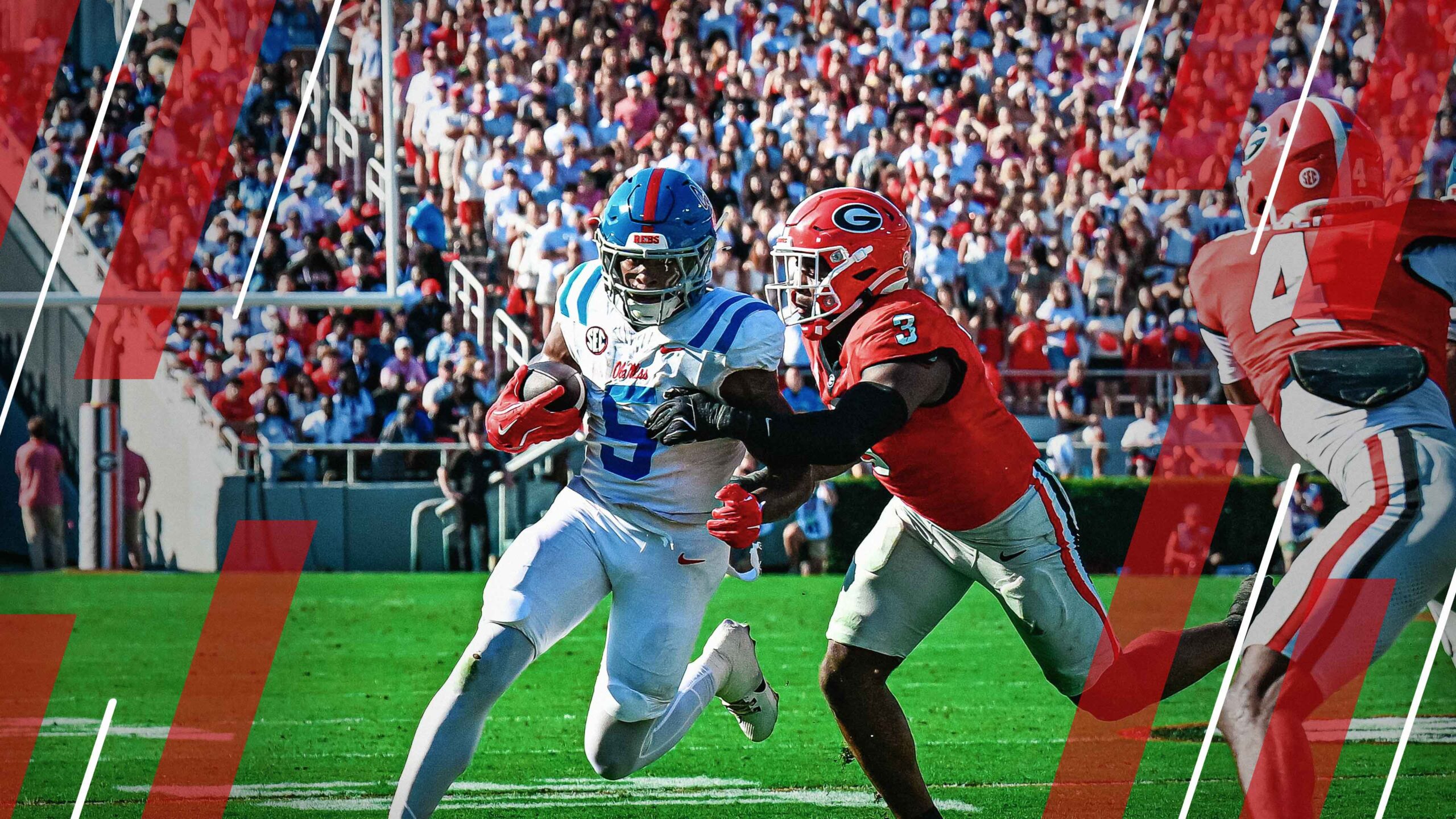
No. 3 Georgia Bulldogs vs. No. 6 Ole Miss Rebels (Sugar Bowl, Jan. 1 at 8 PM ET on ESPN)
Semifinal Matchup: Winner takes on the victor of No. 2 Ohio State/No. 10 Miami (FL) in the Fiesta Bowl
The quarterfinals wrap up with Georgia against Ole Miss in the Sugar Bowl. The Rebels won their first playoff game in program history by dismantling Tulane in the first round by a 41-10 final score. The Bulldogs got to skip the first round after finishing with a 12-1 record and winning the SEC. This game serves as the only rematch in the quarterfinal round, with Georgia winning at home in Week 8 by a 43-35 margin.
The winner of this game moves on to the semifinals to play either Ohio State or Miami (FL) in the Fiesta Bowl.
Georgia’s pass game versus Ole Miss’ pass defense (Dalton): Will Gunner Stockton dominate the perimeter of the field again?
Georgia’s passing game has a horizontal nature to it that Gunner Stockton has taken advantage of all season. When attacking the area of the field at or outside the numbers this season, Stockton has recorded an 87.5 PFF passing grade, a top-25 mark in the nation. He torched Ole Miss when throwing to those areas of the gridiron in the first matchup between these two teams, completing 12-of-13 passes and earning a 91.4 passing grade on those throws.
Ole Miss has struggled to defend the perimeter areas of the field in coverage this season. The Rebels rank just 76th in PFF coverage grade when guarding attempts at or outside the numbers. They’ve allowed 7.1 yards per attempt on these throws as well, which ranks them a mediocre 74th in the FBS.
The Rebels will need to clean up their coverage on the perimeter in order to slow down Stockton and the Bulldogs’ passing game this time around.
Georgia’s run game versus Ole Miss’ run defense (Max): Will the Rebels be ready to defend inside zone?
Back in their Week 8 matchup, Georgia ran for 226 yards against Ole Miss, albeit on a hefty 48 attempts. A total of 100 of those rushing yards came on inside zone, and the Bulldogs averaged 5.6 yards per carry on that concept alone.
Ole Miss defensive tackles Zxavian Harris and Will Echoles had particular issues containing inside zone up front, each recording sub-50.0 PFF grades against that concept. They and the rest of the Rebels’ defense must be better prepared to defend inside zone in the rematch.
Ole Miss’ pass game versus Georgia’s pass defense (Max): Can the Rebels do a better job against the Bulldogs’ man coverage?
Georgia’s defense runs man coverage 26.1% of the time, which is right about average in the nation (65th). But when the Bulldogs beat Ole Miss back in Week 8, that number rocketed up to 40%.
And it worked very well. Trinidad Chambliss posted a season-low 46.4 PFF passing grade against Georgia with only a 43.2 PFF passing grade when kept clean. That’s been a theme for the Ferris State transfer this year, as he has an 85.8 passing grade against zone coverage (19th) but only a 65.7 passing grade against man (65th). He and the Rebels have to be better at beating the Bulldogs’ man blitzes this time around.
Ole Miss’ run game versus Georgia’s run defense (Dalton): Can the Rebels improve upon their season-worst rushing performance in the first game?
Georgia’s stellar run defense has arguably been the most consistent facet of its team this season. Kirby Smart’s group enters this matchup with an elite 93.6 team PFF run-defense grade. The Bulldogs have allowed just 3.4 yards per carry this season and boast 13 players, including defensive tackle Christen Miller and linebacker CJ Allen, who have garnered at least a 70.0 run-defense grade while playing at least 100 such snaps.
The Bulldogs shut down the Rebels’ rushing attack in the first matchup between these two teams. Star running back Kewan Lacy was held to just 31 rushing yards across 12 carries. Ole Miss’ problems started up front, as it posted just a 54.9 PFF run-blocking grade in that game.
The Rebels will need to find a way to add balance to their offense this time around, or they will force Trinidad Chambliss into the unenviable task of carrying his team versus Georgia’s elite defense.
Predictions
While it won’t be quite as high-scoring as the regular-season matchup, the final result will remain the same as the Bulldogs come out on top thanks to their balanced offense. Georgia will move on to play either Ohio State or Miami (FL) in the semifinals.
Dalton: Georgia 34, Ole Miss 27
Chambliss and the Rebels’ receiving weapons pose a serious threat to a Georgia pass defense that has been vulnerable at times. However, the Bulldogs’ defense has been playing its best football of late, and the Rebels’ flaws in the trenches could be their undoing in a Georgia victory.