9 min read
2025 in Review: Highlights from NASA in Silicon ValleyTiffany Blake
Ames Research Center
Gianine Figliozzi
Tara Friesen
Arezu Sarvestani
Public Affairs Officer
Dec 18, 2025 ArticleContents
- This video shows two simulations of the SLS (Space Launch System) rocket using NASA’s Launch Ascent and Vehicle Aerodynamics solver. For the Artemis II test flight, a pair of six-foot-long strakes will be added to the core stage of SLS that will smooth vibrations induced by airflow during ascent. The top simulation is without strakes while the bottom shows the airflow with strakes. The green and yellow colors on the rocket’s surface show how the airflow scrapes against the rocket’s skin. The white and gray areas show changes in air density between the boosters and core stage, with the brightest regions marking shock waves. The strakes reduce vibrations and improves the safety of the integrated vehicle. NASA/NAS/Gerrit-Daniel Stich, Michael Barad, Timothy Sandstrom, Derek Dalle
By combining the technologies of the NASA Advanced Supercomputing facility and Unitary Plan Wind Tunnel at NASA Ames, researchers were able to simulate and model an adjustment to the Space Launch System (SLS) rocket that could improve airflow and stability to the vehicle during the launch of Artemis II. The collaborative effort between researchers is the next step on NASA’s journey to send astronauts to explore the Moon for scientific discovery, economic benefits, and build the foundation for the first crewed missions to Mars.
New Discoveries in Early Solar System Samples
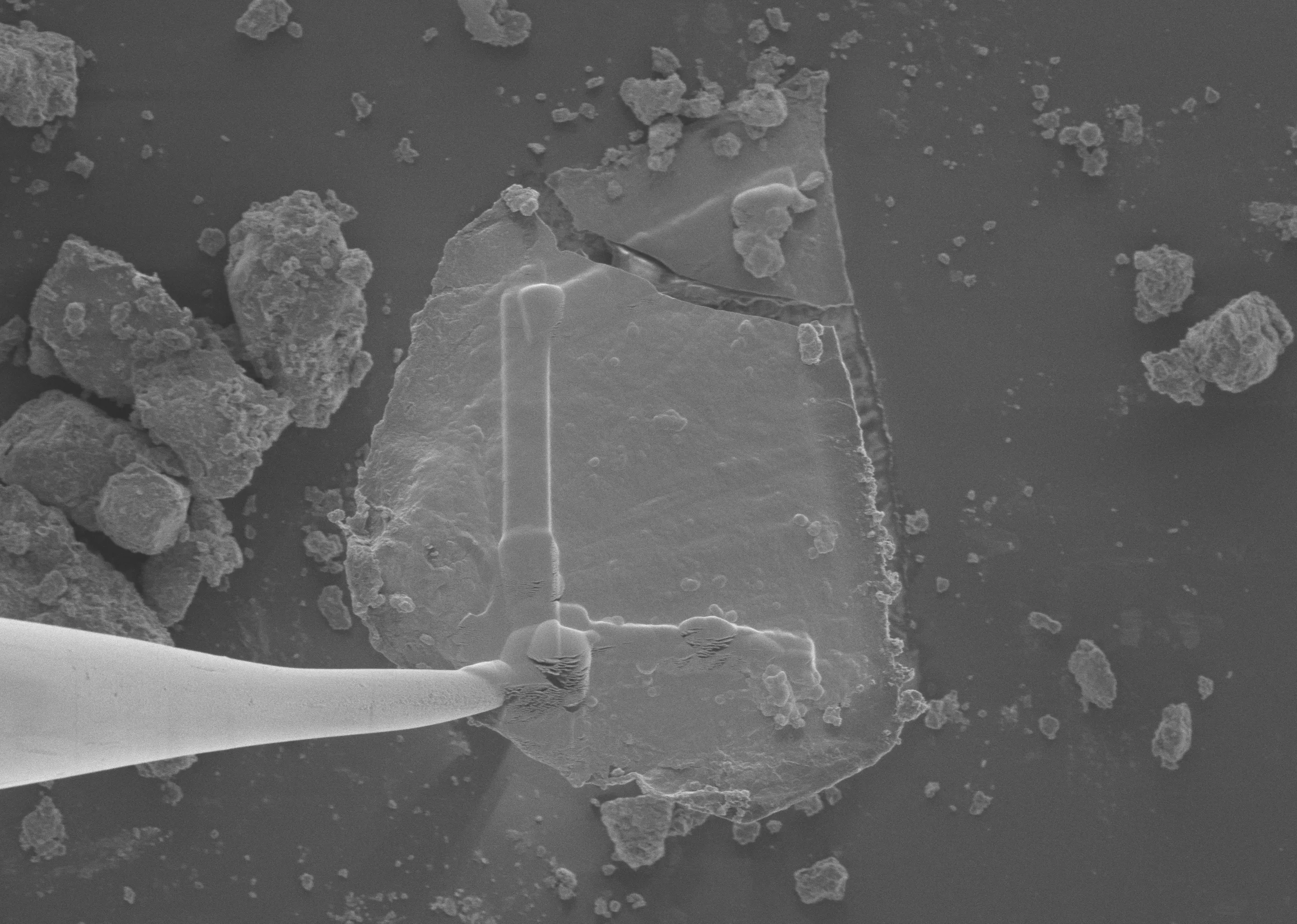
A microscopic particle of asteroid Bennu, brought to Earth by NASA’s OSIRIS-REx mission, is manipulated under a transmission electron microscope. In order to move the fragment for further analysis, researchers first reinforced it with thin strips of platinum (the “L” shape on the particle’s surface) then welded a tungsten microneedle to it. The asteroid fragment measures 30 micrometers (about one-one thousandth of an inch) across. NASAResearchers at NASA Ames discovered a never-before-seen “gum-like” material in pristine asteroid samples delivered to Earth by NASA’s OSIRIS-REx (Origins, Spectral Interpretation, Resource Identification, and Security-Regolith Explorer) spacecraft. The surprising substance was likely formed in the early days of the solar system, as Bennu’s young parent asteroid warmed. Such complex molecules could have provided some of the chemical precursors that helped trigger life on Earth, and finding them in the pristine samples from Bennu is important for scientists studying how life began and whether it exists beyond our planet.
VIPER Gets a Ride to the Moon’s South Pole
This artist’s concept shows Blue Origin’s Blue Moon Mark 1 lander and NASA’s VIPER (Volatiles Investigating Polar Exploration Rover) on the lunar surface. Credit: Courtesy of Blue OriginNASA’s VIPER (Volatiles Investigating Polar Exploration Rover) will search for volatile resources, such as ice, on the lunar surface and collect science data to support future exploration at the Moon and Mars. As part of the agency’s Artemis campaign, NASA awarded Blue Origin of Kent, Washington, a Commercial Lunar Payload Services task order with an option to deliver a rover to the Moon’s South Pole region. With this new award, Blue Origin will deliver VIPER to the lunar surface in late 2027.
Taking to the Skies to Test Remote Wildfire Response
NASA Ames drone team tests the information sharing, airspace management, communication relay, and aircraft deconfliction capabilities of the x-altas drone as it communicates through the Advanced Capabilities for Emergency Response Operations (ACERO) Portable Airspace Management System (PAMS) in Salinas, California in March 2025. This was a part of the project’s first flight demonstration. NASA/Brandon Torres NavarreteNASA researchers are advancing airborne systems that can fight and monitor wildfires 24 hours a day, even during low-visibility conditions. NASA’s Advanced Capabilities for Emergency Response Operations (ACERO) conducted field tests of remotely piloted aircraft for monitoring, suppression, and logistics support in wildland fire situations. The ACERO team was able to safely conduct flight operations of a vertical takeoff and landing aircraft operated by Overwatch Aero, LLC, of Solvang, California, and two small NASA drones.
NASA Installs Heat Shield on First Private Spacecraft Bound for Venus
Engineers at NASA’s Ames Research Center in California’s Silicon Valley, Bohdan Wesely, right, and Eli Hiss, left, complete a fit check of the two halves of a space capsule that will study the clouds of Venus for signs of life. Led by Rocket Lab of Long Beach, California, it will be the first private mission to the planet. NASA/Brandon Torres NavarreteNASA helps the commercial space endeavor succeed by providing expertise in thermal protection of small spacecraft. NASA Ames teams work with private companies to turn NASA materials into solutions, such as the heat shield tailor-made for a spacecraft destined for Venus, supporting growth of the new space economy. Invented at NASA Ames, NASA’s Heatshield for Extreme Entry Environment Technology covers the bottom of the space capsule that will study the clouds of Venus for signs of life during the first private mission to the planet. This mission is led by Rocket Lab of Long Beach, California, and their partners at the Massachusetts Institute of Technology in Cambridge.
Artemis Astronauts & Orion Leadership Visit NASA Ames
Astronauts Victor Glover and Christina Koch tour the Arc Jet Facility at NASA’s Ames Research Center, learning more about the testing equipment’s capabilities to analyze thermal protection systems from George Raiche, thermophysics facilities branch chief at Ames. NASA/Donald RicheyArtemis II astronauts Christina Koch and Victor Glover, along with Orion leaders Debbie Korth, deputy program manager, and Luis Saucedo, deputy crew and service module manager, visited NASA Ames facilities that support the Orion program to celebrate the achievements of employees. Ames facilities were used to develop and test Orion’s thermal protection system and analyze the Artemis I heat shield after its successful return to Earth.
Curiosity Mars Rover Uncovers Subsurface Clues to the Planet’s Evolution
NASA’s Curiosity Mars rover sees its tracks receding into the distance at a site nicknamed “Ubajara” on April 30, 2023. This site is where Curiosity made the discovery of siderite, a mineral that may help explain the fate of the planet’s thicker ancient atmosphere. NASA/JPL-Caltech/MSSSNASA’s Curiosity Mars rover helped shed new light on what happened to the planet’s ancient atmosphere. Researchers have long believed that Mars once had a thick, carbon dioxide-rich atmosphere and liquid water on the planet’s surface. That carbon dioxide and water should have reacted with Martian rocks to create carbonate minerals, but previous investigations haven’t found expected amounts of carbonate on the planet’s surface. Curiosity used onboard instruments to study powdered Martian rock samples from the subsurface of the planet, finding the presence of siderite, an iron carbonate mineral, within the sulfate-rich rocky layers of Mount Sharp in Mars’ Gale Crater.
Managing Satellite Traffic in Orbit
The Starling swarm’s extended mission tested advanced autonomous maneuvering capabilities. NASA/Daniel RutterManaged at NASA Ames, the Starling mission, in collaboration with SpaceX’s Starlink constellation, successfully demonstrated autonomous coordination between spacecraft to improve space traffic management in low Earth orbit. The extended mission, called Starling 1.5, tested how satellite swarms can share maneuver responsibilities and respond more quickly to avoid collisions without relying on time-consuming ground-based communication. This approach aims to streamline space traffic coordination as orbital congestion increases, enabling faster, safer, and more efficient satellite operations.
Proven True: A Companion Star to Betelgeuse
An image of Betelgeuse, the yellow-red star, and the signature of its close companion, the faint blue object. Data: NASA/JPL/NOIRlab. Visualization: NOIRLAB.Researchers validated a century-old hypothesis that there’s an orbiting companion star to Betelgeuse, the 10th brightest star in our night sky. Steve Howell, a senior research scientist at Ames, used both the ground-based Gemini North telescope in Hawai’i and a special, high-resolution camera built by NASA to directly observe the close companion to Betelgeuse. This discovery may explain why other similar red supergiant stars undergo periodic changes in their brightness on the scale of many years.
Space-Fermented Foods Make Vital Nutrients
NASA astronaut and Expedition 72 Commander Suni Williams displays a set of BioNutrients production packs during an experiment aboard the International Space Station. The experiment uses engineered yeast to produce nutrients and vitamins to support future astronaut health. NASANASA’s BioNutrients experiments are helping us better understand the shelf stability of nutrients essential to support astronaut health during future long-duration deep space exploration, such as missions to the Moon and Mars. The project uses microorganisms to make familiar fermented foods, such as yogurt, and includes specific types and amounts of nutrients that crew will be able to consume in the future. The first experiment tested the performance of a biomanufacturing system for almost six years aboard the International Space Station. The latest experiment launched to the station in August.
Enabling Satellite Swarms for Future Astronauts
Caleb Adams, Distributed Spacecraft Autonomy project manager, monitors testing alongside the test racks containing 100 spacecraft computers at NASA’s Ames Research Center in California’s Silicon Valley. The DSA project develops and demonstrates software to enhance multi-spacecraft mission adaptability, efficiently allocate tasks between spacecraft using ad-hoc networking, and enable human-swarm commanding of distributed space missions. NASA/Brandon Torres NavarreteNASA Ames’ Distributed Spacecraft Autonomy (DSA) project tested software that enables swarms of satellites to make decisions and adapt to changing conditions with minimal human intervention. By distributing decision-making autonomy across multiple spacecraft, the system allows satellites to coordinate tasks, optimize scientific observations, and respond to challenges in real time while freeing human explorers to focus on critical tasks. The technology was first demonstrated in space aboard the Starling mission, showcasing how autonomous swarms can enhance mission efficiency and resilience.
Exploring Remotely Piloted Aircraft in U.S. Airspace
NASA researchers Matt Gregory, right, Arwa Awiess, center, and Andrew Guion discuss live flight data being ingested at the Mission Visualization and Research Control Center (MVRCC) at NASA’s Ames Research Center on Aug. 21, 2025. NASA/Brandon Torres NavarreteNASA Ames partnered to ensure that remotely piloted aircraft can take to the skies safely without overburdening air traffic controllers. NASA’s Air Traffic Management eXploration Project (ATM-X) supported Wisk Aero in a flight test designed to evaluate a ground-based radar developed by Collins Aerospace, which could be used during future remotely piloted operations to detect and avoid other aircraft.
Pushing the Boundaries of Autonomous Cargo Drones
Christopher Bryant shows the simulated vehicle as part of the Federal Uncrewed Aircraft System Service Supplier Synthesis Effort (FUSE) live flight simulation in the Verification and Validation (V&V) lab in N210. NASA/Donald RicheyNASA partnered with the Department of War in a live flight demonstration showcasing how drones can successfully fly without their operators being able to see them, a concept known as beyond visual line of sight. Cargo drones successfully carried payloads more than 75 miles across North Dakota in tests designed to demonstrate that the aircraft could operate safely even in complex, shared airspace.
Advancing Mixed Reality for Pilot Training
Damian Hischier of the National Test Pilot School in Mojave, California, takes part in testing of a virtual reality-infused pilot simulation in the Vertical Motion Simulator (VMS) at NASA’s Ames Research Center in California’s Silicon Valley on May 30, 2025. NASA/Brandon Torres NavarreteA NASA research project is accelerating alternatives to conventional flight simulator training, using mixed reality systems that combines physical simulators with virtual reality headsets to train pilots. The agency invited a dozen pilots to NASA Ames to participate in a study to test how a mixed-reality flight simulation would perform in the world’s largest flight simulator for the first time. The technology could reduce costs and allow for a smaller footprint while training pilots on next-generation aircraft.
Flies and Fly Food for Space Station DNA Studies
The Vented Fly Box holds and safely transports vials containing flies and fly food. It includes environmental sensors that monitor temperature and relative humidity. NASA/Dominic HartNew technology for housing and supporting fruit flies is enabling new research on the effects of space travel on the human body. Through a Space Act Agreement between NASA and Axiom Space, the Vented Fly Box contained fruit flies (Drosophila melanogaster) launched aboard a SpaceX Dragon spacecraft from NASA’s Kennedy Space Center in Florida. Because humans and fruit flies share a lot of similar genetic code, they squeeze a lot of scientific value into a conveniently small, light package.
Studying Antibiotic-Resistant Bacteria in Space
Astronaut Jeanette Epps extracts DNA samples from bacteria colonies for genomic analysis aboard the International Space Station’s Harmony module. NASANew studies aboard the International Space Station are advancing the detection of antibiotic-resistant bacteria, thus improving the health safety not only of astronauts but patients back on Earth. Future astronauts visiting the Moon or Mars will need to rely on a pre-determined supply of antibiotics in case of illness, and ensuring those antibiotics remain effective is an important safety measure for future missions. Infections caused by antibiotic-resistant bacteria can be difficult or impossible to treat, making antibiotic resistance a leading cause of death worldwide and a global health concern.
Happy Third Anniversary to BioSentinel Deep Space Mission!
NASA’s BioSentinel – a shoebox-sized CubeSat – is travelling far from Earth. But that also means it’s closer than ever to being the first long-duration biology experiment in deep space. NASA/Daniel RutterThe BioSentinel mission, currently orbiting the Sun more than 48 million miles from Earth, celebrated three years in deep space after launching aboard NASA’s Artemis I in 2022. BioSentinel, managed at NASA Ames, continues to collect valuable information for scientists trying to understand how solar radiation storms move through space and where their effects – and potential impacts on life beyond Earth – are most intense.
Astrobee Partners to Advance Space Robotics
NASA astronaut Anne McClain poses with Astrobee robots Bumble (left) and Honey during their latest in orbit activity in May, 2025 NASANASA is working with Arkisys, Inc., of Los Alamitos, California, to sustain the Astrobee robotic platform aboard the International Space Station. NASA launched the Astrobee mission to the space station in 2018. Since then, the free-flying robots have marked multiple first-in-space milestones for robots working alongside astronauts. As the agency returns astronauts to the Moon, robotic helpers like Astrobee could one day take over routine maintenance tasks and support future spacecraft at the Moon and Mars without relying on humans for continuous operation.