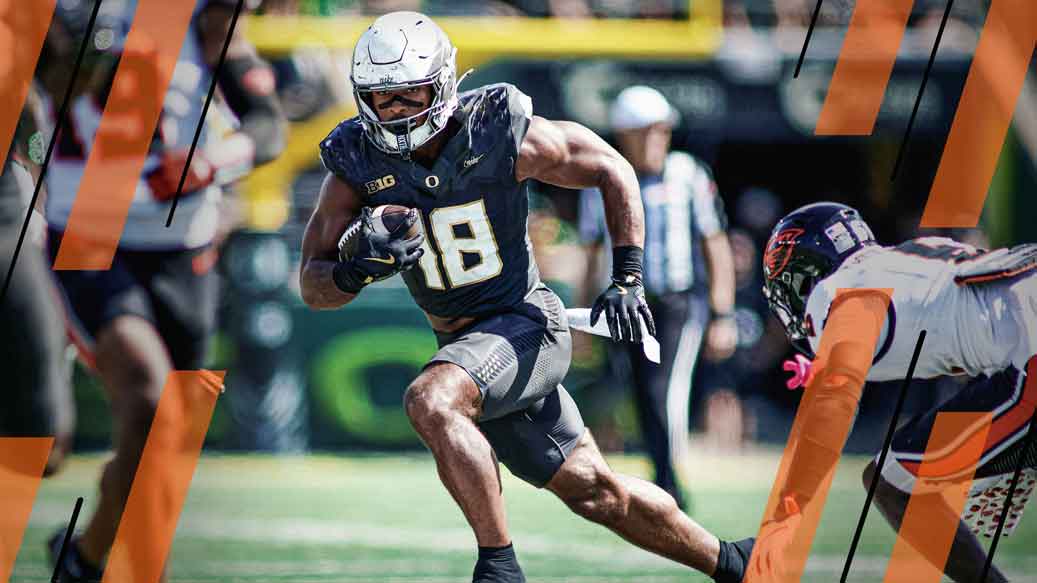
Oregon tight end Kenyon Sadiq, Vanderbilt tight end Eli Stowers and Ohio State tight end Max Klare comprise the consensus top three tight ends in the 2026 NFL Draft, both for fantasy purposes and at the NFL level. All three possess TE1 upside, though each profile is imperfect. This is not an elite class.
Sadiq earned a 70.8 PFF grade in 2025, while Stowers posted an 82.1 mark and Klare recorded a 69.3 grade.
Sadiq, 21, stands 6-foot-3 and 241 pounds and possesses elite athleticism and strength. He earned Big Ten Tight End of the Year and second-team All-American honors in 2025. An undisclosed lower-body injury negatively impacted his season.
Stowers, 23, stands 6-foot-4 and 239 pounds and is an elite athlete. He is a two-time first-team All-SEC selection and earned unanimous All-American honors, the William V. Campbell Award and the John Mackey Award. Stowers strained a hamstring shortly before the NFL Scouting Combine and dealt with a minor, undisclosed injury in August 2025. He entered college as a highly recruited quarterback before transitioning to tight end following multiple shoulder injuries, including a torn labrum as a freshman. He also tore the PCL and meniscus in his left knee in a 2019 high school championship game. Some NFL teams are evaluating him as a wide receiver.
Klare, 22, stands 6-foot-4 and 246 pounds and opted out of pre-draft testing. He earned third-team All-Big Ten honors in 2024 and first-team honors in 2025. Klare tore the deltoid ligament and chipped bones in his left ankle in 2023, requiring surgery, and the injury reportedly originated in 2022. He also fractured a collarbone in high school.
All three are slightly undersized, though Stowers and Klare could feasibly add weight. Sadiq is the highest-graded run blocker of the group, which could increase his role in play-action passing situations.
Receiving and run-blocking data in 2024 and 2025
Kenyon Sadiq, 2025Kenyon Sadiq, 2024Eli Stowers, 2025Eli Stowers, 2024Max Klare, 2025Max Klare, 2024PFF Receiving Grade69.075.785.389.066.585.6Targets672785675574Target Rate19.4%18.5%28.2%25.3%18.2%24.0%Deep-Target Rate13.4%14.8%9.4%9.0%9.1%12.2%Slot-Target Rate11.3%8.2%16.3%17.7%7.3%12.0%Yards Per Route Run1.622.102.552.431.482.22Catch Rate76.1%92.6%72.9%74.6%78.2%68.9%Average Depth Of Target8.32.48.27.16.98.8Missed Tackles Forced Per Reception0.160.400.150.260.120.16Yards After Catch Per Reception4.910.16.17.55.26.6Yards Per Reception11.012.312.412.910.413.4Explosive Pass Plays15918169141st Down/TD Rate8.7%10.3%13.3%12.8%7.3%11.0%PFF Run-Blocking Grade66.378.051.259.371.653.8Sadiq’s inconsistent ability to earn targets is concerning, as is his volatile average depth of target. His post-catch productivity is somewhat inflated by short-area usage, though Oregon’s deployment of him as a quick-hitting option and seam stretcher can also be viewed positively. An NFL team will likely give him the opportunity to develop as a featured receiver and run blocker. The traits for a TE1 outcome are present.
Stowers is an elite receiving weapon who consistently earns targets, generates yardage efficiently and creates explosive plays after the catch. His run blocking may be sufficient to keep him on the field in play-action situations, though that is not guaranteed.
Klare’s receiving production declined while playing alongside Ohio State’s elite wide receiver group, though his earlier output at Purdue remains encouraging. His run blocking improved from 2024 to 2025, which helps keep his starting role within his rookie-year outcomes.
All three prospects have TE1 potential, though their size and run-blocking limitations create unstable floors. Each could be limited to a rotational receiving role, reinforcing that this is not an elite top-three group.