Prepare for the 2026 NFL Draft with PFF+
Your complete draft preparation toolkit
Mock Draft Simulator 2026 NFL Draft Big Board Big Board Builder NCAA Premium Stats SubscribeNow that the divisional round of the NFL playoffs is here, draft season has also arrived for all but eight teams. Here’s one ideal 2026 NFL Draft prospect for all 32 NFL teams.
Arizona Cardinals: QB Dante Moore, Oregon (No. 3 overall)
The Cardinals appear set to move on from quarterback Kyler Murray this offseason, leaving a massive hole under center. Fans should be crossing their fingers and toes that the New York Jets pass on Oregon quarterback Dante Moore at No. 2.
While Moore’s final game against Indiana in the College Football Playoff semifinals left a lot to be desired, he still ranked fifth among all FBS quarterbacks in PFF passing grade (90.2) this season.
Atlanta Falcons: WR Zachariah Branch, Georgia (No. 48 overall)
The Falcons don’t own their first-round pick after trading up with the Rams in last year’s draft to select edge defender James Pearce Jr. at No. 26 overall. So, with their first selection coming in the second round, Atlanta should look to add more weapons to complement Drake London.
The Falcons could find that answer right down the road with Georgia wide receiver Zachariah Branch. He’s a dynamic player with the ball in his hands, having racked up the second-most yards after the catch among Power Four wideouts this season (634).
Baltimore Ravens: EDGE Keldric Faulk, Auburn (No. 14 overall)
The Ravens fielded the second-lowest-graded group of edge defenders this season. Faulk would improve that room after logging an outstanding 89.2 PFF run-defense grade over the past two years at Auburn.
Buffalo Bills: WR Denzel Boston, Washington (No. 26 overall)
The Bills desperately need to upgrade their receiving corps after none of their wideouts ranked among the NFL’s top 35 in PFF overall grade. Meanwhile, Boston’s 87.6 PFF overall grade placed him sixth among all college wide receivers in 2025.
Carolina Panthers: EDGE Cashius Howell, Texas A&M (No. 19 overall)
The Panthers earned the second-worst PFF pass-rushing grade in the NFL this season. After selecting Nic Scourton in the second round last year to help fix that problem, Carolina could grab another Texas A&M edge rusher in Howell. His 12 sacks tied for the fourth most among all edge defenders in college football this year.
Chicago Bears: DI Kayden McDonald, Ohio State (No. 25 overall)
Every Bears defensive tackle produced a 60.0 PFF overall grade or worse this year. McDonald led all college interior defenders with a 91.2 PFF run-defense grade, and his 86.5 PFF overall grade paced the Power Four at the position.
Cincinnati Bengals: EDGE David Bailey, Texas Tech (No. 10 overall)
The Bengals selected one of the best run-defending edge rushers in the first round of last year’s draft in Shemar Stewart and could now target the best pass rusher in this year’s class, Bailey. He led all FBS defenders in PFF overall grade (93.1), PFF pass-rush grade (93.9), pressures (81) and sacks (15).
Cleveland Browns: WR Jordyn Tyson, Arizona State (No. 6 overall)
The Browns logged the second-worst team PFF receiving grade in the NFL this season and didn’t have a single wide receiver place higher than 100th in PFF overall grade. Tyson would immediately become the top weapon for Cleveland’s quarterback, having garnered an 89.5 PFF receiving grade over the past two seasons.
Dallas Cowboys: CB Mansoor Delane, LSU (No. 12 overall)
The Cowboys earned the worst coverage grade in the NFL this season (30.9) and desperately need to upgrade their secondary. Delane surrendered only a 26.7 passer rating into his coverage this year, the lowest mark among Power Four cornerbacks.
The Vikings could use an infusion of talent at cornerback, particularly one with Hood’s aggressiveness at the catch point. He has recorded 16 forced incompletions over the past two seasons and thrives in off-coverage looks, a staple of Brian Flores’ defensive scheme. If retained, Hood has the tools to become an impact contributor in a secondary that values anticipation and ball disruption.
Grade each prospect from 1 to 10 across custom traits. PFF Scouting Mode does the rest — applying your weights and generating a final draft grade that reflects your exact evaluation style.Denver Broncos: TE Kenyon Sadiq, Oregon (No. 31 overall)
Adam Trautman and Evan Engram own sub-60.0 PFF overall grades, and Denver’s tight end unit is the lowest-graded group in the NFL this season.
Kenyon Sadiq would be a dream selection for Denver late in the first round. His eight receiving touchdowns this season led all FBS tight ends, while his 560 receiving yards were the eighth most (tied).
Detroit Lions: T Spencer Fano, Utah (No. 17 overall)
The Lions would be wise to address their offensive line this offseason, especially with longtime left tackle Taylor Decker contemplating retirement. Fano notched an elite 92.2 PFF overall grade across his final two seasons at Utah.
Green Bay Packers: DI Christen Miller, Georgia (No. 52 overall)
The Packers don’t own their first-round pick after trading it away for edge defender Micah Parsons. Considering how badly Green Bay’s defensive line struggled when Parsons went down with a torn ACL in Week 15, the front office should address the issue early in the draft.
Miller would upgrade the team’s interior defensive line after placing second among all defensive tackles in college football with his 90.2 PFF run-defense grade this year.
Houston Texans: T Caleb Lomu, Utah (No. 28 overall)
Neither of the Texans’ starting tackles, Tytus Howard and Aireontae Ersery, is among the 55 highest-graded offensive tackles in the league this year. Lomu posted an impressive 82.1 PFF pass-blocking grade this year, with no sacks allowed across 357 pass-blocking snaps.
Indianapolis Colts: LB Anthony Hill Jr., Texas (No. 47 overall)
The Colts don’t own their first-round pick after trading it away for cornerback Sauce Gardner. At No. 47, Indianapolis would be wise to upgrade a linebacker group that earned the third-worst PFF overall grade as a unit (40.8).
The versatile Hill was an effective run defender, pass rusher and coverage player throughout his three years at Texas.
Jacksonville Jaguars: DI Lee Hunter, Texas Tech (No. 56 overall)
The Jaguars went all in on Travis Hunter in last year’s draft, leaving them without their first-round pick in 2026. Jacksonville failed to address its defensive tackle group in last year’s draft despite it being one of the team’s biggest needs. The Jaguars cannot afford to do the same this year, as none of their interior defenders ranked even in the top 45 in PFF overall grade.
Hunter’s 84.5 PFF run-defense grade this season ranked eighth among FBS defensive tackles. He’s a better pass rusher than one would expect for a 330-pounder, placing second in the Big 12 with 26 pressures this year.
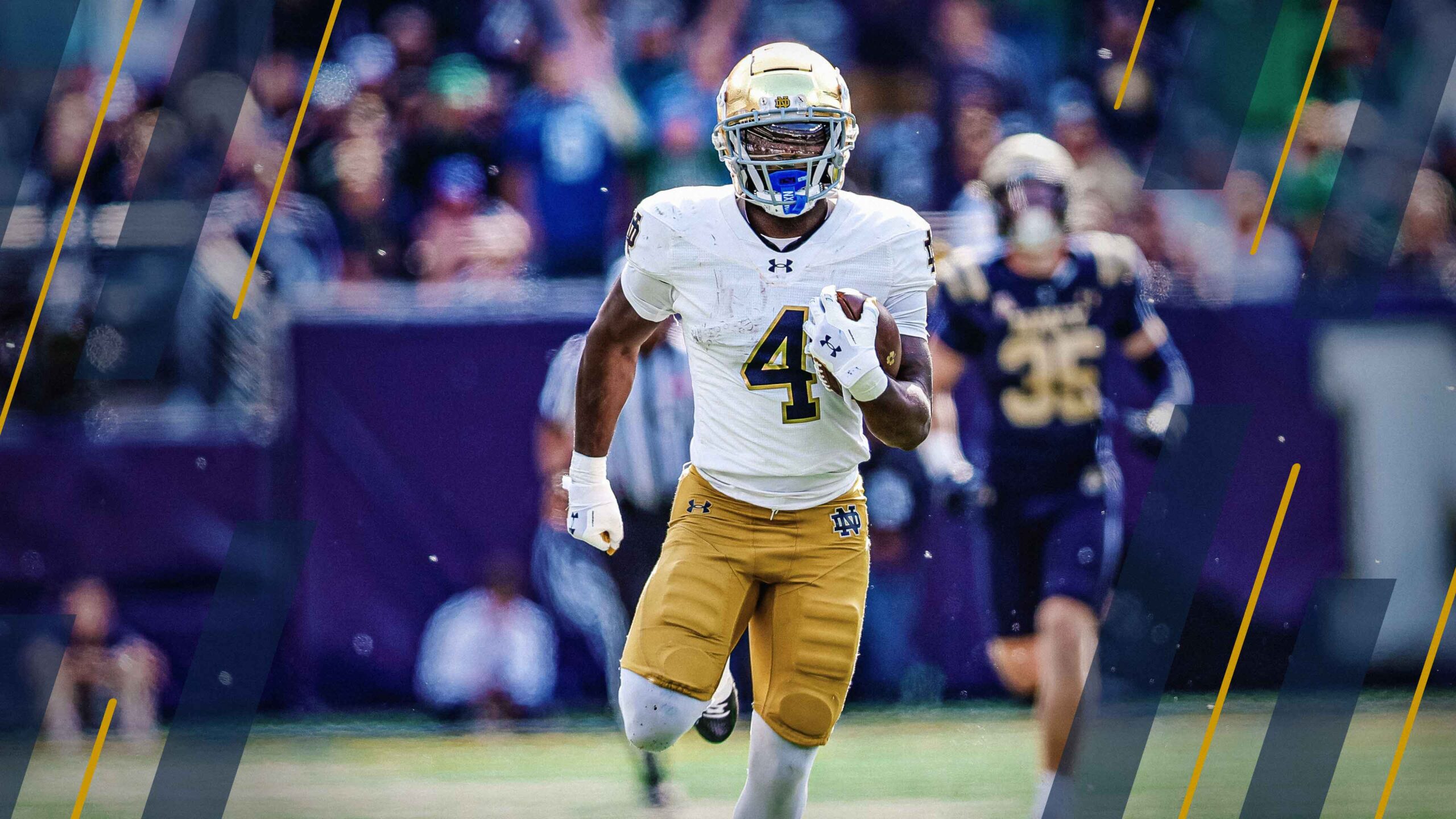
Kansas City Chiefs: RB Jeremiyah Love, Notre Dame (No. 9 overall)
Both Kareem Hunt and Isiah Pacheco are unrestricted free agents this offseason, and it seems likely that the Chiefs will part ways with one or both. Kansas City may opt to turn to the future at running back by drafting Love. After posting a 91.1 PFF overall grade as a sophomore in 2024 (fifth best), he earned a nation-leading 93.1 mark this season.
Las Vegas Raiders: WR Elijah Sarratt, Indiana (No. 36 overall)
You can almost write it in ink that the Raiders will select Indiana quarterback Fernando Mendoza with the No. 1 overall pick. At No. 36 overall, Las Vegas would be wise to reunite the Heisman Trophy winner with his favorite wide receiver.
Sarratt’s 15 receiving touchdowns this season are the most among all receivers in college football, while his 88.9 PFF receiving grade ranks sixth.
Los Angeles Chargers: IOL Olaivavega Ioane, Penn State (No. 22 overall)
The Chargers fielded easily the lowest-graded offensive line in the NFL this season. While the return of tackles Rashawn Slater and Joe Alt from injury will certainly improve that, Los Angeles still badly needs help on the interior. Enter Ioane, who didn’t allow a sack or hit across 297 pass-blocking snaps this year.
Los Angeles Rams: CB Jermod McCoy, Tennessee (No. 13 overall)
It’s hard to find many weaknesses for the Rams — the NFL’s highest-graded team (96.1) — but they could stand to upgrade their cornerback room, as it hasn’t featured a true shutdown player since the team traded Jalen Ramsey in 2023.
Even though McCoy missed all of the 2025 season with a torn ACL, he was still outstanding as a true sophomore in 2024, earning an 89.6 PFF coverage grade (ninth best in FBS).
Miami Dolphins: WR Chris Bell, Louisville (No. 43 overall)
The Dolphins badly need help at cornerback and wide receiver. A cornerback like Mansoor Delane or Jermod McCoy will likely be there for Miami at No. 11 overall. And if the Dolphins can pair one of those two with a wide receiver like Bell in the second round, it would be an ideal situation.
While he is coming off a torn ACL in November, Bell ranked second among ACC wideouts in PFF receiving grade (83.3) this year. His combination of size and speed at 6-foot-2 would nicely complement Jaylen Waddle and Malik Washington.
Minnesota Vikings: CB Avieon Terrell, Clemson (No. 18 overall)
The Vikings need help in their secondary, particularly at cornerback. Terrell, who posted 80.0-plus PFF overall grades in each of the past two seasons at Clemson, is a potential answer. He’s the younger brother of Falcons cornerback A.J. Terrell, who ranked second among all NFL cornerbacks in PFF overall grade back in the 2021 season.
New England Patriots: EDGE T.J. Parker, Clemson (No. 30 overall)
No Patriots edge defender owns a top-40 PFF overall grade this year. Parker was incredibly productive throughout his career at Clemson, posting a 90.1 career PFF overall grade.
New Orleans Saints: LB Arvell Reese, Ohio State (No. 8 overall)
The Saints produced the 10th-worst team PFF pass-rushing grade in the NFL this year, and star linebacker Demario Davis is 37 years old.
Reese is an impressive downhill defender, as his eight sacks in 2025 tied for the fourth most among college football linebackers, and he logged an 86.5 PFF run-defense grade to boot. Reese could play either off-ball linebacker or on the ball as an edge defender for the Saints.
New York Giants: WR Carnell Tate, Ohio State (No. 5 overall)
The Giants need to continue building around quarterback Jaxson Dart. Tate ranked fourth among all FBS wide receivers in PFF grade (88.6) and led the nation in passer rating when targeted (151.8) this season. He would give New York a true X receiver to pair with Malik Nabers once Nabers returns from his torn ACL.
New York Jets: WR Makai Lemon, USC (No. 16 overall)
If the Jets select Oregon quarterback Dante Moore with the No. 2 overall pick, surrounding him with additional receiving talent alongside Garrett Wilson should become a top priority. Lemon has been the top wide receiver in college football this season, winning the Biletnikoff Award and leading the position in PFF grade (90.8).
Philadelphia Eagles: T Kadyn Proctor, Alabama (No. 23 overall)
While Jordan Mailata is entrenched as Philadelphia’s left tackle for the foreseeable future, right tackle Lane Johnson is nearing the end of his career at 35 years old and is coming off a Lisfranc injury. Proctor would provide a clear succession plan and stands out as one of just seven offensive tackles in college football to earn PFF grades of 80.0 or higher as both a pass blocker and a run blocker.
Pittsburgh Steelers: QB Ty Simpson, Alabama (No. 21 overall)
The Steelers have not had a true franchise quarterback since Ben Roethlisberger’s prime and would be wise to take a swing on Simpson. He tied for the national lead among college quarterbacks in big-time throws (30) this season.
San Francisco 49ers: WR KC Concepcion, Texas A&M (No. 27 overall)
With Brandon Aiyuk’s future in San Francisco uncertain, the 49ers would be wise to add another wide receiver with their first-round pick. Concepcion would fit well in Kyle Shanahan’s offense as a dangerous run-after-catch threat, and his receiving first downs and touchdowns (48) led all SEC wide receivers this season.
Seattle Seahawks: CB Colton Hood, Tennessee (No. 32 overall)
While Devon Witherspoon led the NFL in PFF grade among cornerbacks, the Seahawks could still use help on the opposite side. Hood stepped in effectively for the injured Jermod McCoy, ranking sixth among SEC cornerbacks in PFF coverage grade (80.1).
Tampa Bay Buccaneers: LB Sonny Styles, Ohio State (No. 15 overall)
Lavonte David showed signs of decline this season at nearly 36 years old, and the Buccaneers still lack a clear succession plan at linebacker. Styles fits that need, as he was one of just six linebackers nationwide to earn PFF grades of 85.0 or higher in both coverage and run defense.
Build and customize your own NFL draft board by creating, grading and weighting traits for prospects, then stacking those evaluations alongside PFF grades, rankings, WAA and Trevor Sikkema’s analysis to generate your own final rankings.Tennessee Titans: EDGE Rueben Bain Jr., Miami (FL) (No. 4 overall)
While the Titans need to add more talent around quarterback Cam Ward, they also lacked edge production, as no Tennessee edge defender finished higher than 70th in PFF grade this season. Bain addresses that weakness immediately, as his 93.1 PFF grade ranks second among all defenders in college football. He also ranks second nationally in total pressures (80) and sixth among edge defenders in PFF run-defense grade (87.1). Arm length aside, he stands out as one of the top overall players in this draft class.
Washington Commanders: S Caleb Downs, Ohio State (No. 7 overall)
The Commanders need impact players on defense, and selecting Downs would give them one of the premier talents in the draft. He has been an elite performer since arriving in college football as a five-star recruit in 2023, producing a 93.6 PFF grade over his career. Downs stands out as one of the best safety prospects in recent memory and would immediately elevate Washington’s defense.