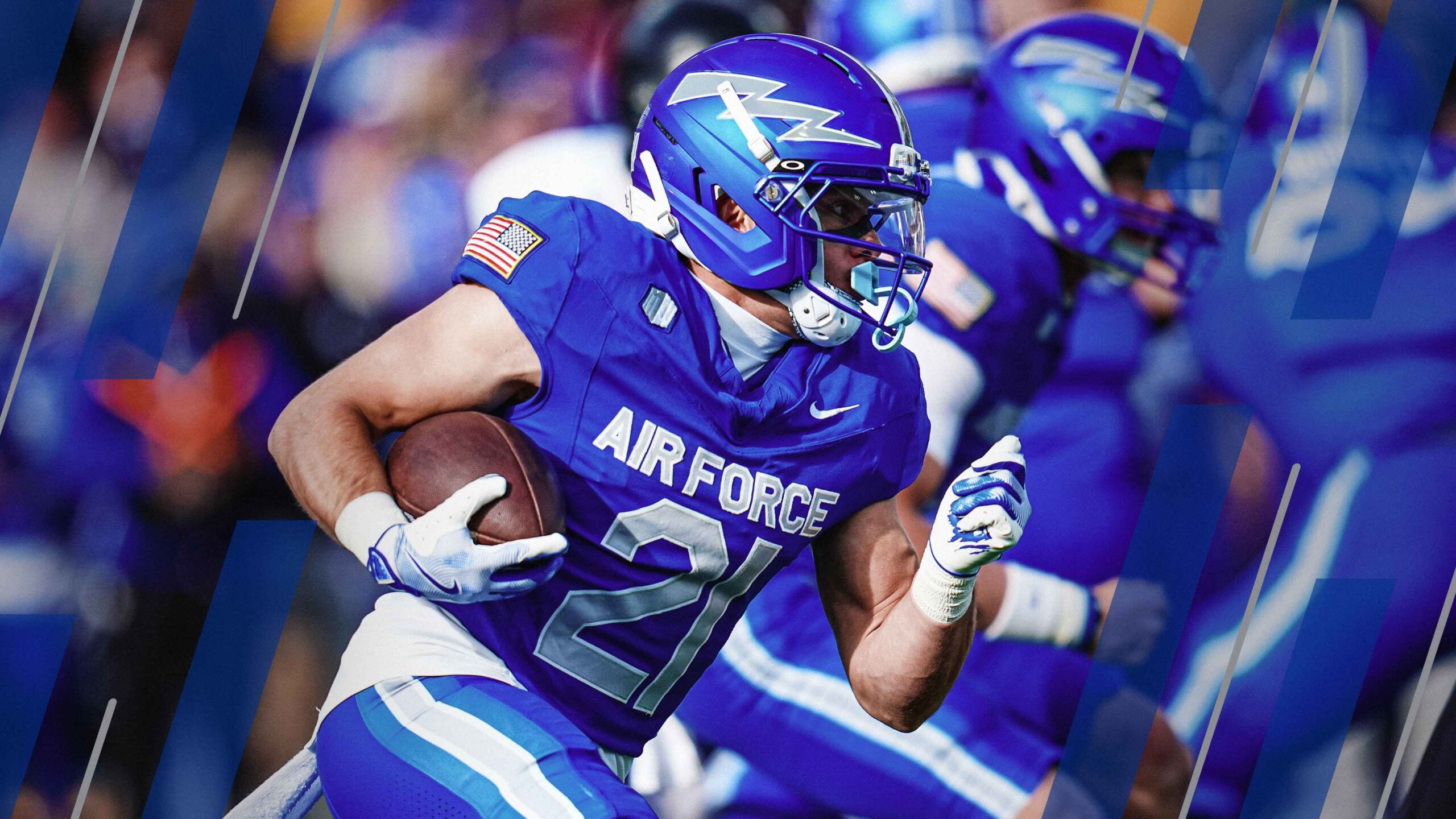
- Air Force's Cade Harris tops the charts: He caught 35 of his 53 targets for 585 yards in 2025. Most of his production came on targets within nine yards of the line of scrimmage.
- 2026 NFL Draft season is here: Try the best-in-class PFF Mock Draft Simulator and learn about 2026's top prospects while trading and drafting for your favorite NFL team.
Estimated Reading Time: 14minutes
Explore PFF Tools Mock Draft Simulator Be the GM for any team in the 2026 NFL Draft with a fully immersive simulation that lets you trade picks and players for a realistic, in-depth draft experience. 2026 NFL Draft Big Board Trevor Sikkema’s personal rankings, complete with three-year player grades, position rankings and in-depth scouting reports for the top prospects in the class. Big Board Builder Create your own customized draft rankings, with Scouting Mode at its core — a fully customizable grading system that puts the entire evaluation process in your hands. NCAA Premium Stats Our exclusive database, featuring the most in-depth collection of NCAA player performance data.Ahead of the 2026 NFL Draft, we'll explore the expansive PFF Premium Stats database to rank the top draft-eligible prospects in various categories.
To qualify for this ranking, players needed to have logged at least 50 targets in 2025.
1. Cade Harris, Air Force: 3.63 Yards Per Route Run
- 2025 PFF Receiving Grade: 86.3
- 2025 Targets: 53
- PFF Predictive Big Board Rank: N/A
- Size/Class: 5-foot-8, 185 pounds/Senior
The all-purpose weapon earned a fifth-ranked 86.3 PFF receiving grade in 2025 and also rushed for 330 yards. Harris was targeted 53 times, catching 35 passes for 584 yards. He gained 21 first downs, secured five contested catches and accounted for 10 passes of 20-plus yards.
Most of his looks came within nine yards of the line of scrimmage, where he secured 14 of 19 passes for 101 yards and six first downs. Most of his yardage, however, came on deep throws, of which he caught seven for 325 yards and two touchdowns. Harris graded out best at the intermediate level (90.8 PFF receiving grade), where he caught seven of 10 targets for 128 yards with four contested grabs.
Over the past two seasons, Harris ranks second among the draft class in yards per route run (3.07 yards), behind Makai Lemon. During that span, he caught 58 passes for 947 yards en route to an 81.2 PFF receiving grade. Harris moved the chains 35 times and averaged 6.8 yards after the catch per reception. He also caught four touchdowns and racked up 22 gains of 15-plus yards.
2. Makai Lemon, USC: 3.13 Yards Per Route Run
- 2025 PFF Receiving Grade: 91.4
- 2025 Targets: 108
- PFF Predictive Big Board Rank: 9
- Size/Class: 5-foot-11, 195 pounds/Junior
Lemon is one of the top receiver prospects in the 2026 class thanks to his playmaking ability. He caught 79 passes for 1,156 yards in 2025, two top-10 marks, while leading the draft class with a 91.4 PFF receiving grade. He tied for sixth in touchdown passes (11), tied for third in forced missed tackles (21) and ranked first in first downs (50) and explosive gains (31). Lemon also placed in the top 10 in yards after the catch (502) and yards after contact (242).
The No. 2 wide receiver on the PFF Predictive Big Board earned a career 89.6 PFF receiving grade from the slot (first). He logged 52 receptions for 791 yards (first) and seven touchdowns from the alignment in 2025. Lemon is the only FBS receiver in the class to have averaged more than three yards per route run from the slot (3.03), and he ranked in the top five in threat rate (29.1%), catches of 15-plus yards (21) and yards gained after contact (169).
Lemon is not only dangerous from the slot; he can attack every level of the field. He saw 18-plus targets at every depth in 2025, earning elite 90.0 PFF receiving grades at every level beyond the line of scrimmage. He also excelled on screens, earning an 86.8 PFF receiving grade across 23 targets.
While most of his targets came within nine yards of the line of scrimmage (42), Lemon also led the class with 16 catches beyond 20-plus yards for 522 yards (sixth most) and five touchdowns, earning a perfect PFF receiving grade on those plays (99.9).
Few in the 2026 class were more productive than Lemon, who averaged 3.09 yards per route run (first) in three seasons at USC. His career 92.4 PFF receiving grade also leads the draft class.
Explore Lemon's Draft Profile
Game grades, positional splits and high-level metrics.
Open Lemon's Draft Profile3. Skyler Bell, UConn: 3.13 Yards Per Route Run
- 2025 PFF Receiving Grade: 85.1
- 2025 Targets: 141
- PFF Predictive Big Board Rank: 80
- Size/Class: 6-foot, 185 pounds/RS Senior
UConn fed Bell to the tune of 141 targets in 2025 (tied for second most), and he did not disappoint. The redshirt senior ranked in the top two among draft-eligible wideouts in catches (102) and receiving yards (1,282).
Like Makai Lemon, Bell did not go down quickly, placing in the top two in the class in yards after the catch (835) and yards after contact (325). He led the FBS in threat rate (34.5%) and tied for third in touchdowns (13), first downs (50) and explosive gains (28). His 85.1 PFF receiving grade in 2025 ranked eighth best among the draft class.
Bell was targeted 20-plus times at every level of the field in 2025. He ranked third in screen catches (38), on which he earned a 91.8 PFF receiving grade. He also led the draft class in passer rating when targeted within nine yards of the line of scrimmage (143.9) and ranked 10th in PFF receiving grade (94.6) from the area.
On intermediate throws (10-19 yards downfield), Bell finished in the top five in receiving yards (418) and touchdowns (seven). Although he brought in only six of his 24 deep targets, he still delivered two touchdowns for a 90.2 PFF receiving grade.
Bell edged out Lemon as PFF’s highest-graded slot receiver in 2025 (90.4), with 45 catches for 449 yards and four touchdowns. He moved the chains 20 times across 53 slot targets.
The 23-year-old spent three seasons at Wisconsin (2021-2023) before transferring to UConn in 2024. He caught 69 passes for 756 yards and six touchdowns with the Badgers but earned just a 56.7 PFF receiving grade in that span.
He has skyrocketed over the past two seasons, raising his PFF receiving grade to 84.3 (tied for 10th best) while tying for third in yards per route run (2.74). He ranks in the top three in targets (234), catches (151) and receiving yards (2,138) over the past two seasons.
4. Carnell Tate, Ohio State: 3.02 Yards Per Route Run
- 2025 PFF Receiving Grade: 89.0
- 2025 Targets: 66
- PFF Predictive Big Board Rank: 7
- Size/Class: 6-foot-3, 195 pounds/Junior
Tate has been overshadowed by elite teammates in the Buckeyes’ receiver room, but the 6-foot-3 receiver is electric in his own right. Tate, who spent his entire three-year college career at Ohio State, caught 51 passes for 875 yards with 35 first downs in 2025. He earned a second-ranked 89.0 PFF receiving grade while generating a 151.8 passer rating when targeted
Tate caught nine touchdowns, each coming 10-plus yards downfield. He notched a 25.8% deep target rate and brought in 11 of 17 deep passes for 453 yards and six touchdowns. He earned a perfect 99.9 PFF receiving grade on those plays. Meanwhile, Tate caught 12 of 17 passes at the intermediate level for 199 yards and three touchdowns, ranking fifth in PFF receiving grade (98.8).
Six of his touchdowns were also contested grabs. He secured 12 of 14 contested looks for 305 yards (third most) and finished third in contested PFF receiving grade (92.2).
Although Tatet never reached 1,000 receiving yards in a season at Ohio State, he still tallied an 82.2 PFF receiving grade (15th). He ranked second in passer rating when targeted (134.4) and improved his yards per route run number every year.
5. Anthony Smith, East Carolina: 2.80 Yards Per Route Run
- 2025 PFF Receiving Grade: 74.4
- 2025 Targets: 100
- PFF Predictive Big Board Rank: 313th
- Size/Class: 6-foot-3, 189 pounds/RS Senior
Another tall vertical threat, Smith ranked sixth in the class in receiving yards this season (1,053), with 486 coming on passes thrown 20-plus yards in the air. He caught 64 of his 100 targets and moved the chains 40 times with seven touchdowns. Smith averaged 15.1 depth yards per target (11th most) and ranked eighth in deep target rate (31.0%). He produced 14 catches over 20 yards.
Smith was targeted at least 25 times at every level beyond the line of scrimmage, helping him rack up nearly 800 receiving yards on 10-plus-yard throws. He brought in 16 catches for 292 yards and a touchdown at the intermediate level, earning a 96.1 PFF receiving grade at that depth.
Most of his touchdowns (five) came from 20-plus yards out, where he caught 11 of 31 targets and earned a 92.2 PFF receiving grade. While Smith didn’t excel as much within nine yards of the line of scrimmage, he still secured 28 of 32 short targets for 10 first downs.
Smith spent the past two seasons at East Carolina after four seasons at North Carolina State (2020-2023). While he reached double-digit targets only once with the Wolfpack (10 in 2021), his target volume exploded with the Pirates. Smith was targeted 184 times at East Carolina (13th most). He ranked in the top 10 in receiving yards (1,858), average depth of target (16.3 yards) and yards per route run (2.50) as a Pirate.
Among 2026 NFL Draft wide receivers, Smith ranks first in deep target rate (33.1%), second in deep receiving yards (866) and tied for first in deep receiving touchdowns (nine) over the past two seasons.
Explore Smith's Draft Profile
Game grades, positional splits and high-level metrics.
Open Smith's Draft Profile6. Demarcus Lacey, Marshall: 2.77 Yards Per Route Run
- 2025 PFF Receiving Grade: 79.4
- 2025 Targets: 93
- PFF Predictive Big Board Rank: N/A
- Size/Class: 6-foot, 187 pounds/Senior
The second converted running back on this list, Lacey lined up almost exclusively in the slot in 2025 (532 snaps) and was targeted 93 times. He caught 65 passes for 774 yards and generated the third-best threat rate in the class (33.3%). He logged five touchdowns, forced 19 missed tackles and gained 37 first downs. Although he ranked in the bottom 10 in average depth of target (6.9 yards), he still averaged 8.2 yards after the catch per reception (tied for second best).
All but five of Lacey's catches came from the slot (60, second most), where he earned an 82.1 PFF receiving grade (tied for 12th best). Marshall featured him heavily as a screen weapon, giving him 32 such targets (sixth most). Lacey earned an 81.0 PFF receiving grade on targets behind the line of scrimmage and increased his mark to 92.4 on short targets beyond the line.
Lacey spent one year at Marshall, his third school in four seasons. In 2024, he played for Jacksonville State, appearing in seven games before suffering a season-ending knee injury. He began his career at North Alabama (2022-2023) as a running back, catching 44 passes for 503 yards. He averaged 1.44 yards per route run and earned a 76.6 PFF receiving grade during his time there.
7. Brenen Thompson, Mississippi State: 2.77 Yards Per Route Run
- 2025 PFF Receiving Grade: 79.9
- 2025 Targets: 91
- PFF Predictive Big Board Rank: 124
- Size/Class: 5-foot-9, 170 pounds/Senior
It was a breakout year for Thompson, who set the Mississippi State single-season receiving yards record (1,054). He also became the first player from the program to lead the SEC in receiving yards in a season.
Thompson may be small, but he was not pigeonholed inside, as he lined up out wide on 579 snaps. He also stretched the field, leading the class in average depth of target (18.4) and generating a 29.9% deep-target rate (11th). Thompson gained 41 first downs on 57 catches, leading to a 120.6 passer rating when targeted.
He finished with near-identical PFF receiving grades on intermediate (96.8) and deep (96.7) targets. Thompson caught 21 of 29 targets at the intermediate level for 384 yards, and he placed in the top 10 in deep targets (26) and receiving yards (478). Five of his six touchdowns came from 20-plus yards downfield.
Thompson also played for Oklahoma (2023-2024) and Texas (2022) during his college career, where he tallied 1,111 career snaps in wide alignments. While his target share increased each season, outside of his 2023 campaign (only seven catches for 241 yards), Thompson averaged more than 2.0 yards per route run in only one season.
8. Junior Vandeross III, Toledo: 2.61 Yards Per Route Run
- 2025 PFF Receiving Grade: 84.1
- 2025 Targets: 118
- PFF Predictive Big Board Rank: N/A
- Size/Class: 5-foot-8, 182 pounds/Senior
Vandeross spent his entire four-year career at Toledo, serving as a slot specialist (1,538 snaps). He finished third in the draft class, behind Marshall's Demarcus Lacey, with 85 slot targets in 2025, and he brought in 58 slot catches (tied for third most) for 664 yards (fifth most). His eight slot touchdowns were the third most.
Vandeross paired top-10 finishes in catches (83) and receiving yards (1,008) in 2025 with a ninth-ranked 84.1 PFF receiving grade. He was targeted 118 times (sixth) and produced a career-high 120.3 passer rating for his quarterback. He showcased impressive ability after the catch, placing in the top 10 in yards after the catch (506) and explosive gains (26).
The 5-foot-8 receiver recorded 90.0-plus PFF receiving grades at every level of the field past the line of scrimmage. Most of his volume came within nine yards of the line, where he caught 34 of 41 targets for 311 yards and 19 first downs (both top-15 marks) and earned a fourth-ranked 95.0 PFF receiving grade.
Improvement in each of his seasons with the Rockets vaulted Vandeross to the top of several statistical leaderboards. He averaged at least 2.25 yards per route run in three consecutive seasons, and he ranks 10th in the class in PFF slot receiving grade (78.5). He made 158 slot catches for 1,880 yards, 13 touchdowns and 82 first downs in his career. In all, Vandeross notched 20 touchdowns and 62 explosive gains of 15-plus yards across 217 career catches.
9. Malik Benson, Oregon: 2.60 Yards Per Route Run
- 2025 PFF Receiving Grade: 75.6
- 2025 Targets: 59
- PFF Predictive Big Board Rank: N/A
- Size/Class: 6-foot-1, 195 pounds/Senior
Benson recorded a career-best 43 receptions for 719 yards in his lone season at Oregon, generating a 133.4 passer rating when targeted. He moved the chains 27 times, caught six touchdown passes and recorded 15 catches of 20-plus yards.
Another downfield weapon on this list, Benson ranked in the top 15 in PFF receiving grade on intermediate (97.0) and deep targets (97.9). He saw 13 targets within 10-19 yards, catching nine for 173 yards and two touchdowns. Most of his receiving yards came from 20-plus yards out, where he brought down 11 of 17 targets for 371 yards and four touchdowns. Benson averaged 13.8 depth yards per target in 2025.
Benson played for four schools in five seasons. He got his start at Hutchinson Community College (2021-2022) and spent time at Alabama (2023) and Florida State (2024) before landing at Oregon. His target share and production increased at each stop, with 2025 being his first season above 311 receiving yards and a 59.5 PFF receiving grade.
Read More Stories Explore PFF Tools 15 min read Quick Read Here is how to use your PFF+ subscription to unearth sleepers for the 2026 NFL Draft, whether for your own NFL scouting or for fantasy football purposes. 2026 NFL Draft: Finding offensive sleepers using PFF+ By Jordan Plocher 10 min read Quick Read Learn more about the top five wide receiver prospects on the 2026 PFF Predictive Big Board through their strengths and weaknesses. 2026 NFL Draft: Strengths, weaknesses for the top WR prospects By Trevor Sikkema Try the tool Mock Draft Simulator Make picks, trade up, and run your own draft in minutes. Build your board Big Board Builder Create custom rankings with Scouting Mode at the core. More Coverage Mock Draft Simulator Be the GM for any team in the 2026 NFL Draft with a fully immersive simulation that lets you trade picks and players for a realistic, in-depth draft experience. 2026 NFL Draft Big Board Trevor Sikkema’s personal rankings, complete with three-year player grades, position rankings and in-depth scouting reports for the top prospects in the class. Big Board Builder Create your own customized draft rankings, with Scouting Mode at its core — a fully customizable grading system that puts the entire evaluation process in your hands. NCAA Premium Stats Our exclusive database, featuring the most in-depth collection of NCAA player performance data.10. Eric McAlister, TCU: 2.60 Yards per Route Run
- 2025 PFF Receiving Grade: 77.5
- 2025 Targets: 119
- PFF Predictive Big Board Rank: 147
- Size/Class: 6-foot-3, 205 pounds/Senior
McAlister was one of the top producers in the nation in 2025, ranking second in the class in receiving yards (1,173) and in the top 10 in catches (71), first downs (49) and touchdowns (10). He was also great after the catch, leading the class in yards after contact (375) and missed tackles forced (27). He ranked in the top five in explosive plays (28) and yards after the catch (560).
As a big slot option, McAlister logged 13 first downs across 19 catches for 214 yards and a touchdown. He racked up more than 300 receiving yards at every level of the field beyond the line of scrimmage, along with 90.0-plus PFF receiving grades at each. He ranked in the top three in receiving yards (458), first downs (23) and missed tackles forced (14) within nine yards of the line of scrimmage. Meanwhile, he tied for third in deep touchdowns (six), earning a 97.2 PFF receiving grade at that depth across 10 catches.
McAlister split his four-year career across Boise State (2022, 2023) and TCU (2024, 2025), averaging 2.60 yards per route run or better in each season. At TCU, he ranked fifth in the class in receiving yards (1,935) and third in forced missed tackles (40). He also paced the draft class in yards after contact (644) while racking up the fourth-most yards after the catch (908).