Adamuz train crash 2026
Adamuz train crash investigation concludes 'rail rupture' caused derailmentGuardia Civil report highlights lack of data on rail materials and provides first images from inside the Iryo cabin
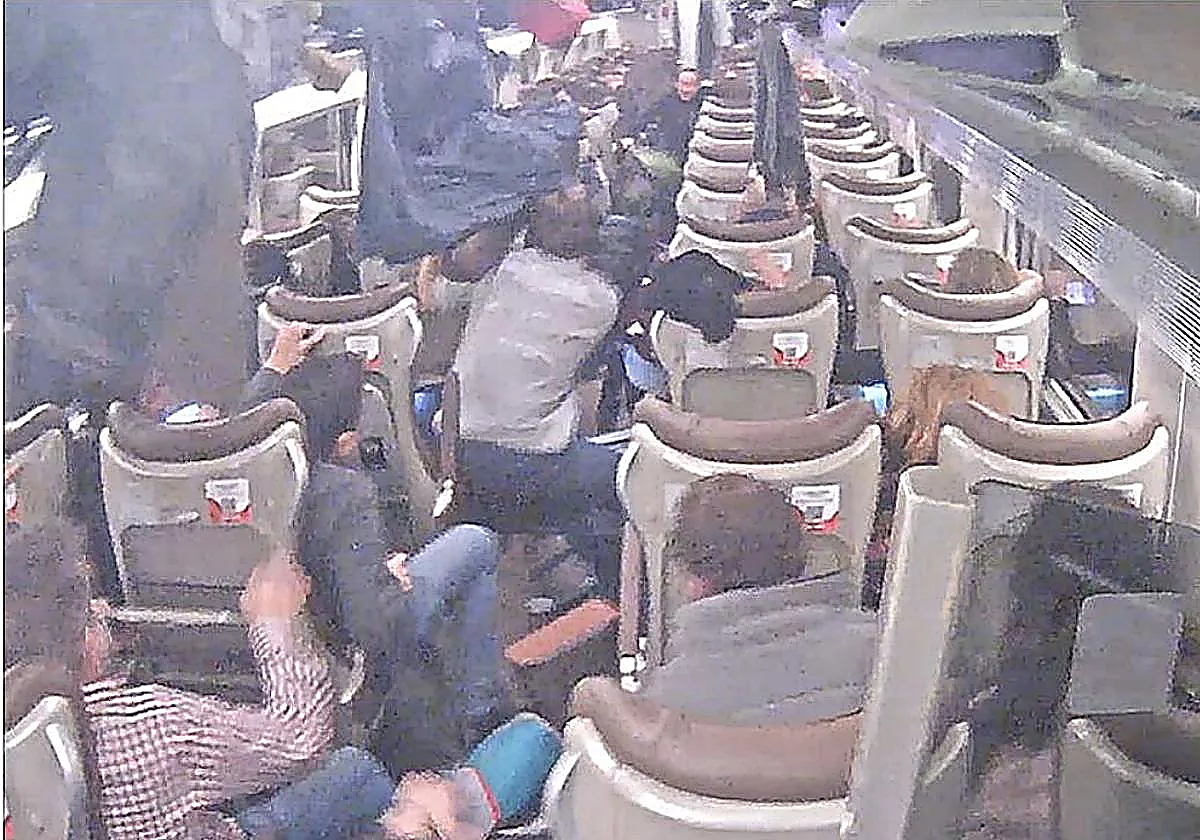
Photo from the inside of the Iryo train at the moment of the derailment near Adamuz. (Guardia Civil)Melchor Sáiz-Pardo
28/04/2026 a las 14:55h.A preliminary investigation into the fatal rail disaster in Adamuz, Córdoba, has identified a "rail rupture" as the primary cause of the collision that claimed 46 lives on 18 January.
The Commission for the Investigation of Railway Accidents (CIAF) and the Guardia Civil have shifted the focus of the enquiry away from mechanical train failure and towards the integrity of the Adif infrastructure.
The infrastructure failure reportedly triggered the derailment of the Iryo Malaga-Madrid train, which ended up colliding with another train travelling on the adjacent track (the Alvia Madrid-Huelva).
The Guardia Civil report, now for review with the judge in Montoro overseeing the investigation, states that "the analysed data shows no evidence of anomalies in either of the two trains involved" the second before the accident (19:43:33). The report says that, at that moment, the Iryo train "was travelling at the point where the outer wire of the track broke", leading to a clear conclusion: "the cause of the derailment and subsequent collision is a broken rail".
Related story
Adamuz train accident 2026
Melchor Sáiz-Pardo
The report reconstructs with pinpoint accuracy the seconds leading up to the accident. At 19:43:34, "axle 21 of the Iryo train […] derailed at the rupture", when the train was travelling at over 200km/h. From that moment on, a series of technical events occurred that demonstrated the progressive deterioration of the situation: "catenary voltage drop", "fluctuations" in the electrical system and "abnormal movements associated with the derailment".
The recordings from inside the Iryo train, which the CIAF has included in the report for the first time, also reflect the impact of those initial moments. According to the report, "the beginning of the vibration associated with the derailment can be seen" in several carriages. In addition, the images show "incandescent fragments […] presumably from the friction between the derailed wheels and the metal parts of the infrastructure".
Just three seconds after the derailment, at 19:43:37, a key moment in the sequence occurred: "signal S613 abruptly closed, changing from white to red", as a result of a malfunction in switch A645. This change forced the safety system to react automatically, causing the Alvia train to activate emergency braking. "With no braking distance available, the system applied emergency braking due to overspeed," the document states.
The collision occurred just five seconds later. At 19:43:42, the Alvia's data recorder stopped transmitting data due to a "power failure" - a moment the report identifies as "presumably […] the moment of the collision". The impact took place while both trains were still travelling at high speed, with the Iryo at 152km/h and the Alvia at 204km/h.
The technical analysis therefore rules out previous train failures and focuses on the railway infrastructure. However, the ongoing judicial investigation keeps encountering obstacles. In another document, the Guardia Civil highlight the "lack of response to a request for information from Adif" regarding the materials the infrastructure company had used on that section of track.
The Guardia Civil had requested clarification on "whether the track elements installed between kilometre 316 and kilometre 320 […] were newly installed or recycled", as well as information on "the traceability of these elements and […] their certification". To date, Adif has not provided this information, leading investigators to refer the matter to the court, "in case it deems it appropriate to demand the requested information".
Furthermore, the Guardia Civil acknowledge technical limitations in the analysis of some evidence. Regarding the train recorders, they state that "the necessary software for downloading the data is not available, nor is there sufficient technical expertise for its interpretation", which hinders full access to the data.
Despite these limitations, the CIAF report clearly identifies the main hypothesis: a "rail rupture" at kilometre point 318.681 triggered a sequence of events lasting only seconds, resulting in one of the most serious train accidents in the country. However, the document says that these are "provisional" conclusions, subject to change based on new findings during the investigation.