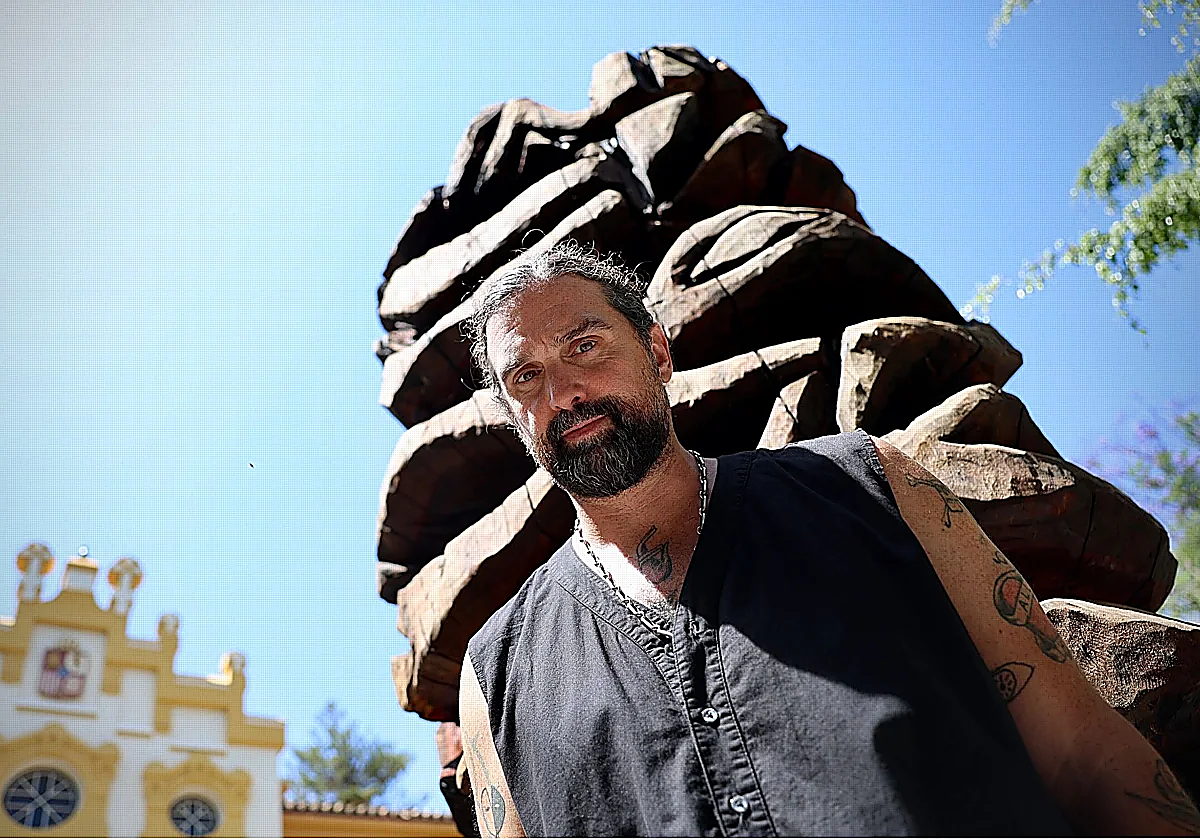
"It has been one of the best experiences I have had as an artist," he said at the presentation alongside the institution's president, Francisco Salado, shortly before apologising for the noise of the chainsaw.
The project was developed "from Malaga for Malaga" by Mármol & FA, curated by Alicia Gutiérrez Mármol, with collaboration from Calleja Studio and the Almine Rech gallery.
Visitors encounter the results of his residency at the building's entrance, now dominated by a monumental work over three metres high. Schneider says he had never previously created a piece of this scale. The starting point was a huge sapelli trunk, a large African tree from the Congo weighing 3,200 kilos.
"In Africa, it is considered a magical and spiritual tree. It was an incredible experience working with it. I had no idea how it would turn out until they stood it upright. Everything came from intuition and trusting the process. I felt as though the tree was guiding me," Schneider says.
The finished sculpture is striking, with dozens of hollows and openings in the wood created instinctively with a chainsaw. It gives its name to the exhibition: Murmuración. At first glance, it might resemble many mouths murmuring at once, but for Ryan Schneider the meaning is different. The word refers to the natural phenomenon in which thousands of birds fly together in unison, forming fluid, shifting shapes in the sky. The American artist, who lives in the Mojave Desert in California, says he had the title in mind even before the exhibition itself.
Months earlier, he and his partner approached the border wall separating the US and Mexico, where they saw a flock of birds crossing naturally over a man-made barrier. "We were thinking about our own work in the desert, working with migrants and trying to help people understand what is happening in the US," Dana Balicki, Schneider's partner and collaborator, says. They then felt a certainty: we are more when we are together, more than the sum of our parts. Together we find a path and can go further.
They found that same sense of community later, unexpectedly, at La Térmica: "a trust and generosity that is enviable compared with what is happening in the US". They say there is nothing like it there, in a place where, depending on the time of day, swing dancing takes place, castanets can be heard or a group of women lean out of a window to watch the artist at work with curiosity.
"The community energy is truly incredible. I felt that it became part of what inspired me while I was creating these works," Schneider says.
Alongside the large Murmuración, other pieces fill the La Térmica gallery and extend into the garden and inner patio. Inside, under carefully designed lighting, two more sculptures created in Malaga using a chainsaw are on display. Schneider also embellishes the wood with blue paint, gold highlights and even the blackened effect of charred material to add another dimension.
These are joined by a constellation of works the artist has made in his Californian desert studio, in southern France and in Italy, in a range of formats (from 23 centimetres to three metres), materials (wood, marble, onyx, bronze, pinolite), and tools (from chainsaws to stone chisels).
From stone and wood emerge figures, masks and abstract forms open to interpretation. As curator Gutiérrez Mármol says, this is an exhibition that cannot really be explained. It must be felt.
The works are modernist, yet carry a distinct ancestral quality, two influences clearly present in Schneider's practice. On one hand, he feels close to Picasso, Matisse, Picabia, Brancusi and Modigliani. On the other, he draws inspiration from ancient art, African traditions, Native American art and Mexican art. "I love going to museums and seeing the stone and wood carvings humans have been making since we first learned to hold tools."
For more culture news click here