- Conditions should be better for the Los Angeles Chargers: The Chargers’ hire of offensive coordinator Mike McDaniel is the NFL’s best offseason transaction.
- Sean McVay always creates a fantasy-helpful system: McVay's quick play designs and bevy of talent make plucking players from his offense appealing.
Estimated Reading Time:15 minutes
Over the past three seasons, NFL offensive playcallers have changed their tactics. Offenses are running fewer plays, using heavier personnel packages with fewer wide receivers on the field and increasing play action, shifts and motion while decreasing run-pass option (RPO) usage, running the ball more often and exploiting increasing blitz rates via quick first-read play designs. The changes reduce the number of flex-viable players, yet insulate star players with reliably large workloads.
Fantasy managers who are able to identify coaches’ positive outlier tactics amid shifting league trends can exploit them to their advantage in drafts. The article below identifies the top-three NFL offenses that are expected to employ positive outlier tactics.
NFL offenses featuring high play volume and no huddle tactics provide skill position players with more opportunities to earn touches.
As shown in the table below, fullbacks and Nos. 2 and 3 tight ends are playing more often.
NFL running backs logged 14,739 offensive touches at a 42.7% rate last season. NFL wide receivers logged 6,717 offensive touches at a 19.3% rate last season. NFL tight ends logged 3,111 offensive touches at a 9.0% rate last season. NFL fullbacks logged 129 offensive touches at a 4.0% rate last season.
Personnel Groupings
- 11 personnel: One running back, one tight end and three wide receivers
- 12 personnel: One running back, two tight ends and two wide receivers
- 21 personnel: Two running backs, one tight end and two wide receivers
- 22 personnel: Two running backs, two tight ends and one wide receiver
- 13 personnel: One running back, three tight ends and one wide receiver
Offensive personnel grouping averages and outliers from 2023-25
Averages 2025 2024 2023 11 Personnel 58.11% 62.30% 63.36% 12 Personnel 24.26% 23.01% 20.43% 21 Personnel 6.85% 6.41% 7.55% 22 Personnel 3.00% 2.31% 2.00% 13 Personnel 65.06% 44.63% 46.13%Fullbacks and Nos. 2 and 3 tight ends earn touches inefficiently. Running backs as well as Nos. 1 and 2 wide receivers playing in entrenched roles, on offenses featuring heavy personnel packages, will earn touches disproportionately more than their counterparts playing in offenses that rely on 11 personnel.
Running backs and wide receivers playing in the advantageous roles outlined above, who also perform in offenses featuring play action and motion, will touch the ball more often. These players will also generate yardage more efficiently than their counterparts.
As detailed in “How play action, pre-snap motion, and RPO rates define 2026 fantasy value,” NFL offenses average 6.72 yards per pass play without play action and 7.76 with play action, and -0.042 expected points added (EPA) per play without motion compared to 0.002 with motion.
RPOs fail to improve offensive performance, going “from -0.015 on non-RPO plays to -0.030 on RPO plays, yet quarterback yards per rushing attempt jump from 4.39 on non-RPO plays to 4.56 on RPO plays.”
Chicago Bears
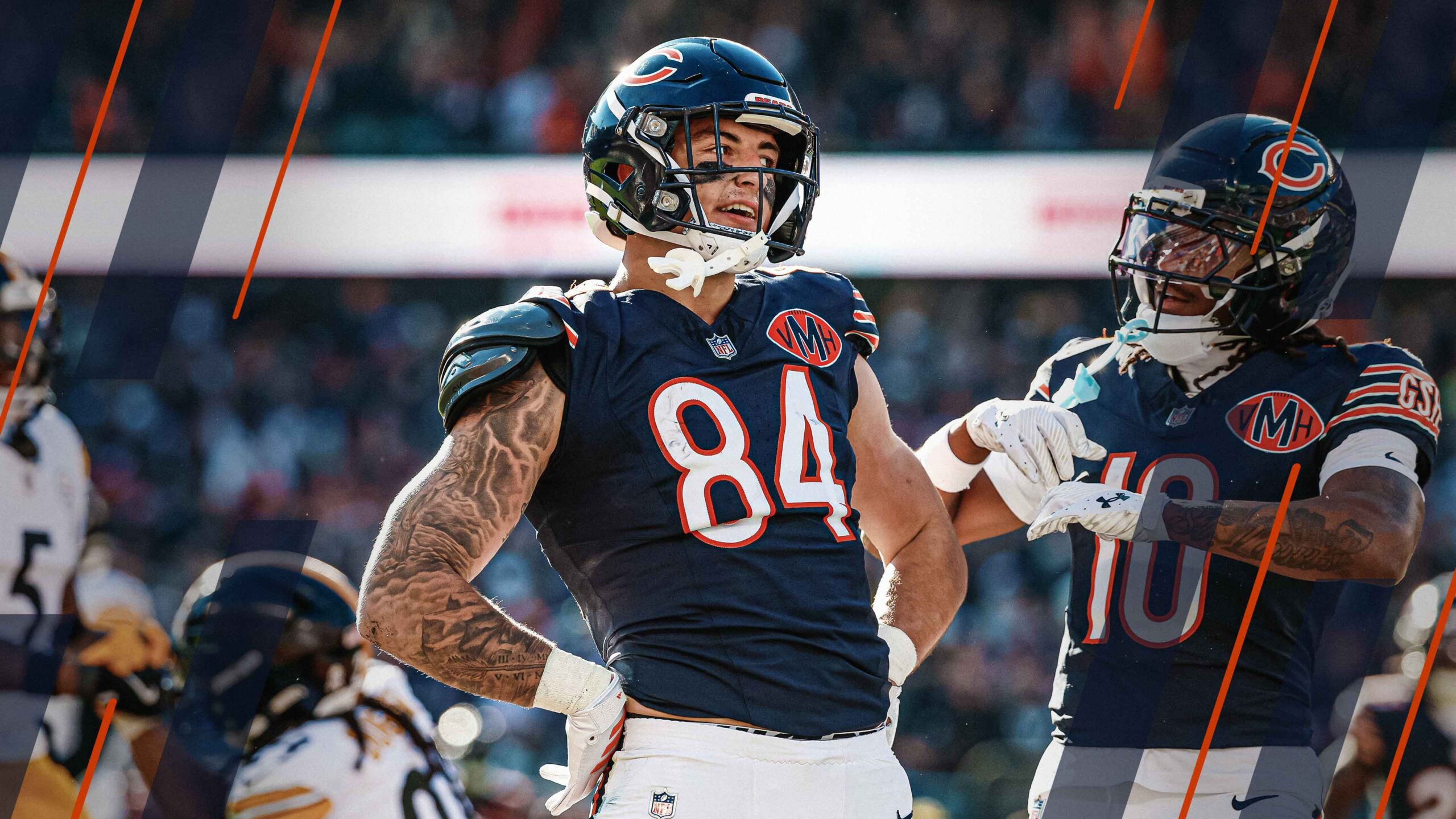
Bears head coach Ben Johnson orchestrates an exceptionally fantasy-friendly, run-heavy offensive scheme that features elite play volume, play action, shifts and motion, quick passes and heavy personnel packages. Bears players must be targeted in fantasy football drafts.
The Bears’ positive outlier metrics in 2025
Chicago Bears Metric Rank Offensive Plays Per Game 69.1 No. 2 12 Personnel Rate 34.4% No. 6 13 Personnel Snaps 131 No. 3 Play-Action Pass Play Rate 33.1% No. 2 Shifts & Motion Rate 68.5% No. 10 Neutral Game Run Play Rate 54.3% No. 3 Quick First-Read Passing Yards Per Play 7.35 No. 7Bears No. 1 tight end Colston Loveland earned an 85.3 PFF offense grade in his 2025 rookie season. He will rarely leave the field and will compete for fantasy football’s overall TE1 spot.
Bears No. 1 wide receiver Luther Burden III’s 2026 outlook is enhanced by No. 2 wide receiver Rome Odunze’s foot-related volatility. The 76.7 PFF receiving grade Burden secured in his 2025 rookie season edges the 70.3 PFF offense grade Odunze garnered last year. Among 35 rookie wide receivers with at least 70 targets earned during their first NFL season from 2021-25, Burden’s 2.34 yards per route run (YPRR) average ranks sixth.
All three top pass-catchers benefit from Johnson’s efficient, quick, first-read play designs. Similarly, Johnson’s run-heavy, high-volume playcalling allows his top two running backs to reliably produce on a weekly basis.
Los Angeles Chargers
The Los Angeles Chargers hired former Miami Dolphins head coach Mike McDaniel as their new offensive coordinator this offseason. It will be remembered as the NFL’s best offseason hire. McDaniel’s fullback-centric offensive scheme features play action, plus shifts and motion, and is a perfect fit for quarterback Justin Herbert’s quick-passing strengths.
As mentioned in “Evaluating first-read efficiency and 2026 volume projections,” Herbert owns a 78.6 PFF passing grade on first-read passes thrown in 2.5 seconds or less.
The Chargers’ positive outlier metrics in 2025
Los Angeles Chargers – Miami Dolphins Metric Rank 21 Personnel Rate 14.5% – 29.4% No. 5 – No. 2 22 Personnel Rate 7.9% – 8.8% No. 7 – No. 3 Play-Action Pass Play Rate N/A – 31.8% N/A – No. 3 Shifts & Motion Rate N/A – 77.7% N/A – No. 2 Neutral Game Pass Play Rate 61.4% – N/A No. 5 – N/A Quick First-Read Passing Yards Per Play N/A – 8.23 N/A – No. 1 Quick First-Read Completions 184 – N/A No. 6 – N/AAmong 41 NFL wide receivers with at least 175 targets over the past two seasons, Chargers wide receivers Ladd McConkey (5.0) and Quentin Johnston (5.0) tie for 11th in yards after the catch per reception. Their skillsets embody the post–catch abilities that McDaniel seeks. No. 1 wide receiver McConkey boasts a 79.3 PFF receiving grade during that span, while Johnston owns a 69.0 receiving grade.
McConkey is primed for a fantasy football WR1 campaign. Johnson could return WR3 value if he can fend offrising second-year wide receiver Tre Harris, who compiled a 66.6 receiving grade last year. Johnston and Harris could lower each other’s ceiling if they split the No. 2 wide receiver role.
Free-agent signee, running back Keaton Mitchell, should betargeted in drafts. He earned a 57.4 PFF offense grade last season and is set up for a bounce-back campaign.
The Chargers’ tight end room ismurky, though second-year tight end Oronde Gadsden II is the group’s best receiver. Among 10 rookie tight ends with at least 70 targets received during their first NFL season from 2021-25, Gadsden’s’ 71.1 receiving grade ranks eighth.
Explore PFF Fantasy Tools
See projected points and full stat lines across PPR, Half PPR, Standard, DFS, IDP, and BestBall formats. Import your league to view projections tailored to your exact scoring settings. Fantasy Football Projections Projected points and full stat lines across every major scoring format—or sync your league to see projections built for your exact settings. (opens in new tab) Overall and position draft rankings by scoring type. We combine PFF grades, strength of schedule, and teammate quality to model upside and downside—among the most accurate in Fantasy Pros’ annual ranking competition over the last five years. Fantasy Rankings Season-long draft rankings by position and scoring type—powered by PFF grades, strength of schedule, and teammate context to capture upside and downside. (opens in new tab) Customizable, printable cheat sheets for PPR, Half PPR, Standard, 2QB, IDP, Dynasty, and Rookie leagues. Players are tiered by position from our draft rankings, with ADP from popular fantasy platforms factored in. Fantasy Draft Cheat Sheet Printable, customizable cheat sheets for PPR, Half PPR, Standard, 2QB, IDP, Dynasty, and Rookie leagues—players tiered by position using our rankings and ADP. (opens in new tab) Sync your fantasy league to unlock the Live Draft Assistant and custom Lineup Optimizers—real-time pick suggestions, waiver wire targets, and sit/start recommendations built for your scoring formats and roster rules. Fantasy League Sync Connect your fantasy league to unlock the Live Draft Assistant and custom lineup tools—real-time picks, waiver targets, and sit/start advice for your scoring and roster rules. (opens in new tab) Subscribe For Full Access (opens in new tab)Los Angeles Rams
Los Angeles Rams head coach Sean McVay set the 13 personnel trend while maintaining the league’s premier play-action pass play rate, which featured high-end play volume and passing frequency. McVay’s brilliant quick-pass designs help keep quarterback Matthew Stafford upright.
Among 33 NFL quarterbacks with at least 100 pressured dropbacks, Stafford’s 12.1% pressure-to-sack rate ranks sixth. McVay continues to churn out fantasy-friendly offenses year after year.
The Rams’ positive outlier metrics in 2025
Los Angeles Rams Metric Rank Offensive Plays Per Game 67.5 No. 5 13 Personnel Snaps 410 No. 1 Play-Action Pass Play Rate 34.4% No. 1 Neutral Game Pass Play Rate 62.0% No. 3 Quick First-Read Passing Yards Per Play 7.24 No. 8 Quick First-Read Completions 199 No. 3Backed up by 33-year-old No. 2 wide receiver Davante Adams and blocking specialist C.J. Daniels potentially operating in the No. 3 wide receiver role, No. 1 wideout Puka Nacua will compete for the league-lead in targets. Adams generated an 83.9 PFF receiving grade last year, while Nacua led the NFL with a 96.2 mark.
Rams coaches hope second-year tight end Terrance Ferguson “takes the lead” this season, yet the front office spent a second-round pick on Max Klare this offseason.
McVay could feature “more of a 50-50 split” in the backfield this season, with starting running back Kyren Williams — who played to an 85.2 overall PFF grade — seeing the field on high-value downs. Fellow Rams running back Blake Corum registered a 78.5 overall PFF grade last year and should not be discounted, either. Both players can reliably return fantasy value in this elite offense.