Zoom
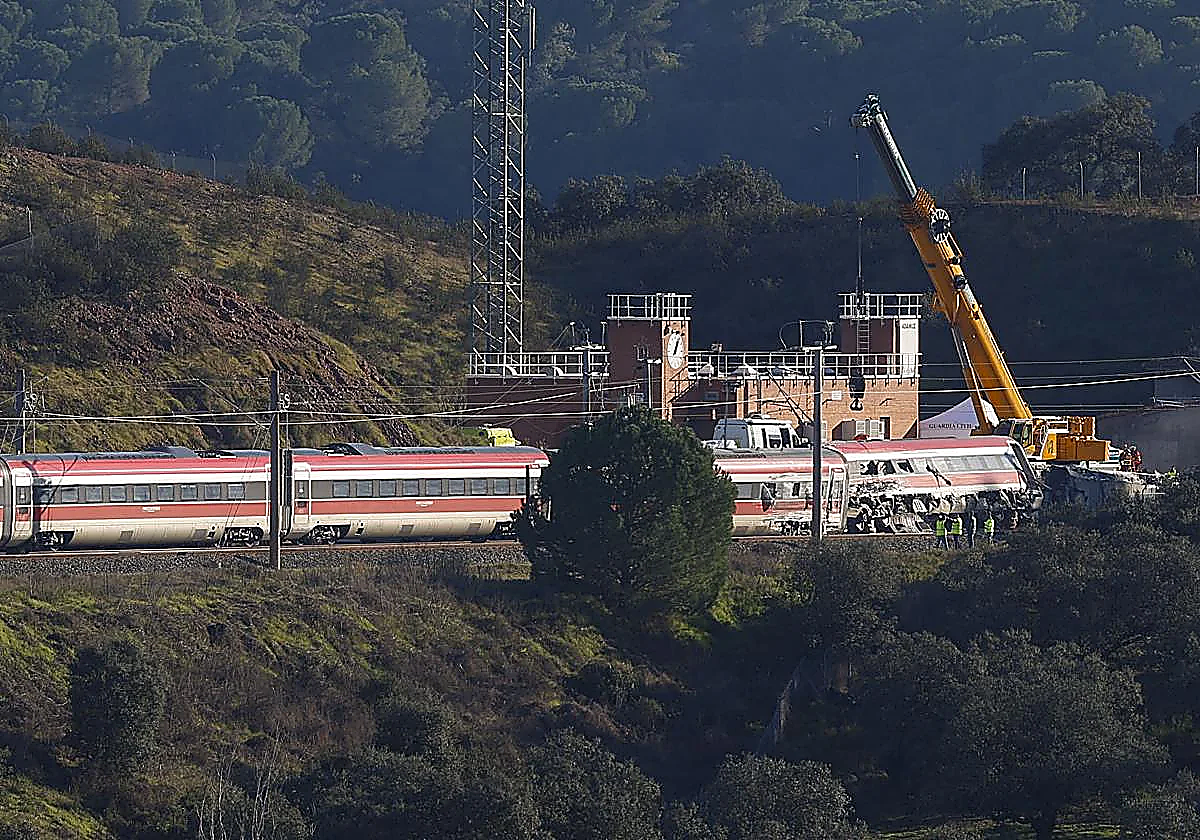
Cranes working in the area near the Adamuz station, where the Iryo train has been stranded. Adamuz train crash 2026 Cordoba crash investigators examine 500 metres of rail tracks and Iryo train gearThe accident commission suspects that the 'interaction' of the wheels with the damaged rails may have been the cause of the tragedy in Adamuz
Melchor Saíz-Pardo and Álvaro Soto
Wednesday, 21 January 2026, 10:17
The railway accident investigation commission (CIAF) has ordered the immediate transfer to a laboratory in Madrid of "the rails at the point where the derailment" of the Iryo Málaga-Madrid train began. It was this incident that then led to the collision with the Renfe Alvia Madrid-Huelva train, with 42 confirmed fatal victims so far.
According to commission sources, technicians consider it essential to examine the track in a controlled, interference-free environment, after the Guardia Civil's forensic unit confirmed the presence of "breaks" and/or "alterations", to establish whether the damage predated the accident. The aim is to establish whether the track was the cause of the incident on Sunday, 18 January.
The CIAF team have already held meetings with several police units, the duty judge and the railway companies involved in the accident (Iryo and Renfe), as well as with the rail infrastructure company of Spain (Adif). Together, they have been coordinating the "removal and custody" of the material, which was renovated very recently - in May 2025, thanks to a large investment.
Once in the laboratory in Madrid, these "complete sections" of the track, that have been found overturned and completely detached from the concrete sleepers on which they were supported, will be analysed.
A 'clean break' of almost one metre
The commission has decided to transfer at least 500 metres of track from line 1 (in the direction of Madrid). The material covers the distance from the exact place of the collision to the place where a "clean break" almost one metre in length has been found.
This is currently the focus of the CIAF's investigation, but it is not the only line of inquiry. On Wednesday, the Ministry of Transport confirmed that the commission team have already given orders to inspect the wheels of the Iryo train and "other trains that have recently travelled" through the accident site. This is an "advanced technical" procedure in which wear and cracks in the wheels and axles are detected.
The commission suspects that the "interaction" between Iryo's "running gear" (the axle and wheel system) and the previously damaged "infrastructure" (the track) may have been a key factor in the fatal accident. In other words, some component may have "touched" the defective track, causing it to become dislodged.
However, carriage 6 of the train, which was the first of the three Iryo carriages to derail, has not yet been thoroughly analysed by the commission's specialists, as the Guardia Civil have requested that it remain sealed. Forensic experts have completed their inspection of carriages 7 and 8, the first to be removed from the area, while carriages 1 to 6 still need to be analysed and photographed in depth.
The CIAF has also requested information from Adif on the traffic records for Adamuz in the two days prior to the incident to see if there had been any specific reports of problems on that section of track by drivers or other personnel.
'All hypotheses'
While awaiting the results of all these tests, CIAF technicians, who have been working on site since early Monday morning, have already confirmed some preliminary data. The accident was caused by the "derailment of the last three carriages of the Iryo high-speed train", which was travelling on track 1 towards Madrid, at the entrance to Adamuz station on the 010 Madrid-Seville line.
"The derailed carriages of the convoy bound for Atocha moved sideways, invading the gauge of track 2, on which the Renfe Alvia train was travelling in the opposite direction at that moment," the specialists have concluded. The number of passengers on board the two trains, according to interior minister Fernando Grande-Marlaska, was 527 passengers plus staff, a figure much higher than that given by the Ministry of Transport, which initially said that there were 486 people on the trains: 300 on the Iryo and 186 on the Alvia.
"At the moment, as we are in the initial phase, all hypotheses regarding the possible causes of the accident are open," Grande-Marlaska said. The minister added that, according to regulations, the CIAF has one year to publish the final report of the investigation.
The Ministry of Transport has stated that the data is provisional and that the investigation is still in its early stages. "The CIAF is currently in the process of gathering information on site and compiling documentation and data from the various records. In the next stages of the investigation, laboratory analyses of the material are planned. Depending on how the investigation progresses, other actions will be carried out as necessary (such as interviews, inspections of other facilities or rolling stock, etc.)," the ministry said.