Zoom
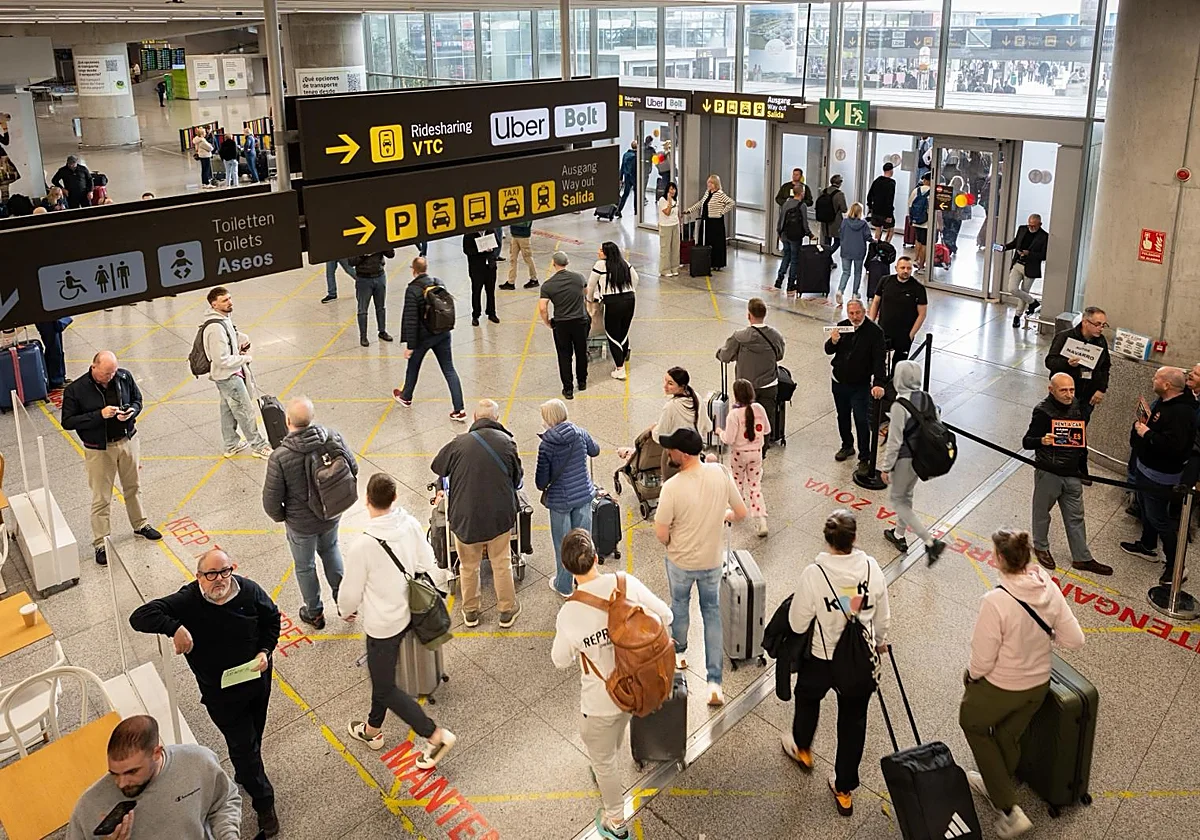
Tourists leaving Malaga Airport to enjoy their stay in the Costa del Sol. Ñito Salas Tourism Costa del Sol expects weaker Holy Week despite discounts and redirection of tourists due to Iran warHotels expect an occupancy rate of 73%, even lower than in 2024 when the rain put a damper on the public holidays
Málaga
Friday, 27 March 2026, 12:32
Costa del Sol hoteliers expect one of the weakest beginnings of the tourist season in terms of occupancy this Holy Week. They forecast rates even lower than in 2024, when the rain cancelled the majority of processions and led to many people deciding to postpone their trips.
The wave of discounts in the face of falling demand, the special initiatives in the domestic market and the war in Iran, which has redirected many tourists to safer destinations, have not been able to offset the drop. At the same time, the initially forecast drop is gradually narrowing and the situation could improve with last-minute bookings.
The first report by the association of Costa del Sol hoteliers (Aehcos) states that establishments will fill an average of 73.9% of their rooms from 27 March to 6 April. The figure contrasts with the 80.18% registered last year and the 75.98% in 2024.
Last-minute offers and the strong increase in international tourism have partly cushioned the decline in domestic demand due to the suspension of the high-speed train. Hoteliers estimate a 78.03% occupancy rate for the peak period (2 to 6 April), down from 83.22% in 2025 and 87.81% in 2023.
President of Aehcos José Luque says that "the current state of railway connections clearly conditions bookings, especially in the national market, which has a decisive weight in Easter". According to Luque, the favourable weather forecasts this year are proof that "the current decline in bookings is more linked to transport challenges than to climatological factors that directly affect demand".
The Aehcos report states that "situations like the current one have an immediate effect on tourist activity, especially in periods of high demand".
The most popular destinations are Marbella-Benahavís, with around 86% of hotel rooms booked on key days, Malaga city and Rincón de la Victoria, which reach 85%, Mijas, with 79% and Benalmadena, with 74%.
President of the Andalusian tourist housing association (AVVA-Pro) Juan Cubo has confirmed that Malaga is below last year's rates, although last-minute bookings have slightly narrowed the gap from a drop of 20% to the current 10%. "We are confident that bookings in the days just before [Easter] will be key," he says.
Rural tourism is clearly at a bigger advantage than coastal tourism. Accommodation in the interior exceeds eight nights, with no drop compared to last year but with higher prices. Meanwhile, the average stay on the coast is "a little shorter", but occupancy is similar to previous years.
The destination most impacted by the high-speed suspension is Malaga city, which "is gradually recovering from the initial drop". "Right now, we have approximately 10% fewer bookings than at this time last year. Prices in Malaga are similar to last year's," Cubo says.
78%
is the expected hotel occupancy rate for the key days of Easter Week, from 2 to 6 April, down from 83.2% in 2025
Cubo believes that last-minute bookings "may be able to save the Easter holidays". "We think that the Gulf War is having a positive impact, although it may seem unbelievable, with the diversion of passengers who had planned departures to the Middle East and are now looking for safe destinations".
The head of AVVA-Pro says that, "in principle, the first part of the week is a little weaker, with less of a difference on key dates".
Co-founder of the Ruralidays platform Felix Zea confirms the pull of rural tourism, with bookings of "more than 80% in Malaga province". According to him, the countryside doesn't feel the impact of the suspension of the high-speed train, because most visitors arrive by car (Spanish residents) or plane (foreigners).
"Rural tourism in the province of Malaga has become a refuge in the face of the uncertainties of the railway transport and the international crisis marked by the war in Iran," Zea states.
Easter occupancy rates in rural accommodation in the province have sharply risen. From Holy Wednesday to Easter Sunday, occupancy will be over 82%, compared to 73% in 2025. After Malaga, come the provinces of Cordoba, with 80.5% (+17%), Granada, with 79% (+12%); and Jaén, with 78% (+19%).
According to Zea, overall occupancy in Andalucía will be 78%, eight points higher than a year ago. Domestic tourism is key, with 34.2% of the tourists coming from within Spain, followed by the Germans, 25.4%; the British, 17%; and the Dutch, 3.7%.
"The most booked areas in the province are Torrox, Frigiliana, Antequera and Nerja," Zea says, adding that "the majority of visitors are looking for villages that are well connected to the coast".
Travel agencies agree that the arrival of tourists who had planned to travel to destinations such as Egypt or Jordan and who have ruled it out due to the war in Iran has an impact. "The diversion of passengers is going to benefit this Easter," head of the association of travel agencies Sergio García says. "We will be able to make a more exhaustive review when Easter is over, but this can be a decisive factor to compensate the loss of national tourists due to the suspension of high-speed train," he adds.
García says that during these first holidays of the year, Malaga residents usually travel within Andalucía and Spain. "Only a minority, between 8% or 9%, plan trips to foreign destinations at this time of year. Those who plan trips outside the country tend to opt for the classic European capitals, where flights are cheaper than to Madrid," he says.
According to García, the increase of around 5% in the price of fuel in airline tickets is already noticeable.
Click here to read more news about tourism on teh Costa del Sol.