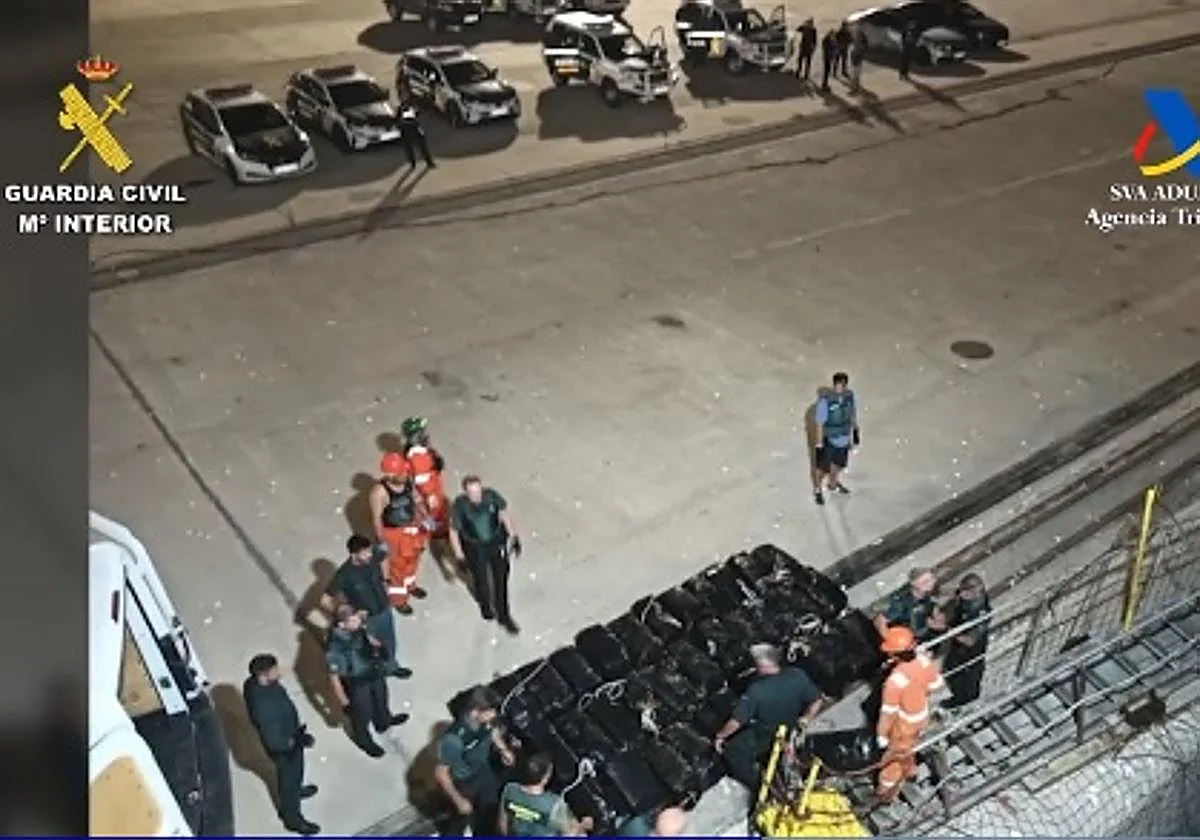
Zoom
Crime Criminal investigation in Mijas leads to seizure of 2,500 kilos of cocaine, 30 arrests and links to the 'Balkan Cartel'The entire infrastructure, set up to smuggle large quantities of cocaine from Colombia into Spain by hijacking container ships, has been completely dismantled
Europa Press
Thursday, 15 January 2026, 17:28
Customs officials from the AEAT (Spain's state tax authority), in a joint operation with the Guardia Civil and the National Police, have dismantled three criminal organisations linked to the 'Balkan Cartel'.
They have taken down the entire infrastructure used by the gangs to smuggle large quantities of cocaine from Colombia into Spain hidden on container ships, and then retrieving their haul by force.
According to a statement from the AEAT, 30 people have been arrested and 19 searches conducted in which more than 2,475 kilos of cocaine, over 166,000 euros in cash, jewellery and watches worth 100,000 euros, eight high-end vehicles, war-grade weapons, 215 fuel canisters, various nautical equipment and ladders used by the hijackers, as well as geolocation devices, have been seized.
Similarly, real estate assets worth nearly five million euros and four virtual cryptocurrency wallets have been frozen.
Where it all started: Mijas, 2024
The investigation began after the seizure of 88 kilos of cocaine hidden inside a vehicle in the Malaga town of Mijas in October 2024. Investigators were then able to uncover the existence of three criminal organisations dedicated to smuggling drugs into Spain. One of them was linked to the 'Balkan Cartel' and owned the drugs, while another was made up of Colombian nationals who operated both in their country of origin and in Spain.
According to the Spanish tax agency, the cocaine shipments were smuggled aboard container ships using the 'trepadores' (climber) technique. This drug-trafficking method consists of using young people from low-income families who are good swimmers to load the drugs onto the vessels while at sea.
More than 2,475 kilos of cocaine, over 166,000 euros in cash, jewellery, watches, high-end vehicles and war-grade weapons have been seized.
Later, members of the same organisation travelled to Spain with the intention of raiding the shipping containers by intercepting the vessels before they reached the Strait of Gibraltar. They relied on the logistical infrastructure provided by a third criminal organisation based in the Campo de Gibraltar area.
In the middle of the same year, the crew of a ship bound for the port of Cadiz alerted the Spanish maritime rescue service to the presence of stowaways on deck, leading to the seizure of 1,355 kilos of cocaine hidden in a container. The ensuing investigation revealed that three men tasked with retrieving the drugs had returned hastily to their country.
Shortly afterwards, according to the AEAT, another ship passing through Portuguese waters alerted the Portuguese authorities to the hijacking of the vessel by stowaways carrying weapons. They had managed to unload several bales hidden in a container, but the authorities were able to recover those narcotics from the criminal organisation.
Based on the Costa del Sol
In September and October, another drug shipment was made when three members of the Colombian organisation and two men belonging to the 'Balkan Cartel' cell based on the Costa del Sol, supported by the organisation in charge of providing the high-speed boats, were able to recover drugs from one of the containers using the 'drop-off' technique.
This method consists of throwing the illegal merchandise from a cargo ship to be picked up by smaller vessels near the shores of the destination country. To achieve this, they first subdued the crew aboard the cargo ship and then extracted the drugs from inside the containers. They were armed and handled it like a military operation.
The cocaine was then distributed across towns located in the Gulf of Cadiz, where it was kept hidden and finally transported by road to European countries.
As the investigation progressed, it was possible to pinpoint the various storage facilities, leading to 19 raids and searches. This resulted in the seizure of 1,032 kilos of cocaine, eight high-end vehicles, war-grade weapons, 215 fuel canisters, various nautical equipment and ladders used for boarding, as well as GPS tracking devices.
In total, 2,475 kilos of cocaine, over 166,000 euros in cash and also jewellery and watches worth 100,000 euros were seized, concluded the Spanish tax agency's statement.