- Introducing the NEW PFF Pro subscription: PFF Pro includes everything in PFF+, plus an upgraded Premium Stats Pro experience, higher base access to Guru AI, revamped player and team pages, enhanced data and visualizations, an improved interface and programmatic data access for modeling. Click here to subscribe.
Many NFL bettors start with individual markets — spreads, totals or player props — and ask, “Which spread looks good?” or “Which totals stand out this week?” It’s a bottom-up approach: Start with the bet, then decide whether the underlying game script supports it.
In this space, we’ll work in the opposite direction. Each week, we’ll focus on one game and take a top-down approach, starting with the broader picture of how the teams and players are performing and what the data suggests about the matchup. From there, we’ll identify the betting markets that best align with that expected game script.
The goal is to form a view of how the game is likely to unfold first, then find the spreads, totals and props that offer the best ways to bet on that outcome.
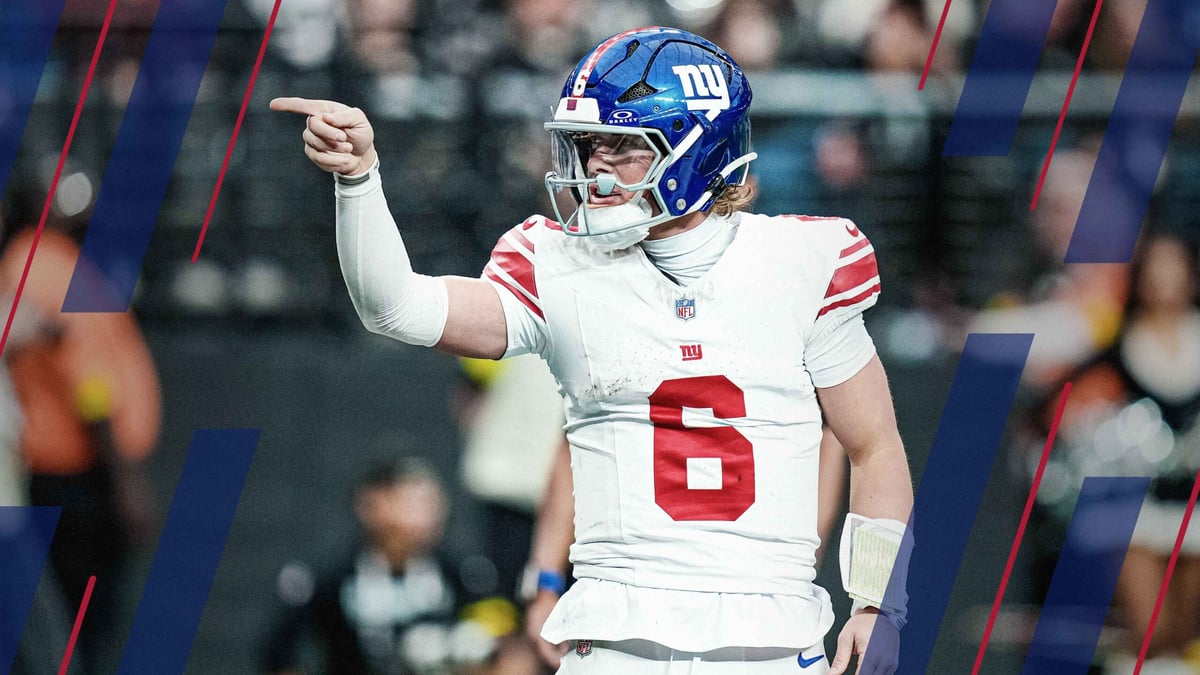
New York Giants moneyline
Week 2 presents an interesting dynamic. We don’t want to get too aggressive in updating our priors based on one week and overreact to new performance, but we also now have the first meaningful data from the 2026 season. Last week’s pricing looked closer to “Week 19” of 2025, but we now have perhaps the most valuable new information available: actual regular-season games from 2026.
That creates plenty of uncertainty. We have to balance established priors and preseason projections against a very small sample of new information. But that uncertainty is exactly where tail opportunities can emerge.
To identify those opportunities, though, we first need to understand what the market is pricing and implying. That sets the frame for the rest of our analysis.
The Rams are roughly a three-quarters favorite, with the spread sitting just beyond 7 points.
This is by no means a dispositive view, but above are Inpredictable’s ratings, which use market lines to estimate how the market is pricing these teams.
While we don’t want to anchor too heavily to one week, it is certainly notable that the Giants had perhaps the best drive-level offensive stats of any team in Week 1. Meanwhile, the Rams were merely average even after accounting for several turnovers, which helps explain why their EPA per play was much lower than their EDP.
Defensively, the two teams performed fairly similarly, with the Rams and Giants allowing the 49ers and Cowboys, respectively, to produce some of the better offensive performances of the week.
The point isn’t to look at Week 1 and declare this the new reality. But there may be some signal in a new Giants offense immediately dominating, even while playing alongside a poor defense. That doesn’t mean the Giants suddenly have a top offense. Maybe we look back and determine it was more about the Cowboys’ defense, or that Week 1 simply represented a top-percentile outcome.
But the market is still pricing the Giants as roughly the 21st-best offense. Much like we said about the Jets last week, I think there’s more upside than downside in that ranking. The Giants have a better chance of proving to be significantly better than 21st than significantly worse.
Therein lies the asymmetric upside with the Giants, and it’s something I’m more willing to buy into early given the new coaching staff, a Year 2 quarterback and the additions on offense.
The market, meanwhile, is already pricing in much of the Rams’ upside. As we discussed in our preview, they may have the best roster on paper, but their age and depth create legitimate downside risk. We’re already seeing some of that downside emerge, with Myles Garrett out and on injured reserve.
Matchup angles
It’s not just the fundamentals that suggest some asymmetric upside. This is also a decent matchup for the Giants. Since Shane Bowen was fired last season, the Giants’ defense ranks first in disruption rate, including third in perfect coverage rate and fifth in pressure disruption rate. They also rank second in quick pressure rate and near the top of the NFL across a variety of pass-defense metrics.
And this is a quarterback in Matthew Stafford who, because of his inability to scramble and extend plays, is more reliant on his situation than the typical quarterback. He sits in the top left here among quarterbacks with the largest gap between his production when kept clean and when disturbed. In those disturbed situations, Stafford was below average from a production standpoint.
But for Stafford, at least last season, those disturbed situations were relatively rare.
Only Aaron Rodgers, who had the quickest time to throw in the NFL last season, faced less disruption pressure than Matthew Stafford. And the gap in Stafford’s play when disturbed is even wider — and “further to the left” — than in our chart above.
I think much of the value lies in the pressure matchup, more so than coverage. The Giants are dealing with injuries in the secondary to Paulson Adebo and Deonte Banks, and Sean McVay’s offenses have consistently ranked in the top five in forcing coverage mistakes. The Rams should still have some success exploiting coverage breakdowns.
More concerning for Los Angeles is the pass rush. The Giants should have one of the NFL’s best after the way they finished last season, while the Rams allowed a whopping 31% disruption pressure rate in Week 1. If the Giants can generate even 75% of that rate, it could create major problems for a Rams offense that faced a disruption pressure rate of just 13% last season.
I don’t expect the Giants to replicate that 31% figure from Week 1, but I am buying their pass rush’s ability to win this matchup. And if it does, the Giants can force Stafford and the Rams into an area where they are at their weakest. Given what we know about Stafford’s profile, that creates a path to another underwhelming performance from a Rams offense the market is pricing as a top-five unit.
Add it all up, and we have a Giants offense that entered the season with a prior suggesting it could take a massive leap, then put together a Week 1 offensive performance as strong as any team in the league. The market still rates this offense below average, creating a tail outcome in which the Giants are actually a much better offensive team than currently priced and the market is slow to fully adjust.
On the other side, a Giants pass rush that ranked in the top five toward the end of last season presents a potentially significant problem for Stafford. His baseline production has benefited from rarely being disrupted, but when quick pressure does arrive, his production falls off more than it does for the typical quarterback. Put those two sides together, and there is a credible path to the Giants outperforming what the current market price implies.