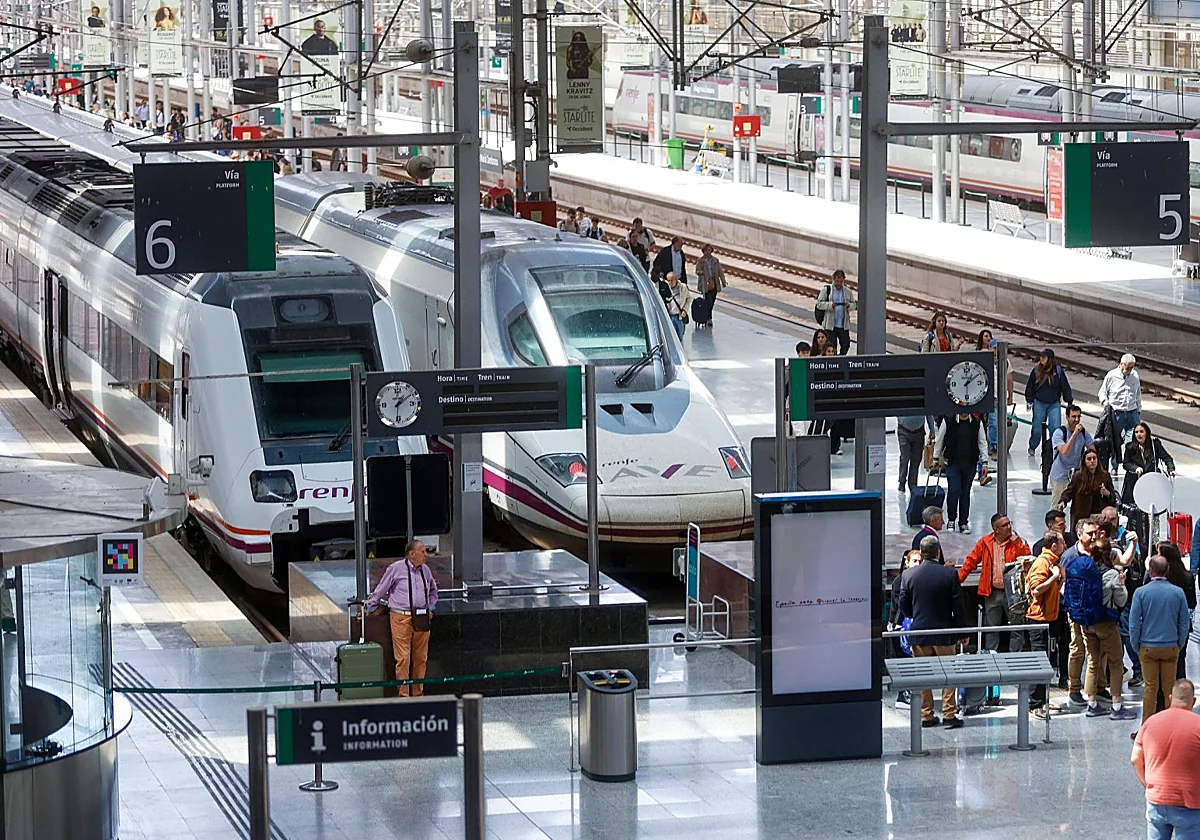
Direct rail links between Malaga and Madrid resumed today (Thursday 30 April) after a three-month closure, though the first morning of operation saw several high-speed services delayed by up to 30 minutes
Departure of passengers on the first AVE train to arrive in Malaga on Thursday. (MARILÚ BÁEZ)Málaga
30/04/2026 a las 16:20h.The high-speed rail connection between Malaga and Madrid finally returned to normal operation today (Thursday, 30 April) ending a 100-day disruption that has ... caused significant logistical challenges for the province.
The resumption of direct services means passengers are no longer required to take a coach transfer between Antequera-Santa Ana and Malaga city.
However, the first morning of the restored service was not entirely smooth. Passengers at Malaga’s María Zambrano station faced a series of delays affecting the earliest departures and arrivals. According to rail infrastructure manager Adif and the national operator Renfe, several trains were delayed by between 15 and 40 minutes.The first journeys without the need to change trains in Antequera after three and a half months of works lasted three hours and 20 minutes, that is, 20 minutes longer than initially planned.
Related story
Tourism
Pilar Martínez
However, the testimonies of the first passengers on Thursday were torn between resignation at the long journey, and joy because at least now it is somewhat shorter and has more frequencies than during the past winter months, especially for those from Malaga who live in the Spanish capital and try to return frequently to see their family and friends.
Among the first to leave María Zambrano was Eduardo González. "I'm living it with tremendous emotion," he says, ironically, "because I've just had my ticket changed three times.... I don't know if the emotion is positive or negative". González, who is from Valladolid, explains that he has been one of those affected by the delay in the reopening date, from 27 to 30 April.
"I know what the minister is capable of because we had him as mayor in Valladolid; I wouldn't be surprised if the train doesn't reach Madrid".
"I bought it two months ago, because it was the day they were going to reopen it, but when the date was about to arrive they cancelled it and offered me the change, 50 minutes late with respect to the scheduled time". "And a few days later they told me that the return journey had been changed twice. So I went to the counter and congratulated them on their efficiency.
Furthermore, Eduardo González emphasises that, although he lives in Malaga, he is a native of Valladolid, "so I know perfectly well what the Minister of Transport (Óscar Puente) is capable of, because we had him as mayor.... So I wouldn't be surprised if the train doesn't reach Madrid".
"This is incomprehensible and I don't think we deserve what we have. This is the responsibility of the Ministry of Transport, because of the lack of maintenance of the tracks. The tremendous rains and the landslides, that's nobody's fault. But it is their fault that it has taken them so long to solve it in a country like ours, which belongs to the EU.
"Slower".
For his part, Marcos travelled in the first one to arrive at María Zambrano, at1.09pm. When asked how it went, he replied, bluntly: "It has been slow; we have been suffering this for years and you can't fight the government". To which he added: "After these months and what has happened, this is a disgrace: they have increased the time for compensation, they have closed tracks and we are getting later and later".
"This is a disgrace: after what has happened, they have closed the tracks and we are getting later and later"
On the other hand, the Government sub-delegate, Javier Salas, believes that this is "an important day" because the full service between the two capitals has been re-established with 161 weekly Renfe rotations, an average of 25 a day, and with a journey time of around three hours, "which is only a few minutes more than before, which means that we are back to full normality both in terms of rotations and journey time".
In reality, the journey time before the line was cut was slightly more than two and a half hours. And with the reopening of the single-track line between Malaga and Antequera alone, up to 30 pe cent of frequencies have been lost: 18-19 total connections, counting the three operators, compared with 26 at the end of 2025.
"It is an important day: we are back to full normality both in terms of rotations and journey times"
For the rest, Salas stresses that Adif has managed to re-establish "the movement of a mountain on top of the railway track" in little more than two months, for which he thanks the workers for "fixing the track in record time". "Adif is working flat out to re-establish the second track", he adds, although he does not give dates, except that he hopes it will be for next summer.
In any case, even if the second track is repaired, it will still be necessary to replace a piece of track equipment that was destroyed and which is vital for trains to be able to pass from one track to the other. Therefore, trains will continue to run on single track for some 54.5 kilometres, from Los Prados to Antequera, at least until the end of the year.
Return home
Despite the difficulties, thousands of passengers used this service yesterday to reach Malaga and the Costa del Sol. Among them, many people from Malaga who live and work in Madrid and were returning home for the long weekend. This is the case of Cristina, who is a civil servant and a regular user of the train.
"Actually, today was not as late as other times, it was only 20 minutes, and I'm still happy"
"Actually, today was not as late as other times, it was only 20 minutes. We have been late for many months, long before the accident it was already rare for us to arrive on time, and that is why they extended the return policy for unpunctuality".
To this, she adds that the journey time has gone from two hours and 40 minutes to more than three hours. "Even so, I'm happy that we've made it to Malaga", she says with resignation. Since January, she has reduced the number of times she comes to see her family due to travel difficulties. "I could only come once a month: at Easter I came by car with a colleague, but on any given weekend we can't do that because it's almost six hours, with the traffic; and the plane is too expensive".