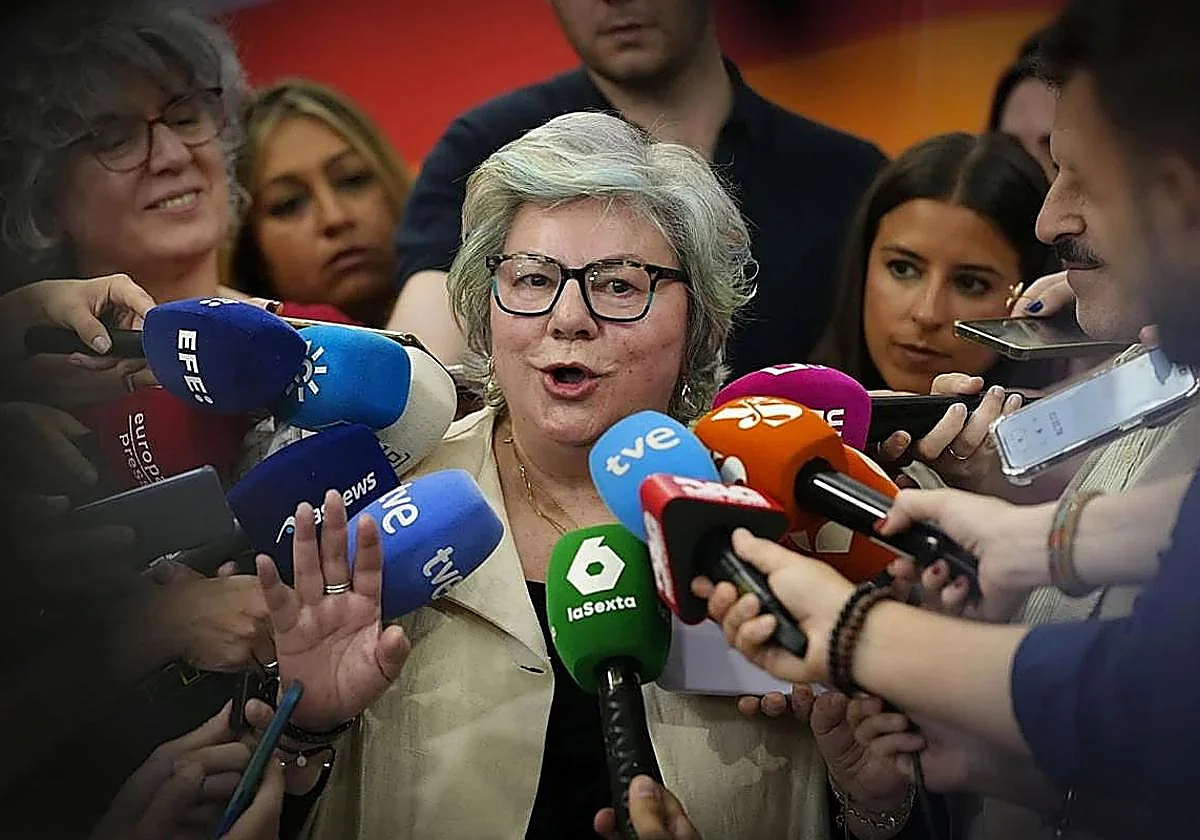
The ministry of equality marked Lesbian Visibility Day by paying tribute to Dolores who was wrongfully convicted 25 years ago for the murder of Rocío Wanninkhof
Dolores Vázquez talks to the media on Monday. (José Ramón Ladra)Carlos Barea
30/04/2026 a las 11:00h.The dawn of the 21st century began in Spain with two questions hanging in the air: what was going to happen with the infamous Y2K bug - which it was feared would cause computer systems to crash worldwide - and who killed Rocío Wanninkhof.
The whole nation was shocked and could not stop wondering who could have taken the life of the young woman from Mijas, who disappeared on 9 October 1999 and was found almost a month later wrapped in plastic bags with nine stab wounds.
Panic gripped Spanish society with fears regarding what would become of young women. How could parents let their daughters walk the streets alone, knowing there was a killer on the loose? Seven years earlier, another terrible tragedy had occurred with the Alcàsser girls murder – a case riddled with unanswered questions that was never fully resolved – and that could not be allowed to happen again.
The case had to be solved urgently. And the sooner, the better. It was perhaps that rush to find a culprit that led to a series of prejudices and unreliable evidence causing one of the most glaring errors in the recent history of the Spanish justice system.
Dolores Vázquez was the scapegoat. The woman who had been in a relationship with Rocío’s mother quickly became the target of all accusations - both social and legal. It made no difference that Dolores had spent the night in question looking after her mother, that several calls had been logged from her home during the hours of the disappearance, or that the tyres on her car did not bear the slightest resemblance to the marks found at the crime scene. In the face of all this evidence pointing to her innocence, her so-called ‘cold nature’ or ‘masculine demeanour’ carried far more weight.
This ‘diabolical’ conduct, combined with other factors such as accepting the testimony of a psychic who claimed that Dolores had told her she was going to take revenge on her ex-partner, and the account of an employee who claimed to have seen her stab a photo of Rocío, led to Dolores Vázquez, Spain's 'perverse lesbian', being sent to prison in September 2000.
In February 2002, after seventeen months behind bars and an appeal, she was released on bail for 30,000 euros. In 2003, following the murder of the young Sonia Carabantes, the real killer of both girls, British national Tony Alexander King, was finally arrested.
There has been silence since. The then Minister of Justice, José María Michavila, stated in an interview with ABC in September 2003 that the error had been made by the jury members and that it was the judges who had corrected it.
In other words, he tried by every means to deflect blame. Not even the media, which had publicly vilified her and heavily influenced the jury’s decision, offered any admission of fault. As if nothing had happened. No one took responsibility for the fact that an innocent person had spent almost a year and a half in prison simply for not appearing feminine enough or sufficiently distraught.
This Monday, however, the Ministry of Equality made amends, at least in moral terms, for the appalling injustice that had been left unresolved for 26 years. To mark Lesbian Visibility Day, Minister Ana Redondo presented the medal for the promotion of equality values at a ceremony held in the ministry’s own auditorium.
Before the event began, Dolores Vázquez stepped before the media to share her thoughts on how she was feeling. Upon her arrival, she had admitted that she was very nervous and had barely slept.
The interest in Dolores’s story seems undiminished, judging by the large number of media outlets present for these statements. “It’s a very special day for me,” she said. “I feel like a different person. I haven’t forgotten, but I’m coping better with my life and it’s very important for me to feel this way.” She appeared visibly moved, happy to accept this token after almost 26 years of a nightmare.
“There are two things that still sometimes keep me awake: the prison cell, which still haunts me, and the trial, where I felt like a circus act,” she admitted. She is clear that, besides from the government, she hopes for more apologies: “from many people: from the press and from people on the street, who I hope can understand today that I was and am innocent.”
Revindication
She also spoke of the damage that the media coverage and public demonisation had caused her in her daily life: “For a bit over three years, I couldn’t go out in public. I couldn’t even go to the job centre to register as unemployed and continue contributing to the social security. As a result, I don’t have a pension today; I receive a benefit because I’m two years and two months short of qualifying.” Thus, when asked by a journalist, she was emphatic: “It’s time for me to be compensated,” pointing out that, to this day, no one has compensated her financially.
A bottomless pit
During the official ceremony, the first thing Dolores did was to make it clear that this recognition feels all the more special and important because of the people around her: “I accept this on behalf of my family, my nieces and nephews, my sisters, my mum who is no longer with us... For the many friends who have been there for me and who used to come round at night so the press wouldn’t catch them. For all the support I received back then and throughout this time. This is for them,” she emphasised.
In her speech she once again emphasised the journey she has had to undertake to find happiness again: ‘I’m proud of myself because they made me go through a very dark place that I couldn’t seem to escape from.’
Although she says she feels like her old self again, she also admits that she isn’t quite the same: ‘I’m a little more reserved, more cautious. I can face the microphone now, look at the camera… I feel freer. There are things that still haven’t been forgotten, but that’s something you never forget in life.”
A long journey
Acknowledging the past, she recounted how she had tried to get in touch with the children of Alicia (Hornos, Rocío’s mother), who was barely mentioned during the event: "I bear them no ill will. I tried to get in touch with the children so that I could speak to them, but it wasn’t possible. The response was silence, and I understood that."
Dolores Vázquez - Loli Vázquez as she was known - now wants to look to the future and only look back to remember the resilient woman she is and how she has emerged from the dark place she was pushed into by social lesbophobia, prejudice and the lack of professional ethics in many media outlets. Before stepping off the stage, she admitted that she wants more recognition and asked that this be just the tip of the iceberg in a larger process of reconciliation that minister Ana Redondo had alluded to and that Dolores echoed with her final plea: “I want more.”
Just before that, it was the minister who explained the reason behind this event, “It was a social and institutional witch-hunt against you. Recognition is not enough; we must make amends, and that is what we are working on. This is the first event, but it will not be the only one. The microphone is yours, and we are here to applaud you.”
As part of the event, the ministry of equality organised a round-table discussion moderated by the lawyer, businesswoman and LGBT+ feminist activist Eva Pérez Nanclares, during which lesbophobia in society was debated. Participants included the president of FELGTB+, Paula Iglesias, LGBT+ activist Beatriz Gimeno and University of Valladolid lecturer Marta Redondo.
The discussion covered, among other issues, the role of the media in the public shaming Dolores endured and how even LGBT+ groups found it difficult at the time to take a clear stance on the case.
Also speaking was Beatriz Gimeno, the author of the book published in 2008, “La Construcción de la Lesbiana Perversa” (The Construction of the Perverse Lesbian), in which she reflects on the representation of lesbians in the media, specifically in the case of Dolores Vázquez.