2 min read
ECLIPSE – Efficient variable Conductivity Lunar Insulator for Passive Surveyor Environmental controlLoura Hall
Jul 21, 2026 ArticleAustin Phoenix
Virginia Polytechnic Institute & State
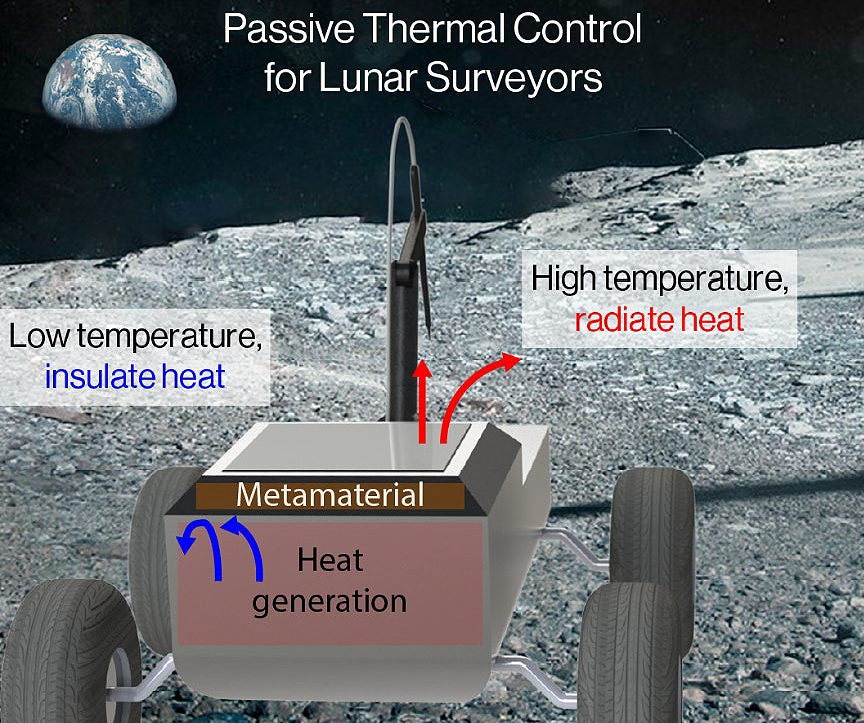
A disaggregated lunar infrastructure requires novel thermal management methods to enable future lunar operations. While thermal management solutions exist for large infrastructure, the smaller mobile systems that operate independently require improved temperature regulation devices that can survive without heaters or substantial power requirements, while limiting stress-inducing temperature fluctuations. New material solutions can passively regulate the flow of thermal energy to enable small devices to survive the extremes of the lunar environment without relying on external infrastructure. The Variable Thermal Conductivity Metamaterial (VTCM) outperforms other VTCMs and can be designed to act as an advanced mechanical thermal switch. Variable internal contact is used to regulate the flow of energy to the radiator passively. The design of the metamaterial’s internal geometry, material selection, and the passive shape memory alloy actuation system can achieve an arbitrary thermal conductivity as a function of temperature using internal mechanical contact. The metamaterial concept begins in a low temperature state with no initial contact and a corresponding low conductivity state. As the temperature of the metamaterial increases, partial SMA actuation induces partial contact internal to the metamaterial, resulting in an increase in conductivity. As the temperature continues to increase, the contact area increases until full contact is achieved. This metamaterial enables the design of an arbitrary thermal conductivity as a function of temperature by designing the thermal pathways’ cross-sectional area and length. The proposed work will use the variable thermal conductivity metamaterial, capable of passive thermal control, to enable mobile autonomous surveyors that can perform extended lunar operations while minimizing Size, Weight, Power, and Cost (SWaP-C).
2026 Selections
Facebook logo @NASATechnology@NASA_TechnologyShare
Details
Last Updated Jul 21, 2026 EditorLoura HallRelated Terms
- NASA Innovative Advanced Concepts (NIAC) Program
- NIAC Studies
- Research and Technology Mission Directorate
Discover More NIAC Topics
Space Technology Mission Directorate
NASA Innovative Advanced Concepts
NIAC Funded Studies
About NIAC