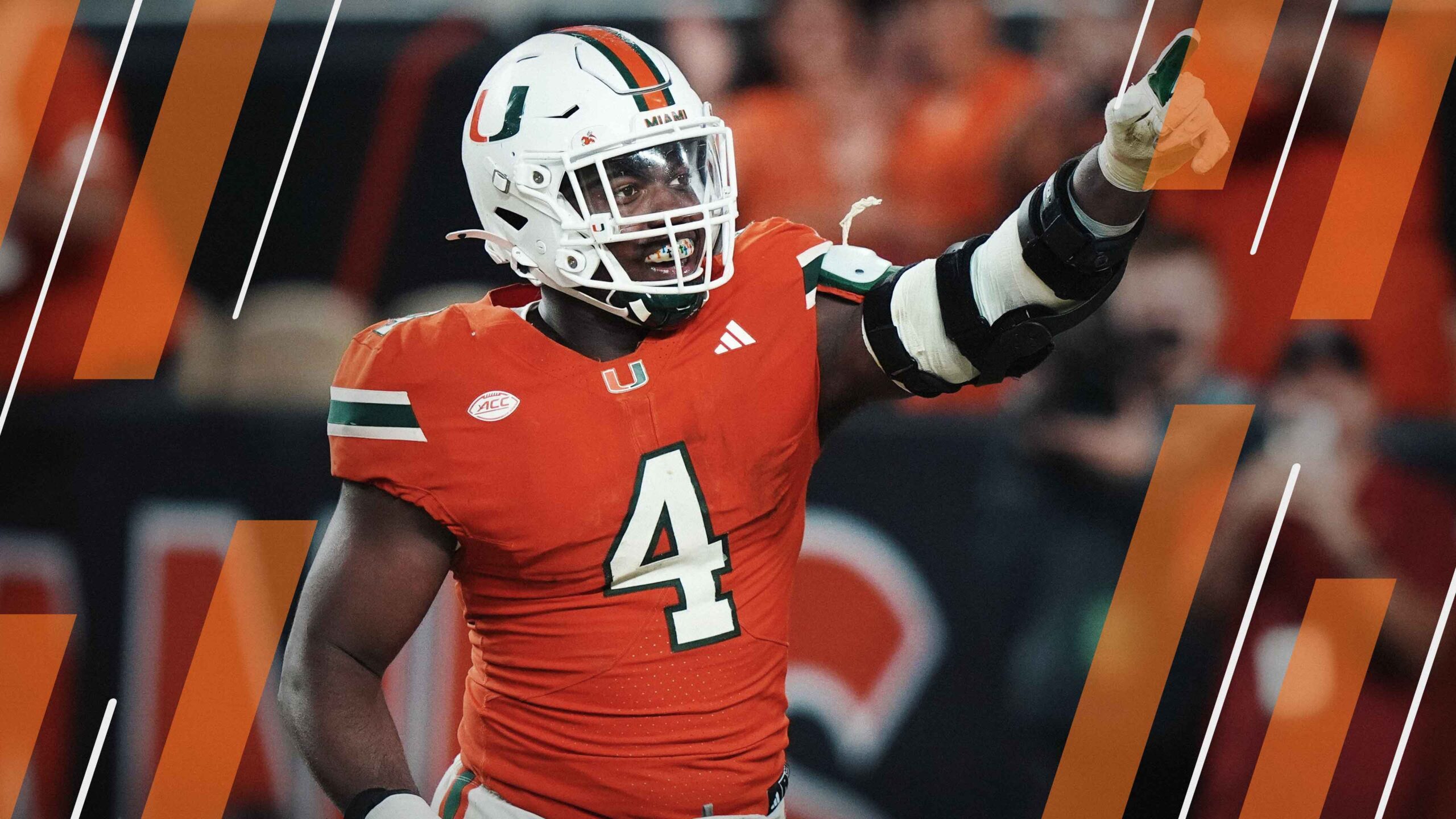
We hear some version of the same story every draft cycle: a notable offensive tackle or edge rusher measures in with arms below an arbitrary threshold, and questions about his draft stock quickly follow.
This year, that spotlight falls on Rueben Bain, who led all FBS edge defenders in PFF Wins Above Average (WAA) at Miami this past season.
There are valid reasons the conversation persists. Length can create a natural advantage in the engagements between tackles and edge defenders. But across a large sample, is there empirical evidence that arm length at these positions meaningfully impacts NFL outcomes?
This article aims to answer that question using PFF data on every offensive tackle and edge defender drafted from 2015 to 2024.
The sample
We analyzed 752 offensive tackles and edge defenders across 10 draft classes (2015-2024), incorporating combine and pro day measurables, PFF play-level grades from each player’s final two college seasons and NFL outcomes measured by PFF Wins Above Replacement (WAR) over their first three NFL seasons.
Arm length buckets were defined using position-specific percentiles: the bottom 25% classified as short, the middle 50% as average and the top 25% as long. That sets the short-arm threshold at 33.5 inches for offensive tackles and approximately 32.5 inches for edge defenders.
Note: The full sample of 752 prospects is used for draft position and college grade comparisons. NFL WAR analysis is limited to players with three seasons of data (188 offensive tackles, 309 edge defenders). Rep-level matchup analysis requires arm length measurements for both the blocker and the pass rusher.
Baseline look at arm length vs. NFL production
At a basic level, if arm length were a key driver of NFL success, it would show at least some positive correlation with production. That is not the case for either offensive tackles or edge defenders.
There is little to no correlation between arm length and WAR over a player’s first three NFL seasons.
The scatterplot for edge defenders offers a slightly more nuanced view. Shorter-armed edge rushers cluster more tightly around 0 WAR, with fewer extreme outcomes outside of outliers such as Aidan Hutchinson. As arm length increases, the distribution widens in both directions. One possible explanation is that players with better physical tools receive more playing time and longer leashes to work through early-career struggles.
Looking at the same arm-length buckets tells a similar story. Short-armed tackles — albeit a smaller sample (n = 38) — actually post the highest median WAR through three seasons. However, there are no meaningful differences in outcomes for either position across arm length groups.
What actually predicts NFL success at these positions?
If arm length is not a major driver of NFL success, the next question is what is. To explore that, we built a predictive model incorporating measurables, college production metrics and draft capital for each position group.
The features are ranked in the charts above based on how well they predict cumulative WAR over a player’s first three NFL seasons. Unsurprisingly, draft capital is the strongest predictor for both positions.
For offensive tackles, impact run-block percentage and defeated run-block percentage rank second and third, respectively. Arm length does not appear among the top 15 features out of 17 tested.
Arm length ranks higher for edge defenders (eighth in this dataset), but still trails other measurables — such as the 20-yard shuttle and 40-yard dash — as well as production metrics like pass-rush grade, pressure rate and run-defense win/loss rate. Ranking eighth does not make arm length irrelevant, but it does indicate it carries less predictive weight than those variables.
Interestingly, wingspan ranks highly for both positions, suggesting overall frame and reach matter more than arm length in isolation. In that context, Bain remains an outlier in wingspan (approximately the 15th percentile in this dataset), though not to the same extent as his arm length (approximately the third percentile).
Rep-level test: OT vs. EDGE matchups
Arm length may not be a major driver of career outcomes, but does it matter at the play level? Specifically, does it show up in individual offensive tackle versus edge defender matchups when there is a significant arm-length disparity? PFF’s All-Blocking data allows us to examine more than 134,000 pass-blocking reps with known arm-length differentials on both sides.
Each rep was grouped by the arm-length differential between the blocker and the rusher, ranging from a 1.5-inch advantage for the defender to a 1.5-inch advantage for the offensive tackle.
The results do not support the idea that arm length provides a meaningful advantage in these one-on-one matchups. There is no significant difference in outcomes when tackles hold at least a 1.5-inch advantage (mean pass-blocking grade of -0.10 per play) compared to when defenders hold a similar edge (mean of -0.08).
It is important to note that this analysis does not control for external factors such as scheme or opponent quality. While not definitive, the results suggest that arm-length advantages alone do not translate to improved per-play performance and are not isolated from other variables in these matchups.
Impact of Survivor Bias
A reasonable counterargument is that the short-armed players who reach the NFL are talented enough that their arm length is less of a concern, while teams may be more willing to take chances on less productive college players who possess desirable physical traits, such as arm length.
Confirming the draft filter exists
The data shows that teams do filter aggressively on arm length. Among edge defenders in our sample, 65% of short-armed players went undrafted, compared to 33% of long-armed prospects. Short-armed edge defenders were selected, on average, 52 picks later than their long-armed counterparts, and just 31% were drafted in the first three rounds, compared to 53% of long-armed players.
A similar pattern holds for offensive tackles. Among prospects with verified measurables, 56% of short-armed tackles went undrafted, compared to 36% of long-armed players. Additionally, 32% of short-armed tackles were selected in the first three rounds, versus 43% of long-armed tackles.
Confirming the filter selects for talent
There is also evidence that short-armed players at these positions face a higher bar to get drafted. Among edge defenders, those with shorter arms who were selected posted significantly higher mean pass-rush grades over their final two college seasons than their long-armed counterparts (0.146 vs. 0.119, p = 0.0002).
In other words, college edge defenders with shorter arms had to outproduce their long-armed peers to receive similar draft consideration.
Testing whether arm length matters after removing the filter’s effects
All of this confirms that the survivor-bias objection has merit. Teams do apply a filter when drafting, and short-armed players do have to clear a higher bar to get drafted. Are they correcting for a real NFL disadvantage or overcorrecting based on a trait that doesn’t matter as much as teams think?
To test whether arm length has a negative effect in the NFL that is being masked by the talent selection, we can use partial correlation — a technique that isolates the relationship between arm length and NFL WAR after removing the influence of college pass-rush grade, college run-defense grade and draft pick.
We’re essentially comparing players with similar college production who were drafted in similar spots, and then asking whether players with longer arms performed better in the NFL. If the survivor bias objection is accurate — i.e., if shorter arms are a disadvantage being hidden by the college production filter — this analysis should reveal a positive relationship between arm length and NFL WAR.
It doesn’t.
For edge defenders, the partial correlation is -0.01 (p=0.88), essentially no correlation. For offensive tackles, it’s -0.17 (p=0.04). This is actually negative with significance, indicating that after accounting for selection effects, longer arms are associated with slightly worse NFL WAR.
NFL teams are clearly drafting short-armed edge prospects lower and require them to be more productive in college, but there is no underlying arm-length disadvantage being masked by that filter.
Short-armed successes
Plotting NFL WAR over a player’s first three seasons against college Wins Above Average (WAA) from his final two seasons — using the same short, average and long arm-length buckets — provides a player-level view of how college production translates to the NFL. Notable recent short-armed successes at offensive tackle include Penei Sewell, Rashawn Slater and Braden Smith, while the edge group features players such as Aidan Hutchinson, Bryce Huff, Carl Lawson and Trey Hendrickson.
Hendrickson is a notable case in which his peak NFL production falls outside the three-year window. That highlights a key limitation, as development at the position can be nonlinear, and a longer WAR window may capture more late-career breakouts.
Among edge defenders in particular, the plot reinforces the draft bias, with more long-armed players appearing on the right side (higher college production). Another notable trend is the presence of long-armed players in the upper-left quadrant — less productive in college but more productive in the NFL — including Greg Rousseau, Danielle Hunter and Odafe Oweh. Few short-armed players fall into that category.
In other words, less productive edge defenders with shorter arms are unlikely to take a significant step forward at the NFL level. Teams appear to account for that, as reflected in draft position and the stronger college production profiles required for players in that group.
What this means for Rueben Bain Jr.
Bain is only the latest player to get the brunt of the arm-length discussion. Across every analysis above — baseline correlations, predictive models, individual matchups and survivor-bias analysis — arm length does not meaningfully predict NFL success for offensive tackles or edge defenders. The data suggests that the discount teams apply to short-armed prospects in the draft at these positions is larger than what the on-field evidence warrants.
It is worth calling out that Bain isn’t just an outlier; he’s a big outlier with 30 ⅞” arms. That sits below the third percentile among players in the dataset. Even in the list of “short-armed successes”, players on the lower end like Markus Golden (31.1 inches) had longer arms than Bain.
So what does the track record actually look like at Bain’s arm length measurements or lower? There are 11 edge defender prospects in the data set with arms at or shorter than Bain’s measurements, and they’re outlined in the table below.
The track record does not inspire confidence. Seven of the 11 players in this bucket went undrafted, and only four logged enough snaps in their first three seasons to record a WAR value. Matt Longacre — a 2015 undrafted free agent out of Northwest Missouri State — saw the most extensive playing time, with just under 1,000 career defensive snaps.
However, it is difficult to compare any of those players to Bain’s college profile. Sutton Smith was the most productive of the group, posting 1.06 WAA across his final two seasons, but he weighed roughly 30 pounds less than Bain and produced at a lower level of competition at Northern Illinois.
This extreme subset does not definitively show that sub-31-inch arms lead to NFL failure, largely because no player with Bain’s combination of production and Power Four pedigree has been given a comparable opportunity. In that sense, Bain represents a rare test case.
There is also important context that adds to the uncertainty. Bain’s wingspan (approximately the 15th percentile) suggests his overall reach is not as extreme an outlier as his arm length alone would indicate, and earlier analysis showed wingspan to be more predictive of NFL success than arm length in isolation. He was also highly productive at the college level, ranking first in WAA this past season and earning PFF grades above 80.0 against top competition, including Notre Dame, Ohio State and Ole Miss.
A lack of historical precedent does not, by itself, justify passing on Bain. His arm length introduces real uncertainty, given the limited sample and poor outcomes at that extreme, but the broader evidence suggests teams may be overweighting that risk relative to his production, athletic profile and overall projection.