- DeVonta Smith is the new top target in Philadelphia: The Philadelphia Eagles traded A.J. Brown this offseason, and now Smith will be able to line up where he plays his best football more frequently.
- Get ready for draft day with PFF Fantasy: Build your rankings with the Fantasy Rankings Builder, practice with the Mock Draft Simulator, get real-time help from the Live Draft Assistant and dig into the Fantasy Draft Kit, Fantasy Rankings and PFF Premium Stats to make every pick with an edge.
Finding value is about more than identifying talented players. It requires pinpointing situations where talent, opportunity and cost align. These five players check all three boxes and have the potential to dramatically outperform their current ADPs in 2026.
ADP listed is a consensus from ESPN, Yahoo! and Sleeper.
Last updated: Friday, Aug. 28
RB Kenneth Walker, Kansas City Chiefs (ADP: 2.06)
Walker has been one of the NFL's most efficient running backs on a per-play basis over the past three seasons. He is tied for first among running backs in PFF rushing grade (93.7) over that span, matching De'Von Achane, while his 77.3 PFF receiving grade ranks 11th among running backs with at least 1,000 snaps. Overall, he ranks second in PFF overall grade (93.2), trailing only Derrick Henry.
That efficiency has not fully translated to fantasy success, particularly this past season. Walker split backfield work with Zach Charbonnet, who ranks 12th among running backs in PFF overall grade over the same three-year span. Charbonnet handled a significant share of goal-line work, limiting Walker's touchdown production, while Seattle's offense reduced running back involvement in the passing game, cutting into both players' reception totals.
Walker now joins a Chiefs backfield that moved on from Isiah Pacheco and has not re-signed Kareem Hunt. Kansas City added third-down specialist Emari Demercado in free agency and selected Emmett Johnson in the fifth round, giving the rookie a chance to compete with Brashard Smith for rotational snaps.
The Chiefs were the NFL's second-most pass-heavy offense last season, throwing on roughly two-thirds of their offensive plays, and have ranked among the league's most pass-oriented teams in five of the past six seasons, consistently favoring the pass near the goal line as well.
At minimum, Walker projects as a weekly fantasy starter. He has shown promise as a receiver in limited opportunities, and Kansas City has historically targeted running backs at a higher rate than most offenses. While Demercado or Johnson could siphon some third-down snaps, Walker's experience in two-minute situations may help him carve out a larger overall role. If his usage expands in the passing game or Andy Reid leans more heavily on the run than in recent seasons, Walker has the upside to finish as a top-five fantasy running back.
WR DeVonta Smith, Philadelphia Eagles (ADP: 3.10)
Smith has been a dependable fantasy starter during his time in the NFL, averaging at least 3.5 receptions and 50 receiving yards per game throughout his career. He's ranked among the top 30 wide receivers in fantasy points per game in each of the last four seasons despite being the second option in the Eagles’ offense behind A.J. Brown.
Smith has consistently graded between a 78.0 and 84.0 each season, putting him in the range of a great, but not elite, receiver. That's culminated in an 89.4 career overall PFF grade, slotting 20th among wide receivers over the last five seasons. Because career grades reward sustained performance over larger samples, his sits above any single season's mark. That is particularly impressive considering Smith’s career 20.5% target rate, tied for third-lowest among those 20 receivers.
Smith has played more in the slot over the last two years than in his first three, but has improved most out wide. He posted an 89.9 PFF receiving grade out wide in 2025 with a 25.3% target rate. Smith also achieved 2.95 yards per route run when lined up out wide last season, tied for third-best behind Jaxon Smith-Njigba and Puka Nacua. Meanwhile, Smith’s grades in the slot have deteriorated over time.
The Eagles traded away Brown and lost Jahan Dotson in free agency while adding Makai Lemon, Hollywood Brown and Dontayvion Wicks. Lemon will primarily be a slot receiver, while both Brown and Wicks have played inside at times in their careers. We should see a significant shift toward Smith playing out wide rather than in the slot. Brown's departure should help Smith's target rate.
Smith's ability to be a top-five or top-10 fantasy wide receiver will somewhat depend on the Eagles' ability to rebound as a team, but given the talent on the unit, that is a decent bet to make. At worst, his floor will be higher with the elevated target rate, making him an even safer starting fantasy option.
WR Garrett Wilson, New York Jets (ADP: 4.06)
Wilson was the 10th overall pick in the 2022 NFL Draft and opened his career with three consecutive 1,000-yard seasons. His receptions per game increased each year, culminating in a 2024 campaign in which he finished 10th among wide receivers in PPR points and 21st in points per game. Expectations were high entering his fourth season, particularly after he reunited with former college quarterback Justin Fields.
Wilson delivered over the first five weeks, averaging 76.4 receiving yards per game — more than 10 yards above his 2024 average — and scoring a touchdown in 80% of his games. That production came despite Fields missing 1.5 games during that stretch. Wilson then suffered a knee injury in Week 6 that sidelined him for a month. He briefly returned before reinjuring the knee, ending his season.
Wilson has earned an 85.6 PFF receiving grade over his first four seasons, ranking 25th among wide receivers over that span. Inconsistent quarterback play has limited his production, with Jets quarterbacks combining for a 55.6 PFF passing grade over those four years. Expectations for new quarterback Geno Smith should be similar to those for Aaron Rodgers in 2024, the best quarterback Wilson has played with in the NFL.
Wilson has also benefited from relatively little competition for targets. The exception was 2024, when Davante Adams earned a 78.2 PFF receiving grade with New York. The Jets have since added first-round picks Omar Cooper Jr. and Kenyon Sadiq, while Adonai Mitchell is expected to serve as the X receiver. That trio may not command targets at the level Adams did, but Wilson faces more competition than he has for most of his career.
Wilson's ADP is roughly in line with his per-game production over the past two seasons, leaving much of his upside tied to the quality of the Jets offense. If the unit clicks, he has clear top-10 fantasy potential. If New York remains among the league's least productive offenses, however, Wilson could once again finish outside the top 20 wide receivers.
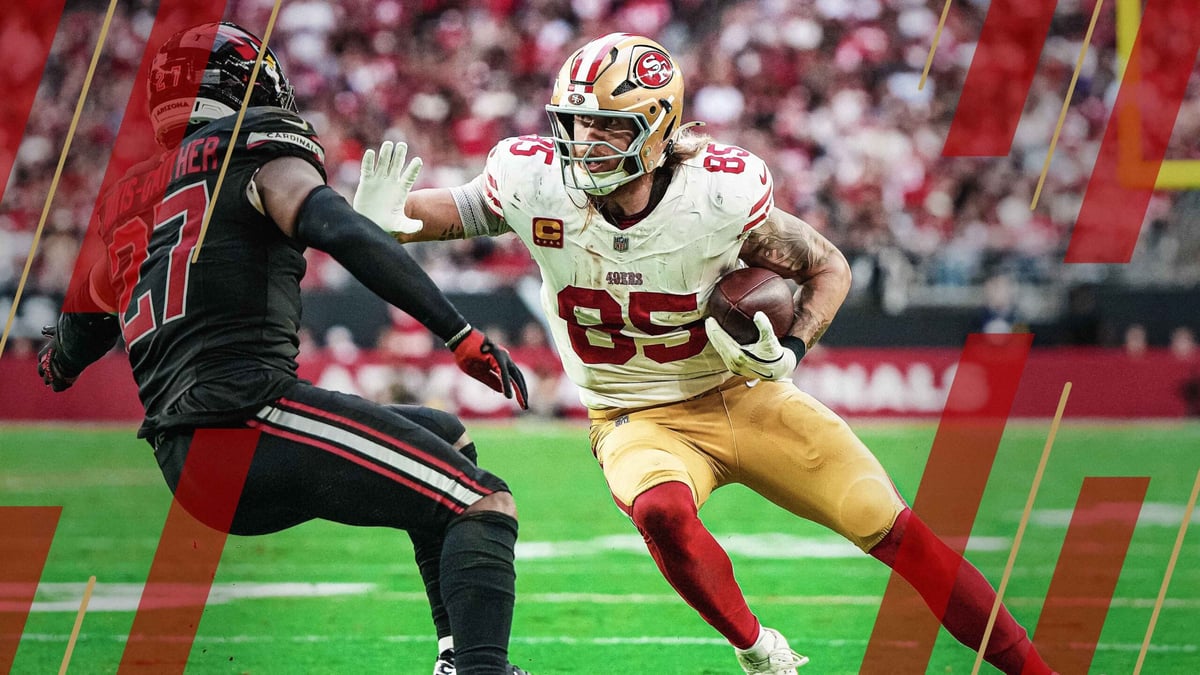
TE George Kittle, San Francisco 49ers (ADP: 7.11)
Kittle has been among fantasy's elite tight ends whenever healthy. He's finished among the top six tight ends in fantasy points per game in each of the past eight seasons, including two first-place, two second-place and two third-place finishes.
He's spent his career in Kyle Shanahan's run-first offenses, but he's remained a focal point of them. His 2.27 career yards per route run is the best among all tight ends over the past 20 seasons. Since Brock Purdy took over at quarterback, he's been the league's top tight end on intermediate and deep passes. He has 78 receptions, 1,616 yards and 15 touchdowns on passes of 10 or more air yards, leading all tight ends in each, with nearly 500 more yards than the next-closest.
Kittle's problem throughout his career has been injuries. He's played every game in a season just once, in 2018. Most recently, a hamstring injury cost him five games early in the 2025 season, and then he tore his Achilles tendon in the 49ers‘ wild-card game.
The Achilles injury makes it questionable whether he'll be the same player he has been. He's pushing to play Week 1, but being ready to play and being productive in fantasy are two different things. He returned in Week 7 last season but caught just eight passes for 75 yards over his first three games back. He gained at least 60 yards in each of the following six games.
This is a more serious injury. Even if he plays Week 1, it might not make sense to start him in fantasy leagues. Kittle will also turn 33 early in the season, and it would be understandable if his quality of play took a step back even without the injury.
Kittle is the last tight end anyone can draft with overall TE1 upside, but whoever drafts him will also need a second, less volatile option.
QB Trevor Lawrence, Jacksonville Jaguars (ADP: 8.04)
Lawrence spent four years as the Jaguars' starter to mixed results, with some stretches where he looked like a Pro Bowl-caliber quarterback and others where he played like a backup. In 2022 and 2023, his fantasy production made him a high-end backup. But in 2024, his passing yards per game fell by more than 45 amid lower volume, and then an injury cut his season short.
He became a top sleeper quarterback in 2025 after the Jaguars hired Liam Coen as head coach and drafted Travis Hunter with the second overall pick to pair with Brian Thomas Jr., who mostly excelled after Lawrence's injury. Lawrence finished fourth in fantasy points and sixth in points per game at 20.6, though that owed more to his connection with Parker Washington, Jakobi Meyers and Brenton Strange than to Thomas and Hunter. Lawrence also set career highs in rushing attempts, rushing yards and rushing touchdowns.
Some regression in Lawrence’s nine rushing touchdowns is reasonable to expect, but his overall outlook should be similar to last season. Lawrence will have all five of his receivers available at once, allowing for a rotation and no single player for a defense to key on.
That should make Lawrence a top-10 option again, yet he is being drafted outside the top 10 since there are several quarterbacks to feel good about this season. That makes him a strong value at his current ADP.