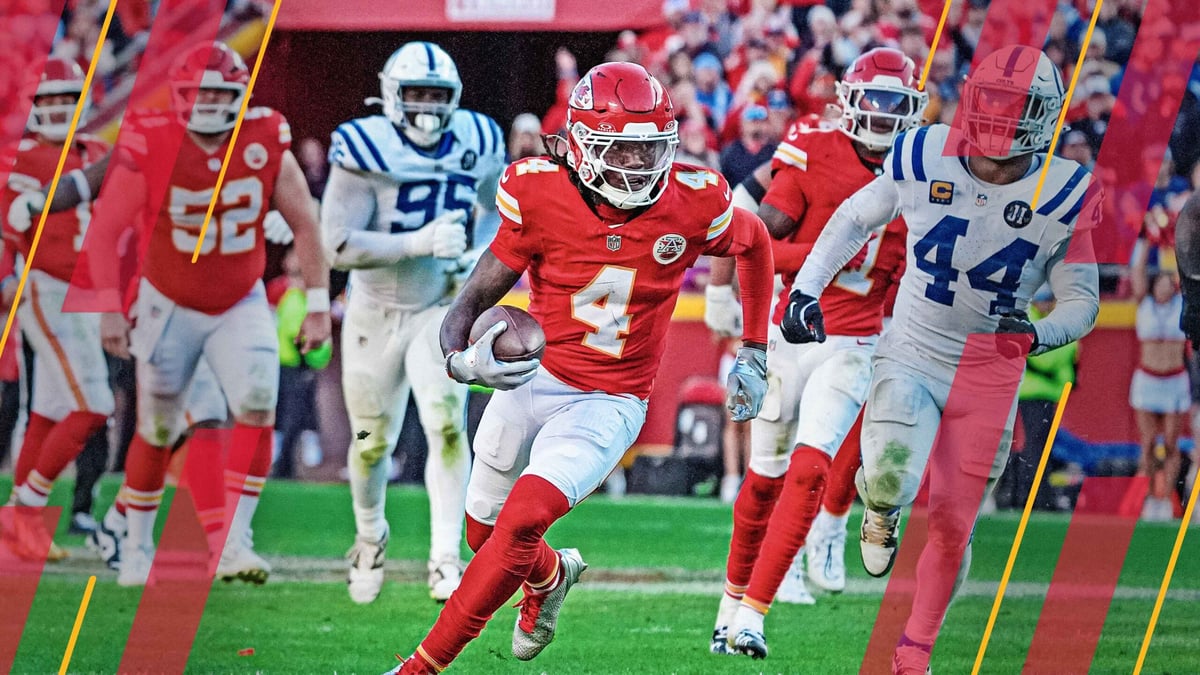
- Davante Adams faces touchdown regression: Adams scored a league-high 14 touchdowns last season, but his receptions and receiving yards per game were his lowest since 2015.
- Last Chance! The PFF Early Bird Sale Ends Aug. 17: Save 33% and get PFF+ for just $79.99, our lowest price of the year.
Fantasy football drafts are often driven by what players have done rather than what they are likely to do next. That can lead to players being overvalued when recent production overshadows changes in coaching, competition for touches and targets, expected regression or age-related decline.
The players featured here are being drafted as though they will largely replicate their recent production, but each has a clear reason to expect a decline in fantasy output. That doesn’t necessarily make them bad players or complete avoids, but their current draft prices don’t fully account for the downside.
The average draft positions below are a consensus of ESPN, Sleeper and Yahoo drafts for 12-team redraft leagues.
WR Rashee Rice, Kansas City Chiefs (ADP: 3.03)
Rice finished fourth among wide receivers in fantasy points per game last season at 18.8, despite playing only eight games. He missed the first six due to suspension and the final three because of a concussion.
His 77.2 receiving grade was relatively modest for a player with that level of fantasy production. Rice’s role has been remarkably consistent across his three seasons, with his average depth of target landing between 4.9 and 5.2 yards each year. He has thrived as a high-volume, short-area receiver who generates much of his value after the catch rather than downfield.
That role could change this season. The Chiefs replaced Matt Nagy with Eric Bieniemy at offensive coordinator, and Bieniemy’s offenses have historically featured wide receivers with deeper target profiles. During his first stint in Kansas City, most Chiefs wide receivers averaged more than 9.0 yards downfield per target. Even JuJu Smith-Schuster, who led the team’s wide receivers in targets during Bieniemy’s final season, had a 7.1-yard average depth of target. Curtis Samuel posted the same mark as Washington’s second-most-targeted wide receiver during Bieniemy’s lone season there. After Kansas City’s short-area passing attack produced mixed results last season, there is reason to believe the offense could become more aggressive downfield.
There are also concerns beyond Rice’s role. He has finished each of the past two seasons on injured reserve and underwent another procedure on his right knee during OTAs. He also served a jail sentence for violating the terms of his probation, costing him valuable offseason time. During his absence, rookie Cyrus Allen had an opportunity to build chemistry with Patrick Mahomes and could compete with Rice for snaps in the slot. Given Rice’s recent availability issues, Kansas City also has reason to avoid making the passing game as dependent on him as it has been in the past.
Rice’s ADP already accounts for some of this uncertainty, as he is no longer being drafted like a top-five wide receiver. Still, a third-round price assumes he will remain one of fantasy football’s most productive receivers when healthy. The combination of potential changes to his role, recurring availability concerns and increased competition makes that a risky assumption.
RB Cam Skattebo, New York Giants (ADP: 4.05)
Skattebo began his rookie season third on the Giants’ depth chart but was already playing more than 50% of the offensive snaps by Week 2. A Week 3 injury to Tyrone Tracy opened the door for Skattebo to start in Week 4. He averaged 19.2 fantasy points and 19 carries per game over his next four starts, maintaining a significant role even after Tracy returned two weeks later. That stretch ended in Week 8, when Skattebo suffered a season-ending injury that included a dislocated ankle, fractured fibula and ruptured deltoid ligament.
Skattebo was one of several rookie running backs held back by poor offensive line play. His 1.0 yards before contact per attempt tied for eighth-lowest among 49 running backs with at least 100 carries. Despite that, 26.7% of his carries resulted in a first down or touchdown, ninth-best at the position, while his 0.22 avoided tackles per carry also ranked inside the top 10.
The concern for 2026 is less about Skattebo’s ability and more about his opportunity. The Giants brought in a new coaching staff led by John Harbaugh and Matt Nagy, both of whom have long histories of utilizing running back committees, including three-man rotations.
The preseason opener provided an early example of what that could look like. Skattebo started, but Tracy and Devin Singletary both rotated in with the first-team offense. Skattebo remains the favorite to lead the team in carries, but his workload could be significantly less secure than it was during his four-game stretch as the starter last season. Tracy also handled most of the passing-down work, which is particularly important for a Giants team that could frequently find itself playing from behind.
Skattebo proved last season that he can produce like a high-end fantasy running back with enough volume. The question is whether that volume will still be there. Between his return from a significant injury and the possibility of a three-man committee, he carries enough workload risk to make his fourth-round ADP difficult to justify.
WR Davante Adams, Los Angeles Rams (ADP: 4.12)
Adams has been a fantasy starter at wide receiver for a decade. He gained at least 880 receiving yards every season from 2016 to 2024 and reached double-digit touchdowns in most of them. But he will be 34 before the season ends, and his days as a top-10 fantasy receiver are likely over. His play has already begun to slip: He earned PFF receiving grades of 87.0 or better each season from 2017 to 2022, but that has fallen to 84.0 or lower in each of the past three.
Adams joined the Rams last season, where he averaged 4.3 receptions and 56.4 yards per game, his lowest marks since 2015. He landed in an offense built around Puka Nacua, on a team that often won and ran out the clock late. Los Angeles also leaned into 13 personnel down the stretch, and Adams was on the field for only 28.3% of its 13-personnel snaps when healthy.
Despite the dip in receptions and yardage, Adams still finished as a top-10 fantasy receiver in points per game because he scored a league-high 14 touchdowns. He saw 57.4% of the Rams' end-zone targets, the highest share among wide receivers, drawing 25 end-zone targets and converting 13 into scores. Both were the second-most for a receiver in a season over the past 20 years, trailing only Randy Moss in 2007.
The problem is that end-zone touchdowns aren't reliably consistent from one season to the next. No wide receiver in the past 20 seasons has posted back-to-back years with double-digit end-zone touchdowns. If Adams matches his receptions and yards per game but scores five fewer touchdowns, he falls from top-10 in fantasy points to 25th.
Terrance Ferguson, a 2025 second-round tight end, is expected to take on a bigger role this season and should be a red-zone threat of his own. Adams should still be an asset to Los Angeles in its pursuit of another Super Bowl, but his footing as a fantasy starter gets shakier if his role shrinks and the touchdowns regress. He could be a frustrating WR3, with big weeks when he finds the end zone and quiet ones when he doesn't.
QB Lamar Jackson, Baltimore Ravens (ADP: 3.08)
Jackson is the highest-risk, highest-reward quarterback in the top five. He is the only quarterback to ever average 25 fantasy points per game in multiple seasons — having done so in both 2019 and 2024 — and he has won the NFL MVP twice while nearly claiming a third in 2024.
The concern is his declining rushing volume. Jackson averaged double-digit carries per game from 2019 through 2021 before falling to 9.3 in both 2022 and 2023, 8.2 in 2024 and just 5.2 in 2025. Some rebound is reasonable to expect, but a return to his peak rushing workload is not.
His passing efficiency has remained strong, as he has averaged more than 8.0 yards per attempt in each of the past three seasons. However, his sack rate climbed to a career high in 2025, contributing to a decline in passing volume compared to the previous two seasons.
The Ravens also overhauled their coaching staff, hiring Jesse Minter as head coach and Declan Doyle as offensive coordinator. Doyle spent 2025 with the Chicago Bears but did not call plays under head coach Ben Johnson, making 2026 the first season he will run his own offense. At 29, he is one of the youngest and least experienced play-callers to inherit an elite quarterback, and some growing pains are to be expected.
Baltimore also lost several notable offensive players in free agency, including center Tyler Linderbaum, tight ends Isaiah Likely and Charlie Kolar, wide receiver DeAndre Hopkins and fullback Patrick Ricard. The offense now leans on Derrick Henry, Mark Andrews and Ronnie Stanley, all of whom are on the wrong side of 30. Baltimore also used seven draft picks on offensive players, and how quickly those rookies contribute will meaningfully affect Jackson's floor and ceiling in 2026. Even with his league-winning upside, the uncertainty surrounding his rushing workload, new coaching staff and supporting cast makes his top-five price difficult to justify when similar upside is available several rounds later.
RB TreVeyon Henderson, New England Patriots (ADP: 5.08)
Henderson was drafted 38th overall in the 2025 NFL draft by the Patriots. Several had lofty expectations that he could take over the backfield, but his offensive coordinator was and still is Josh McDaniels. McDaniels has been a head coach or offensive coordinator for 19 seasons in the PFF era, and in 18 of them, the running back who led the team in rushing yards was not the one who played on third downs.
Henderson began the season in a three-man rotation. Known in college as a receiving back, he actually played more on early downs than on third downs. A few weeks in, it looked like his role would grow after a season-ending injury to Antonio Gibson, but it shrank instead because of inefficient play. An injury to Rhamondre Stevenson then made Henderson the starter throughout November.
Henderson had one especially dominant two-week stretch. In the first game, he ran 14 times for 147 yards and two touchdowns, then scored three times the following week. Even with Stevenson back, the rookie held a decent role through the rest of the regular season, though partly thanks to some blowout wins. In the playoffs, Henderson played 40% of snaps or fewer and averaged just 2.5 yards per carry.
New England didn't re-sign Gibson or make any other meaningful changes to the backfield, so both Stevenson and Henderson should have significant roles. Stevenson graded better as a runner, receiver and pass-blocker. If the two play at the level they did last season, Stevenson should remain the primary back, and Henderson would carry fantasy value mainly when the Patriots are blowing opponents out.
Henderson is a good bet to improve, though. He was known for his receiving in college, but his pass protection likely kept him off the field in some passing situations. If he sharpens as a pass-blocker this offseason, he could see more receiving work, in which case both backs could be weekly fantasy starters.
There is also a path where Henderson takes a slight majority of the carries, Stevenson does the dirty work and Henderson handles most of the passing-down work, which would make Henderson a weekly must-start. That would be a deviation from how McDaniels has typically split his backfields, so it is the less likely of the two scenarios, but Henderson's receiving talent makes it a real possibility.