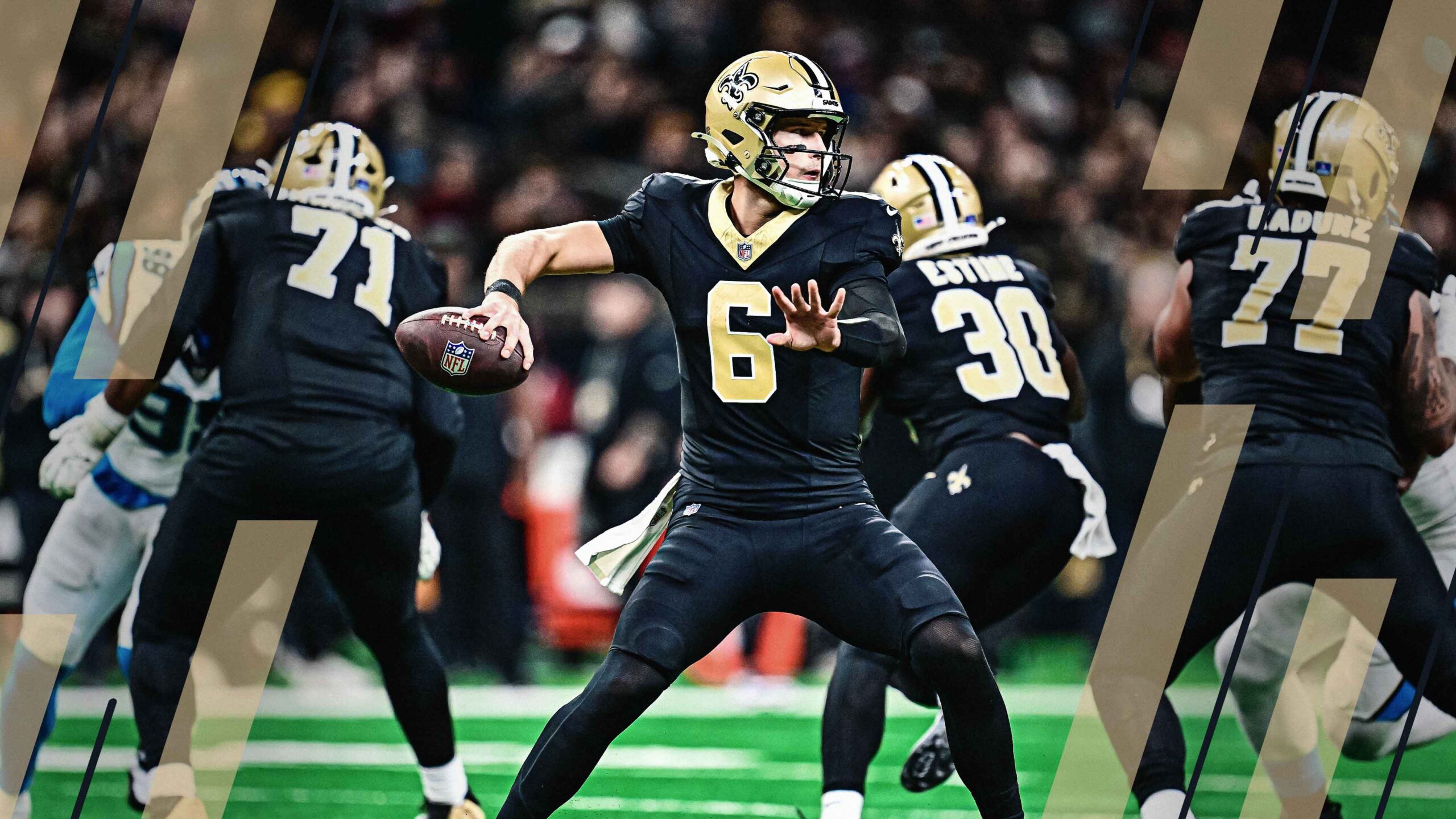
- Chris Olave thrived with Tyler Shough under center: From Weeks 1 to 8, Olave was averaging an unremarkable 62 yards per game and had just three touchdowns on the season. With Shough, he scored six touchdowns in the final eight weeks of the season and didn’t log a single PFF receiving grade below 60.0.
- 2026 NFL Draft season is here: Try the best-in-class PFF Mock Draft Simulator and learn about 2026's top prospects while trading and drafting for your favorite NFL team.
Estimated Reading Time: 6minutes
🏈 Draft Season 2026Prepare for the 2026 NFL Draft with PFF+
Your complete draft preparation toolkit
Mock Draft Simulator 2026 NFL Draft Big Board Big Board Builder NCAA Premium Stats SubscribeThis very author had a fantasy football week where he had to start Kirk Cousins and Max Brosmer in a superflex league. That is called the trenches.
When a starting quarterback goes down, our first thought after “I hope it’s not serious” often turns to our fantasy teams.
Backup quarterbacks bring with them an uncertain fantasy outlook — and that isn’t always a bad thing. But how exactly does it impact the production of those around them?
For this exercise, we’ll be looking at quarterbacks who logged at least 150 dropbacks in the 2025 regular season. Ten teams this season had at least two quarterbacks reach that mark, with the Cleveland Browns and New York Jets having three each hit the threshold.
We’re also not including Week 18 due to most fantasy championship games taking place in Week 17. Plus, if a team had locked in a playoff spot, then the second-stringer probably got more snaps in Week 18, along with other backups.
Firstly, let’s look at which backup quarterbacks produced from a fantasy standpoint on average. The disclaimer here is that the swings may be wild, not just because of the quality of the quarterback but also because some backups played around only 150 dropbacks, while others, such as Jacoby Brissett, played the majority of the season but began as a backup.
PlayerGamesFantasy Rk.Pass TDsRush TDsPPR PointsJacoby Brissett13QB15231241.4Kirk Cousins9QB35101110.5Dillon Gabriel10QB407072.1Shedeur Sanders8QB377196.9Davis Mills6QB425165.0Carson Wentz5QB396073.3Tyler Shough10QB2792143.2Tyrod Taylor6QB415166.5Brady Cook4QB491028.4Mac Jones8QB29130138.0Marcus Mariota10QB30101136.5Naturally, you can’t read too much into the final standings of these quarterbacks, but it is interesting to see where each ranked. Wentz playing in five games yet finishing a spot higher than Gabriel, who played in 10, is quite something.
Fantasy owners of Justin Jefferson were probably feeling slightly more optimistic when Wentz filled in for J.J. McCarthy due to the latter’s slow start to life as an NFL signal-caller.
During Wentz’s five-game stint as the starter, Jefferson logged double-digit targets in each outing. That happened only twice the rest of the season. Jefferson also notched two of his three 100-plus-yard receiving games with the former Philadelphia Eagle at the helm, the final one coming in Week 18.
Jefferson logged just two WR1 finishes during the season — not including Week 18 — and both came with his backup slinging him the ball (WR8 in Week 4 and WR11 in Week 5). His highest finish after that was the WR19.
That fluctuation in production cannot be said for the San Francisco 49ers, who had to battle through half of the season with Mac Jones. Filling in for Brock Purdy, Jones threw for 2,151 yards, 13 touchdowns and six picks on his way to a very respectable 77.1 PFF overall grade.
Purdy, meanwhile, notched 2,167 passing yards, 20 touchdowns and 10 picks on his way to an elite 90.0 PFF overall grade.
The 49ers' offense hummed regardless of who was at the controls, and it didn’t seem to impact their top offensive weapon, Christian McCaffrey.
McCaffrey had seven top-10 weekly position finishes across Jones’ starts, including two RB1 overall finishes in Weeks 7 and 9. The former Carolina Panther averaged 17 rushes a game with Jones at quarterback, as well as six catches.
With Purdy, that average was 18 rushes a game and five catches. The split was nearly identical, perhaps further strengthening head coach Kyle Shanahan’s case as the best quarterback-agnostic play-caller in the league. And for fantasy managers, it was a sign of relief.
Read More Stories Explore PFF Tools 9 min read Quick Read Preparing for the rookie draft — and utilizing your draft picks — is one of the key parts of the year-round commitment that is dynasty fantasy football. Fantasy Football: How to use dynasty draft picks By Ryan Conway 8 min read Quick Read Watson missed half of the 2025 season, but his 17-game pace is that of a top-tier fantasy receiver. Williams continues to showcase unparalleled explosiveness, flashing an abilit… Fantasy Football: Why Christian Watson, Jameson Williams could be top-10 fantasy receivers in 2026 By Ryan Conway 7 min read Quick Read Dynasty fantasy football values can shift in the blink of an eye. Some players fail to make good on their projections, while others come out of nowhere to propel your roster. Fantasy Football: Biggest dynasty value swings of the 2025 season By Ryan Conway 13 min read Quick Read Top wide receiver picks in the NFL draft are generally strong bets to produce in fantasy football. Fantasy Football: What should we expect from first-round wide receivers? By Ryan Conway Try the tool Mock Draft Simulator Make picks, trade up, and run your own draft in minutes. Build your board Big Board Builder Create custom rankings with Scouting Mode at the core. More Coverage Mock Draft Simulator Be the GM for any team in the 2026 NFL Draft with a fully immersive simulation that lets you trade picks and players for a realistic, in-depth draft experience. 2026 NFL Draft Big Board Trevor Sikkema’s personal rankings, complete with three-year player grades, position rankings and in-depth scouting reports for the top prospects in the class. Big Board Builder Create your own customized draft rankings, with Scouting Mode at its core — a fully customizable grading system that puts the entire evaluation process in your hands. NCAA Premium Stats Our exclusive database, featuring the most in-depth collection of NCAA player performance data.Chris Olave was another huge beneficiary of a quarterback change. The New Orleans Saints rolled into the season with Spencer Rattler at quarterback, and from Weeks 1 to 8, Olave was averaging an unremarkable 62 yards per game and had just three touchdowns on the season.
The Saints' pass catcher also earned two sub-60.0 PFF receiving grades in that span (59.2 in Week 4 against the Bills and 51.8 in Week 8 against the Buccaneers).
Once Tyler Shough entered the lineup, things changed.
Olave logged all three of his 100-plus-yard receiving games with the second-round rookie at the helm, and he scored six touchdowns in the final eight weeks of the season and didn’t log a single PFF receiving grade below 60.0. He even garnered an elite 88.5 mark in Week 17 against the Titans.
In fantasy circles, it still made Olave slightly volatile, and he had some duds, such as a WR50 finish in Week 14 against the Buccaneers. But here are his weekly finishes with Shough at quarterback:
- Week 9: WR45
- Week 10: WR5
- Week 12: WR17
- Week 13: WR18
- Week 14: WR50
- Week 15: WR9
- Week 16: WR2
- Week 17: WR2
Before that, Olave’s best weekly finish was as the WR17 in Week 6, but it was the hot end to the season that saw him end the season as the WR6 overall. That was probably an unthinkable outcome when the Saints entered the season with Rattler and Shough as their quarterbacks.
The bottom line is that while it’s never ideal to see a starting signal-caller go down injured, it doesn’t necessarily mean that the production of the skill players around them will slip.
In some cases, there may be a huge jump in production due to the backup feeding targets or touches to the best offensive player.
It may not be reflected in the weekly finishes for those quarterbacks stepping in, but whatever production they have is going to come by way of the team’s best offensive player — which means you could be in line for a fantasy bump.