Estimated reading time: 11 minutes
The process matters — in the draft and in trading. Get the tools serious traders use at tastytrade — tastytrade.com/PFFThe NFL draft is weeks away. While this is not a strong running back class relative to the previous year, a few running backs will factor into running back rotations this season, and several others have a shot to join a rotation. The order is how they should be drafted in dynasty rookie drafts, although for now, the rankings are nearly identical for redraft leagues.
Here are my top 20 running backs from this season's class, with fantasy analysis on the top eight players, and links to the draft guide for 17 of the players. Stats referenced in this article are how players performed over the last three seasons, and the players are compared to the other 19 players in the rankings.
RankPlayerSchoolDraft Guide LinkFantasy Analysis1Jeremiyah LoveNotre DameDraft GuideDetails2Jadarian PriceNotre DameDraft GuideDetails3Mike Washington Jr.ArkansasDraft GuideDetails4Jonah ColemanWashingtonDraft GuideDetails5Emmett JohnsonNebraskaDraft GuideDetails6Nicholas SingletonPenn StateDraft GuideDetails7Kaytron AllenPenn StateDraft GuideDetails8Demond ClaiborneWake ForestDraft GuideDetails9Seth McGowanKentuckyDraft Guide10Le'Veon MossTexas A&MDraft Guide11Kaelon BlackIndianaDraft Guide12J'Mari TaylorVirginiaDraft Guide13Desmond ReidPittsburghDraft Guide14Adam RandallClemsonDraft Guide15Roman HembyIndianaDraft Guide16Robert Henry Jr.UTSA17Jaydn OttOklahomaDraft Guide18Jam MillerAlabamaDraft Guide19Noah WhittingtonOklahoma20Dean ConnorsHouston1. Jeremiyah Love, Notre Dame
Love is a top-five player on PFF's predictive big board and is generally expected to be drafted among the first 10 picks. Generally, running backs in that range have found immediate fantasy success. If a team is willing to spend that high of a pick on a back, it will often receive significant volume in its rookie season, regardless of efficiency.
Ashton Jeanty, Bijan Robinson and Jahmyr Gibbs are the only running backs who have been selected among the first 20 picks in the last five seasons, and all three finished in the top 12 in their rookie season. The other first-round picks include Najee Harris, who was RB3 his rookie season, in addition to Omarion Hampton and Travis Etienne, who dealt with injuries during their rookie seasons.
One reason why Love stands out so much is his receiving. While others have compiled larger stat totals over the last few seasons, Love has a 79.2 PFF receiving grade, which is second-best among the top 20 running backs. This will help whichever team drafts him, as well as his fantasy value.
Love is the clear top pick in dynasty rookie drafts, assuming he gets selected among the top 10 picks of the NFL draft. He will also be considered a top 15 running back in redraft leagues.
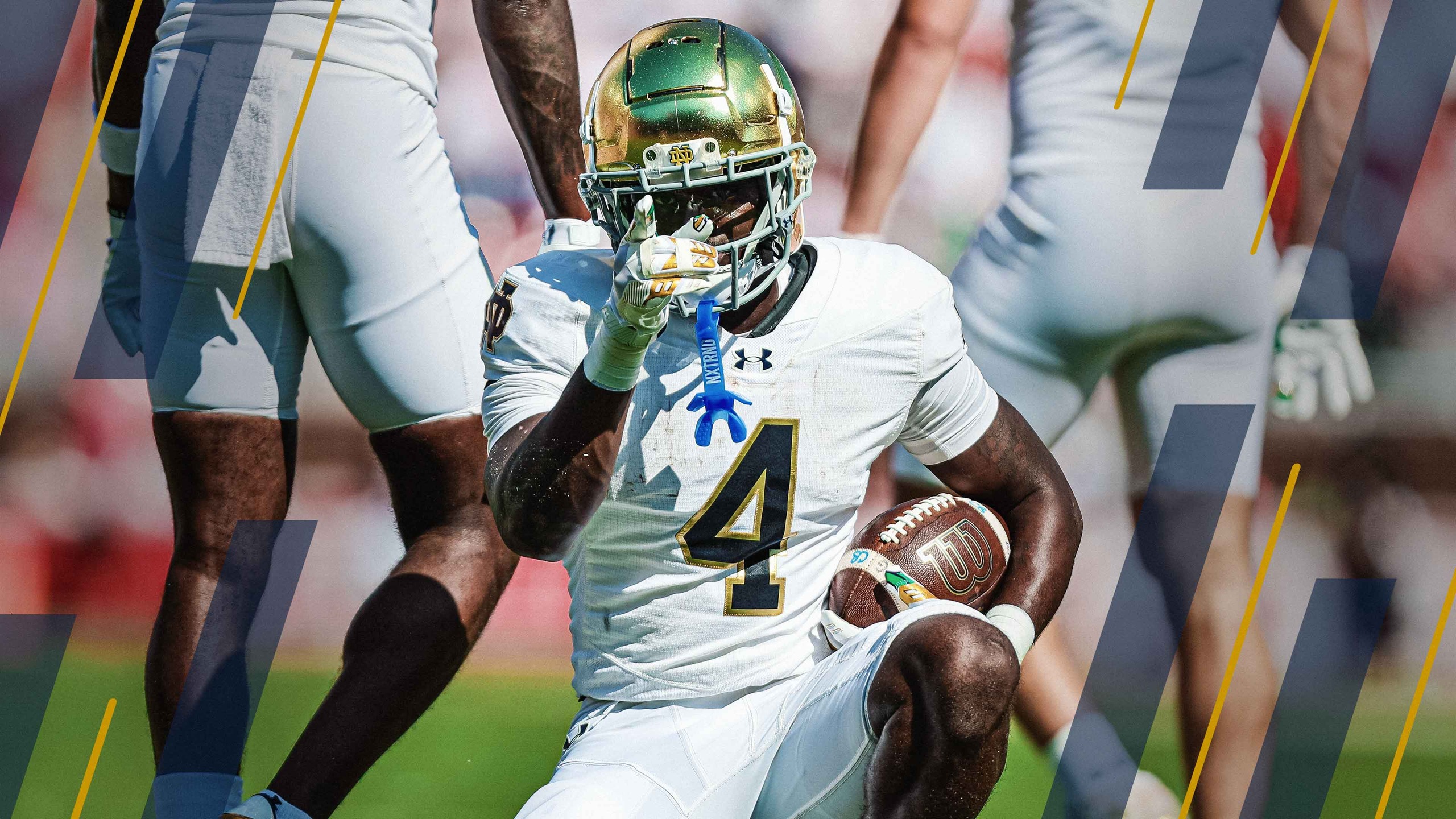
2. Jadarian Price, Notre Dame
Price has emerged as the second-best running back of the class, despite being a backup last season. He has the least collegiate experience among the top-10 running backs of the class, but his 6.0 yards per carry were second-best among the top-20 running backs behind Love. He is tied for the most yards after contact per carry at 4.3.
Where he really stands out is his rate of making big plays. He has both the best rate of runs with a 1.5 grade or better, as well as the highest rate of runs with a 1.0 grade.
His inexperience is a red flag, particularly as a receiver. He has 15 receptions over the last three seasons. His 9% targets per route are by far the lowest among the 20 running backs. However, our draft guide notes his strength and willingness as a pass protector could still make him a three-down back.
The combination of the likely draft capital spent on him and the fact that he is the most likely three-down back outside of Love leaves him second on this list.
3. Mike Washington Jr., Arkansas
Washington’s statistics are in the middle of the pack for running backs in this class. His runs lasted for at least 10 yards on 18% of his carries in his final year, after jumping from one school to the next. However, he has the potential to be a great early down back.
He’s 6-foot-2 and 228 pounds, making him one of the biggest running backs in this draft class. The only running backs of that size or larger to see at least 1,000 snaps over the last eight seasons are Derrick Henry, Latavius Murray and Brian Robinson. Where Washington stands out is his speed relative to his height. He ran a 4.33-second 40-yard dash at the combine, and the tracking data backs up. He is the most athletic and best at accelerating in the draft class. Even without accounting for size, he is among the faster running backs of the draft class.
He’s fumbled seven times on his carries in the last three years, which is the most for the top 20 running backs. He’s also posted an above-average drop rate. Those ideally won’t be a problem in the NFL, but it is more likely to be a problem for Washington than most backs.
Washington will probably only be a two-down back in the NFL, but there are plenty of running backs who have been fantasy starters in a two-down role.
4. Jonah Coleman, Washington
Coleman stands out among running backs in this class for a variety of reasons. He is the third-highest graded runner of the top 20 running backs with a 95.1 PFF grade. His 4.3 yards after contact per carry are tied with Jeremiyah Love and Jadarian Price for the best in the class. Coleman’s is arguably more impressive, finishing with 1.3 yards before contact per carry, which were the lowest in the class. His 148 avoided tackles on carries are the most among running backs in the class. He has 249 pass-blocking snaps, which makes him the most experienced pass blocker of the top running backs of the class.
He is also a unique size for a running back, listed at 5-foot-9 and 220 pounds on Washington’s website, and weighed at 228 pounds at the combine. No current NFL running back weighs that much while being that short. Doug Martin is the best comparison to Coleman’s unique size, who has found success in the NFL in the last 20 years.
In a league full of speedy running backs, Coleman’s size could help him stand out, particularly at the goal line. His ability to score touchdowns helps give him an early lead over the other running backs with an expected similar ADP.
5. Emmett Johnson, Nebraska
Johnson is one of the most well-rounded running backs of the class. His most likely role with an offense will be as a third-down back, but among the several likely third-down backs of the class, he is the most likely player to also be able to handle a role on early downs.
He avoided 33 tackles as a receiver, which is second-most among running backs. He averaged over 30 receiving yards per game in his final college season. Our draft guide notes his footwork and vision, which helped him to success in college. Our player comparison for him was Tyjae Spears, and others have also compared him to running backs who mostly played on third downs, but were also able to find some role as a runner at some point in their careers.
Johnson will need to improve as a pass protector in order to find a significant role as a rookie. His upside is potentially higher than some backs ranked ahead of him, if he can become a three-down back, but his floor is also lower, because he might only be a receiving back.
6. Nicholas Singleton, Penn State
Singletary is a unique back in that he is among the bigger running backs in the class, as well as one of the most experienced as a receiver, which is a rare combination. He would be ranked higher, except his rushing production wasn’t as strong as it should be.
Singletary measured at 6 feet and 224 pounds, making him the fourth-largest back of the class. He’s reached 20 miles per hour as a runner or running a route 10 different times, which is tied for third-most in the class. This gives him a unique combination of strength and speed.
He’s also gained 901 yards as a receiver over the last three seasons, which is second-most in the class. He’s not only had volume, but also efficiency with 1.58 yards per route run, ranking third-most.
The problem is he only averaged 3.1 yards after contact per carry, tied for fourth-lowest. He’s avoided 0.16 tackles per carry and 0.15 per reception, which was lowest and fourth-lowest, respectively. Our draft guide notes “inconsistent patience and creativity with the ball limit his ceiling.“ If he is able to learn to be a better runner, given his physical gifts, he could be among the best running backs in the class. If not, then he likely won’t last long in the NFL.
7. Kaytron Allen, Penn State
Allen is arguably the most accomplished runner in the draft class. His 601 attempts and 3,303 rushing yards over the last three seasons are the most among running backs in the draft class. He gained a positive grade on 52.2% of his runs, which was the second-best rate for all running backs behind Jeremiyah Love, which is particularly remarkable given his volume.
While Allen has played well, his profile doesn’t necessarily project to the NFL. He’s among the slower running backs in the class, which makes sense given his size. He hasn’t accomplished much as a receiver. His 0.64 yards per route run are the fewest among the top 20 running backs in the class.
Similar to other running backs his size, he is better than most running backs on non-perfectly blocked plays, and worse than most on perfectly blocked runs. This combination makes it unlikely he will ever be a top-10 fantasy running back, but running backs of his experience and strengths should be able to find a role in an offense, and that role could involve scoring a lot of touchdowns.
8. Desmond Claiborne, Wake Forest
Claiborne is one of the more experienced running backs of the class, but doesn’t have as good of production, in part due to Wake Forest’s offense. His 1.6 yards before contact per attempt is tied for the third-fewest among running backs in the class.
The reason he is this high on the list is his speed. Per tracking data, he is the second fastest running back among the top 15, only behind Jeremiyah Love. The one area he’s stood out statistically is how successful he’s been when changing his point of attack, averaging 4.6 yards per carry, which is in the 88th percentile of FBS running backs. Our draft guide agrees that his ability to change direction is one of his strong points.
Given his speed, he might be used more as a receiving running back or gadget player. This makes it unlikely he will see significant volume, but ideally, he becomes one of the better receiving backs in the NFL, and pairs that with just enough rushing volume to be fantasy-relevant.