Gibraltar border
'Freedom of movement in Gibraltar will be absolute'“We must turn the page, but it will take generations for the siege to which Spain subjected us to be forgotten,” says chief minister Fabian Picardo of the agreement to tear down the fence
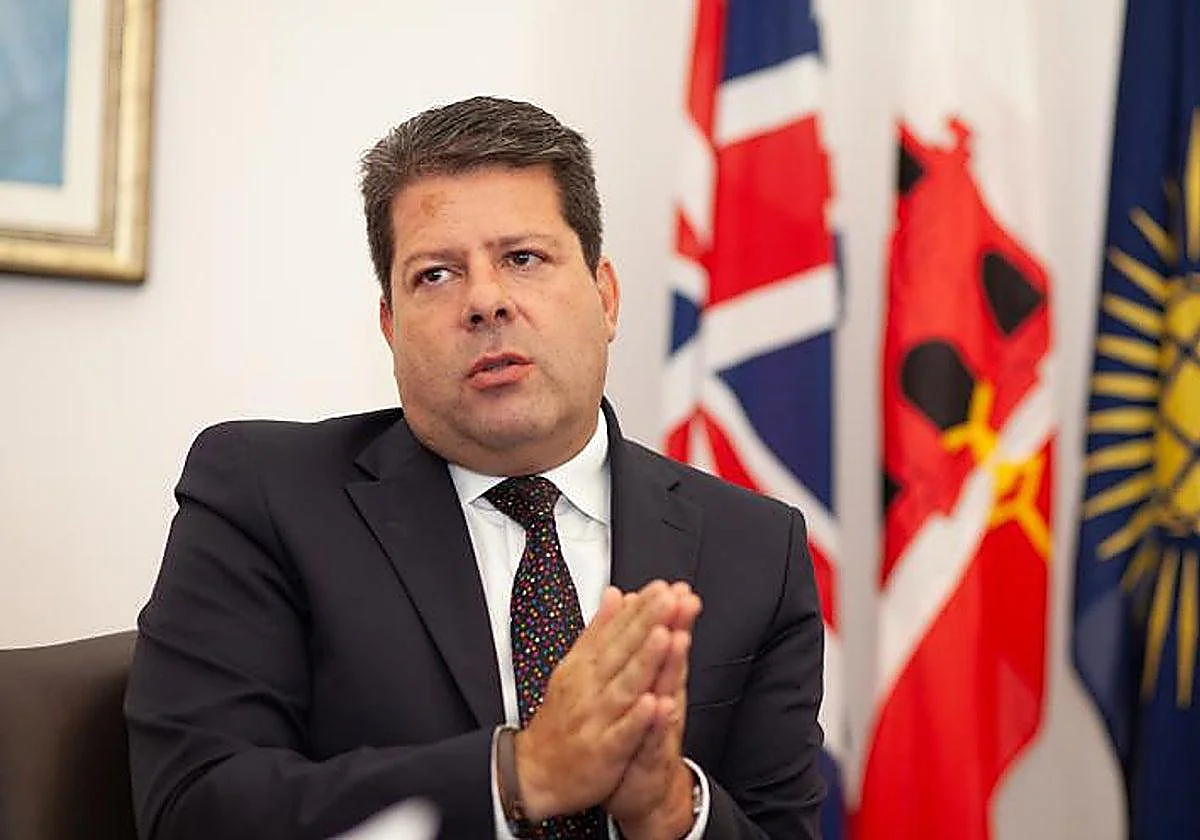
Añádenos en Google Chief Minister Fabián Picardo. (RC) 14/07/2026 a las 17:50h.Fabian Picardo is the Chief Minister of Gibraltar and one of the creators of the Treaty that will come to fruition on Wednesday with the ... dismantling of the fence that has shaped the lives of thousands of families on both sides of the border for decades.
About to step down from office after almost 15 years in the chair at Number 6 - the Gibraltar equivalent of Downing Street - he has no doubts about the benefits of the agreement: “It would be madness to backtrack.”
– Does the Treaty mean that you’re joining the Schengen Area, or is it not quite that simple? What has changed?
– It’s not quite that simple: we’re going to have an agreement with the Schengen Area, but without actually being part of it. We are going to create an area of free movement between Gibraltar’s immigration jurisdiction and that of the Schengen Area. For the average person travelling between Gibraltar and Spain - which is part of the European Union - it will, for all practical purposes, seem as though both territories are part of the Schengen Area. Freedom of movement will be absolute.
– Does this agreement mean any change to the sovereignty regime?
– No, not at all. Neither Gibraltar nor the United Kingdom nor Spain are considering it; Spain has maintained its claim, however outdated it may seem to me.
– The fence has strained relations between the two communities for far too long.
– The physical border is one thing, and the psychological border is quite another. And if you ask me whether we are going to forget the last siege Franco subjected us to – tearing families apart in the most brutal manner, which in itself constitutes torture – the answer is no. But I’m not just talking about us, the people of Gibraltar; I’m also talking about the whole of the Campo de Gibraltar, whose lives have been scarred for life by the Verja. It will take generations for us to turn the page.
– Brexit hasn’t done you any favours. How do you view the attempts at rapprochement between the British and EU authorities?
– I have always been in favour of the United Kingdom remaining in the European Union. I frankly considered what happened in 2016 and the subsequent withdrawal in 2021 to be an almost suicidal act. I am confident that the agreement coming into force on Wednesday will help bring London and Brussels closer together, and that in the future we will once again be part of the European Union. That would be a good thing, although I fear it will be years before that happens.
– There are currently more than 16,000 cross-border workers, 70 per cent of whom are Spanish. What does this change mean for them?
– For you and for us, we’ll have the chance to live our lives without a border dividing us. We’ll only have to worry about whether there’s more or less traffic, but not about all those bureaucratic checks that used to affect our daily lives. For a long time, we’ve lived knowing that whenever Spain played a match or the UK won Miss World, it meant longer queues and waiting times. But that’s over now. Politics is there to make life easier for citizens, not to turn their lives into an obstacle course, as others have done before.
– The Treaty includes a number of fiscal measures, including, among others, the introduction of a 15 per cent tax equivalent to IVA on goods. Crossing the border to buy alcohol or tobacco will no longer make sense.
– I don’t think so, because we’re not just talking about prices, but also about quality. The alcohol and tobacco are different from what you can find in Spain. Whisky, for example, is the original Scottish whisky. What’s more, those products were already taxed in Gibraltar, so the price difference wasn’t that big any more.
– There are no military bases in Gibraltar, but there is a British contingent. What will the relationship with the Spanish army be like?
– Well, the Constitution of Gibraltar does not give me any powers in military matters, but I hope that relations between the British and the Spanish in Gibraltar will be as good as they are in other parts of the world. It’s only here that there seems to be a sort of ‘Bermuda Triangle’ where there is no communication. I hope this is a thing of the past and does not set the tone for what lies ahead.
– Would you say that the main stumbling block in the negotiations has been the question of which police force will man the border crossing? Because we will now see national police officers at the port and the airport, but they will be acting in their capacity as European officers.
– No, because that clause forms part of the New Year’s Eve Agreement signed five years ago. Spanish National Police and Guardia Civil officers will be carrying out immigration and customs duties for the Schengen Area and the European Union in an area of the airport that will be jointly administered by Spain and Gibraltar, and where Gibraltar Police will also be present. I think it’s an ingenious solution that has been in the works for some time. Everyone can see that it is designed not to create any sovereignty issues for either Gibraltar or Spain.
– Speaking of the airport, it currently has only four or five daily flights to London, Birmingham, Bristol and a few other destinations. Will the agreement make it possible to expand the range of destinations?
– Spain has banned flights from the EU to Gibraltar for years. Now it has lifted that ban, and there is a possibility of flights to Madrid, Bilbao, Barcelona and even Berlin. And I hope that will be the case, that this airport will soon be used for the purpose for which it was designed.
– Applications for residency in Gibraltar have risen from 1,000 a year to 3,000 in just three months, to the extent that restrictions have been put in place to prevent the situation from getting out of hand.
– That’s right, last week we published a gazette setting out the new rules for becoming a resident in Gibraltar. We are going to be very thorough about who we allow to come here, because Gibraltar now has a great opportunity - it is very attractive - and we do not want just anyone coming here with no other aim than to set foot in the EU. It will have to be someone who can support themselves, who has a genuine economic and employment link with Gibraltar. We do not want to put a strain on the system, with people who do not contribute but still try to make use of public services. That would be a disaster for Gibraltar, and it was one of the first red flags that went up when we signed the agreement.
‘Justice has finally been served’
– On the other side of the border, people are being blamed for the rise in house prices in an area hit hard by unemployment.
– Shared prosperity leads to greater demand for housing and a rise in land prices. I agree with my great ally and friend Juan Franco - the mayor of La Línea - that this agreement creates as many opportunities as it does uncertainties and potential problems. We have to manage this properly, which is why the first thing we’ve done is to restrict residency, because otherwise the cost of land would rise even further, if that were possible. Remember that in Gibraltar, the price per square metre has soared to between 12,000 and 13,000 euros. That is a lot, and we must ensure that Gibraltarians can live in their own land.
– Relations with Spain have been through constant ups and downs, but it seems that it is with progressive governments that you feel most at ease.
– Let’s see, it wasn’t Spain’s first democratic government that opened the border; it was Felipe González’s first cabinet. Later, the Cordoba agreements were reached under Zapatero and were breached under Rajoy, and it was only under Pedro Sánchez’s government that we were able to finalise this. So yes, we’ve fared better with the left than with the right.
– Smuggling and illegal migration are taking their toll on the Campo de Gibraltar. Some believe that the treaty undermines the security provided by the border.
– Well, back when there was a border and you had to show your passport, three IRA activists slipped through to carry out attacks on a military band and a school in 1988. There was also an Al-Qaeda terrorist working here who was planning an attack in Algeciras and was coming and going every day. I think the border has given us a sense of security that hasn’t always matched reality, even though before the border opened, everyone used to leave their front doors open and their keys in the car. We all feel that way, and so do I – as someone who grew up under the closed border and who has sons and daughters of my own. Of course, security is a major concern, which is why we have recruited 50 new officers, installed cameras and implemented facial recognition systems linked to Interpol’s databases. Let there be no doubt that Gibraltar will be safer than ever.
Brexit
"To me, the UK's departure from the EU seemed like an act of suicide. I trust that the Treaty will help pave the way for a return at a later date"
Provocation
"There is freedom to protest here, but if anyone breaks the rules, the response will be a police one, not a political one"
– Spain removed Gibraltar from its list of tax havens with two weeks to go before the Treaty comes into force. What is your take on this?
– That justice has finally been done. Gibraltar didn’t deserve to be on that list, and if it was, it was for political rather than technical reasons. Incidentally, the first people to be adversely affected were cross-border workers, who had to pay social security contributions twice because they were on that list - in Spain and in Gibraltar. Now, those earning less than 60,000 euros will only have to pay once.
– The Treaty will be on a four-year trial period. Are you concerned that a change of government in Spain might derail it?
– What the Treaty says is that the work of the parties will be monitored over the next four years, and then there will be an opportunity to review it in order to tweak anything that hasn’t worked well. I believe the agreement is here to stay because it is a great opportunity for everyone. It would be madness to backtrack, and the people of the region would not forgive whoever was responsible, let alone for issues of sovereignty or rhetorical nonsense such as that seen on the Spanish far right. It is worth remembering that 300,000 people live here who vote in Spain and, as things stand, it is not in our interests to lose support along the way.
– What would happen on Wednesday if someone organised a demonstration chanting ‘Gibraltar is Spanish’ and crossed the border?
– Well, in Gibraltar, if you want to take part in a protest, you have the right to do so. Here we uphold freedom of expression; it’s enshrined in our Constitution and is in our very DNA. But such a demonstration must be registered with the police, and all the rules must be followed to organise it properly so that it does not lead to public disorder. And if that happens, it will no longer be a political issue, but a police matter.