3 min read
From Hampton to Mars: How NASA Langley Helped Land on the Red PlanetJoe Atkinson
Public Affairs Officer, NASA Langley Research Center
Charles G. Hatfield
Science Public Affairs Officer, NASA Langley Research Center
Jul 20, 2026 ArticleContents
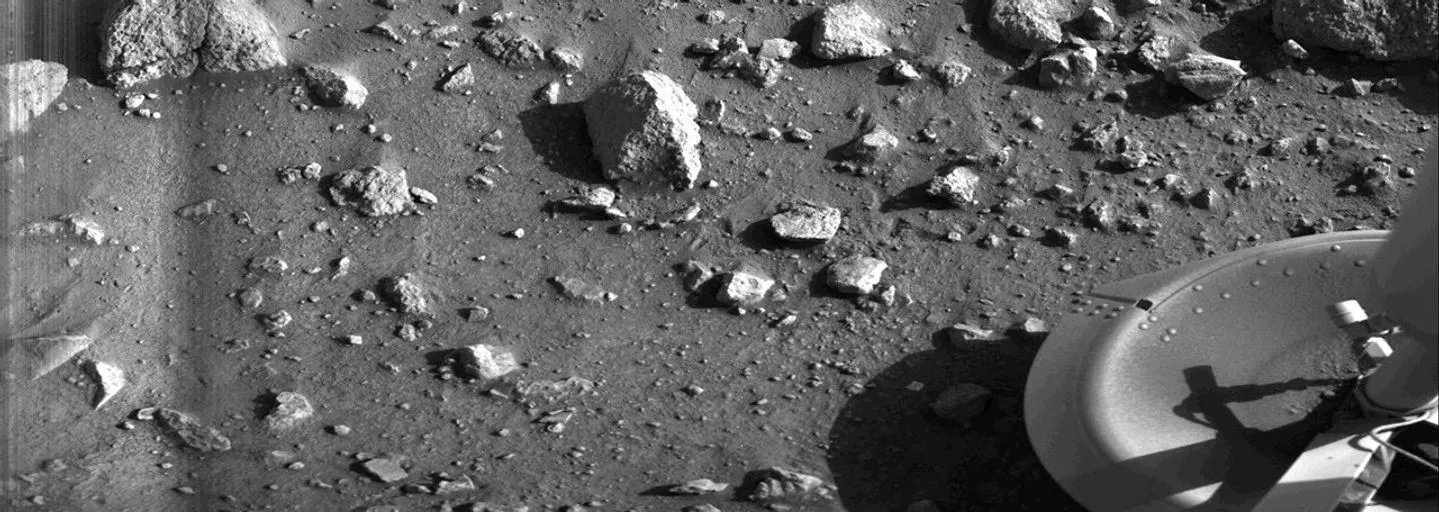
- This historic image — the first from the surface of Mars — confirmed that NASA’s Viking 1 lander had become the first spacecraft to touch down on the Red Planet on July 20, 1976. NASA/JPL-Caltech
Fifty years ago, NASA’s Viking 1 and 2 landers made the first successful landings on Mars, opening a new era in planetary exploration. Behind that achievement was a team at NASA’s Langley Research Center in Hampton, Virginia, whose steady leadership and technical expertise helped turn an ambitious idea into a mission that reshaped how we explore other worlds.
Building the Blueprint for Mars
NASA selected Langley in 1968 to lead the massive Viking project, the first U.S. mission designed to land safely on Mars and search for signs of life. Project Manager James S. Martin Jr. set the tone from the start. He wanted clear priorities, tough engineering reviews, and the discipline to test every system until the team was confident it would perform on Mars.
A full-scale Viking model is suspended in the air at NASA Langley’s Landing and Impact Research Facility. NASAEntry, Descent, and Landing
Langley engineers faced a challenge unlike anything attempted before: slowing a spacecraft plunging into the Martian atmosphere at more than 10,000 miles per hour. So they leaned into their expertise in atmospheric entry aerodynamics, heat shielding, and parachute technology. Their work produced the protective aeroshell and heat shield, as well as the supersonic parachute. These systems didn’t come from theory alone — they were shaped by years of wind‑tunnel tests, analysis, and problem‑solving. Langley still excels at entry, descent, and landing systems today.
Science and Safety, Hand in Hand
Langley also helped create a new approach to finding safe landing sites. Teams combined images from Viking’s orbiters with radar data from Earth‑based observatories to identify regions that balanced scientific value with engineering safety — a method now standard for Mars missions.
Viking also changed how mission teams operated. Engineers and scientists adopted the sol — a Martian day slightly longer than 24 hours — to keep daily work aligned with local time on Mars, a practice still used for surface missions.
From left to right, Dr. Thomas Mutch, Brown University, James Martin, Viking Project manager; and Dr. Gerald Soffen, Viking Project scientist talk at a Viking Science Review. NASAA Mission Reborn: From Voyager to Viking
Viking grew out of a pivotal program shift. The earlier Voyager Mars lander concept was canceled because it was too costly and risky, relying on two large landers stacked on a single Saturn V rocket. Langley helped chart a more realistic path forward, pairing each lander with its own orbiter and using Titan IIIE‑Centaur rockets instead. The new design preserved scientific ambition while making the mission achievable.
A Legacy That Endures
Viking provided an early model for how NASA could explore the solar system: scout with orbiters, certify landing sites with real data, and land only with systems tested well beyond their limits. That “planetary playbook,” shaped heavily by Langley, provided a guide for future Mars missions like Curiosity and Perseverance.
The two landers returned thousands of images and groundbreaking data, revealing Mars as a world with weather, geologic history, and complexity that scientists are still studying today. And while no human has ever set foot on the Martian surface, Viking proved that reaching another planet — and working on it — was within reach.
As the 50th anniversary of those landings arrives, Langley’s influence is unmistakable. The center continues to advance new entry, descent, and landing technologies, and explore concepts that will support future human explorers. The same spirit that guided Viking still drives the work happening in Hampton today — steady, curious, and always looking toward the next horizon.
Famous scientist Dr. Carl Sagan, center, speaks with two other men at a Viking Science Symposium Biology Conference at NASA Langley. NASAShare
Details
Last Updated Jul 20, 2026Related Terms
Explore More
3 min readNASA Pushes New Wing Design to Find Structural Limits
Article 3 days ago 2 min readEstablishing a VTE Risk Score for Astronauts Algorithm
Article 3 days ago 3 min readNASA Welcomes Mauritius as 70th Artemis Accords Signatory
Article 3 days ago