Zoom
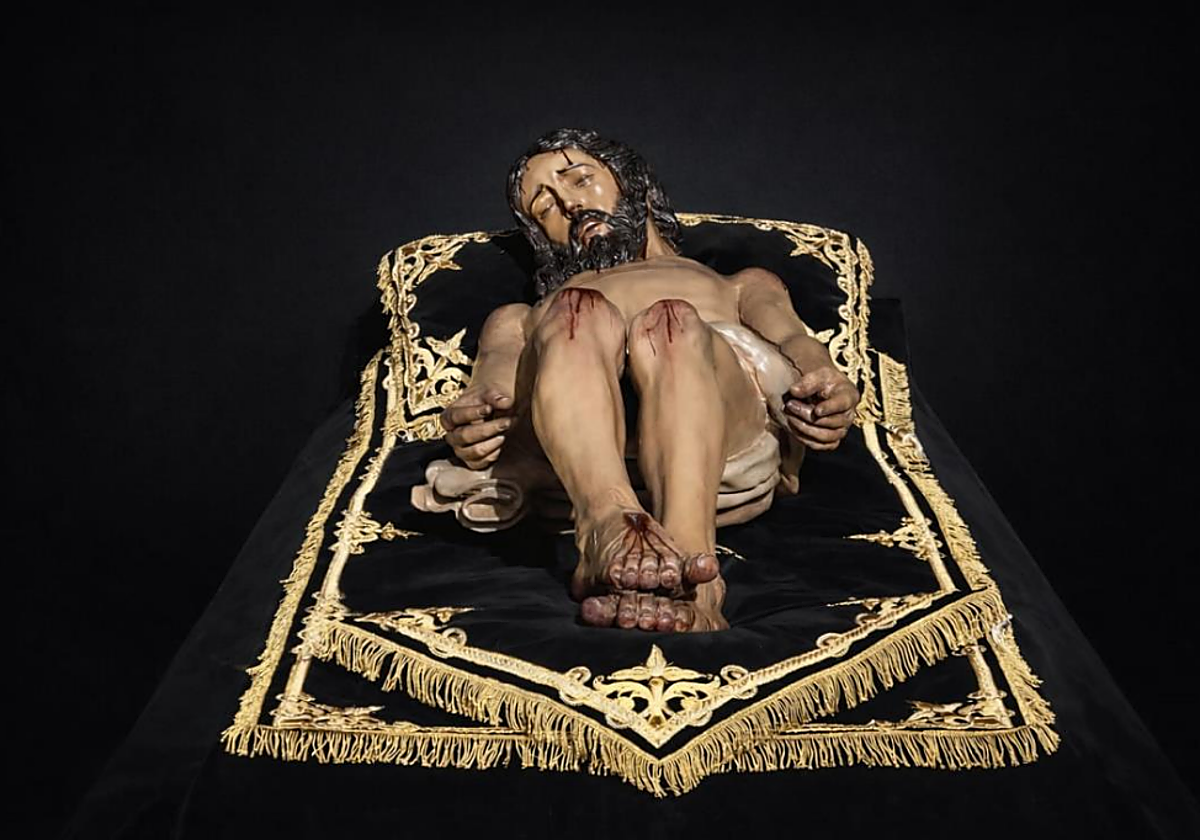
The 'Recumbent Christ' in Sierra de Yeguas, following its recent restoration. SUR Religion Historic restoration of the 'Recumbent Christ' in Sierra de Yeguas recovers original 1941 polychromyAfter a four-month conservation process, the masterpiece by Antonio Castillo Lastrucci returns to Malaga, revealing the sculptor's authentic flesh tones and artistic intent
Wednesday, 11 March 2026, 13:00
The 'Recumbent Christ' of the Holy Burial brotherhood of Sierra de Yeguas has been restored to its original appearance, as conceived by its creator more than eight decades ago.
The image, the work of Sevillian sculptor Antonio Castillo Lastrucci, is back home after a four-month restoration process that recovered much of its original polychromy.
What is "polychromy" in the context of Spanish sculpture?
Polychromy refers to the traditional technique of painting wooden sculptures to look lifelike. This involves multiple layers of gesso, paint, and translucent glazes (encarnadura) to simulate the texture and tones of human skin
The statue was removed from public view on 17 October 2025 and transported to the workshop of restorer Juan Antonio Aguilar, in the town of La Roda de Andalucía in Seville.
Since then, it has been undergone a process of conservation and restoration that has allowed for an in-depth analysis of its condition and action to be taken on the various problems it presented.
This decision was taken following a preliminary study by the restorer, which revealed that the statue exhibited various issues common to works of this type. The damage affected different levels of the sculpture, both in the underlying wooden support and in the layers of paint that make up its polychromatic finish.
According to the technical report, some of this deterioration was caused by environmental factors, while other damage was related to previous interventions or just down to the use and manhandling of the image over the years.
The 'Recumbent Christ' was created in 1941 by Antonio Castillo Lastrucci, one of the most influential sculptors of religious imagery in 20th-century Andalucía. The sculpture is made of polychrome wood by assembling several pieces joined lengthwise, which were then reinforced with nails and wooden dowels - a common technique in the processional imagery of the period.
Over the years, the artwork had suffered wear and tear inherent in the aging of the materials used, as well as various alterations resulting from previous interventions. Although these previous actions had not modified the morphology of the image, they had partially altered its aesthetic appearance, in some cases obscuring the original polychromy of the carving.
Among the alterations detected in the wooden support were losses of material, plus cracks and fissures in different parts of the sculpture. Surface dirt, lifting of the polychromy, wear and tear and losses caused by detachments or abrasions had accumulated in the painted layers. Furthermore, the image exhibited numerous touch-ups and overpainting that covered much of the original polychromy.
What did the restoration process entail?
The restoration process began with scientific and technical studies aimed at precisely understanding the structure and composition of the artwork. This analysis allowed for the detailing of the actions needed to guarantee the stability of the sculpture and restore its aesthetic interpretation.
The intervention has focused primarily on consolidating the wooden support and treating the flesh tones of the image. The work carried out included cleaning the whole surface, removing overpainting and additions from previous interventions, as well as restoring the original paint layers.
The ultimate goal of the restoration has been to recover the artistic message conceived by Castillo Lastrucci, returning the image to its original appearance within current heritage conservation standards. This process, beyond the technical intervention, seeks to preserve a work that forms part of the devotional and cultural heritage of Sierra de Yeguas.
After four months of restoration work, the 'Recumbent Christ' has returned to its rightful place with the Santo Entierro brotherhood, displaying an image much closer to the one that left the artist's workshop in 1941. This restoration allows for the rediscovery of the nuances of the original polychromy and ensures the preservation of the sculpture for future generations.