Zoom
FOTO: ÑITO SALAS | VÍDEO: DANI MALDONADO Population Homeless in Malaga: 200 people face extreme cold and rain in the city’s harshest winterA SUR investigation reveals the harsh reality for the city’s most vulnerable as record storms and freezing temperatures hit the Costa del Sol
Wednesday, 11 March 2026, 11:46
Malaga has recorded its coldest and rainiest winter in a decade, characterized by a "train of storms" that triggered provincial flooding and evacuations.
While tourists frequent the city's exclusive hotels, a growing humanitarian crisis persists, with around 200 people seeking shelter under bridges and in arcades during storms, with cardboard boxes flying and blankets soaked.
SUR toured the city during the coldest nights to talk to Malaga's most vulnerable inhabitants - those without a roof over their heads.
Frequently asked questions about homelessness in Malaga?
How many people are currently homeless in Malaga? Approximately 200 people are currently sleeping outdoors in the Malaga capital.
What are the main locations for homeless settlements in Malaga? Key locations include the Guadalmedina riverbed, Puente de la Esperanza, and Tetuán bridge.
What help is available for the homeless in Malaga during extreme weather?Facilities like Café y Calor (Cáritas) and the Santo Domingo dining hall in the La Trinidad district provide vital but limited aid.
Sheltered on the roof of the Las Fusionadas brotherhood house, on a mattress, covered up to his mouth, with some of his belongings in a box, Manuel spends his nights.
After a period in prison, "life's circumstances" left him homeless, without a safety net and exposed to the elements. Although he says he is used to sleeping rough, he admits that in Malaga, one never gets used to waking up "with everything wet".
Next to him, wrapped in a plaid scarf and holding an umbrella, finishing a can of beer, José is killing time until 9pm so he can rest at Café y Calor - the Cáritas shelter that provides dinner, a chair or bed, breakfast and a shower to about 20 homeless people in urgent need of refuge every day.
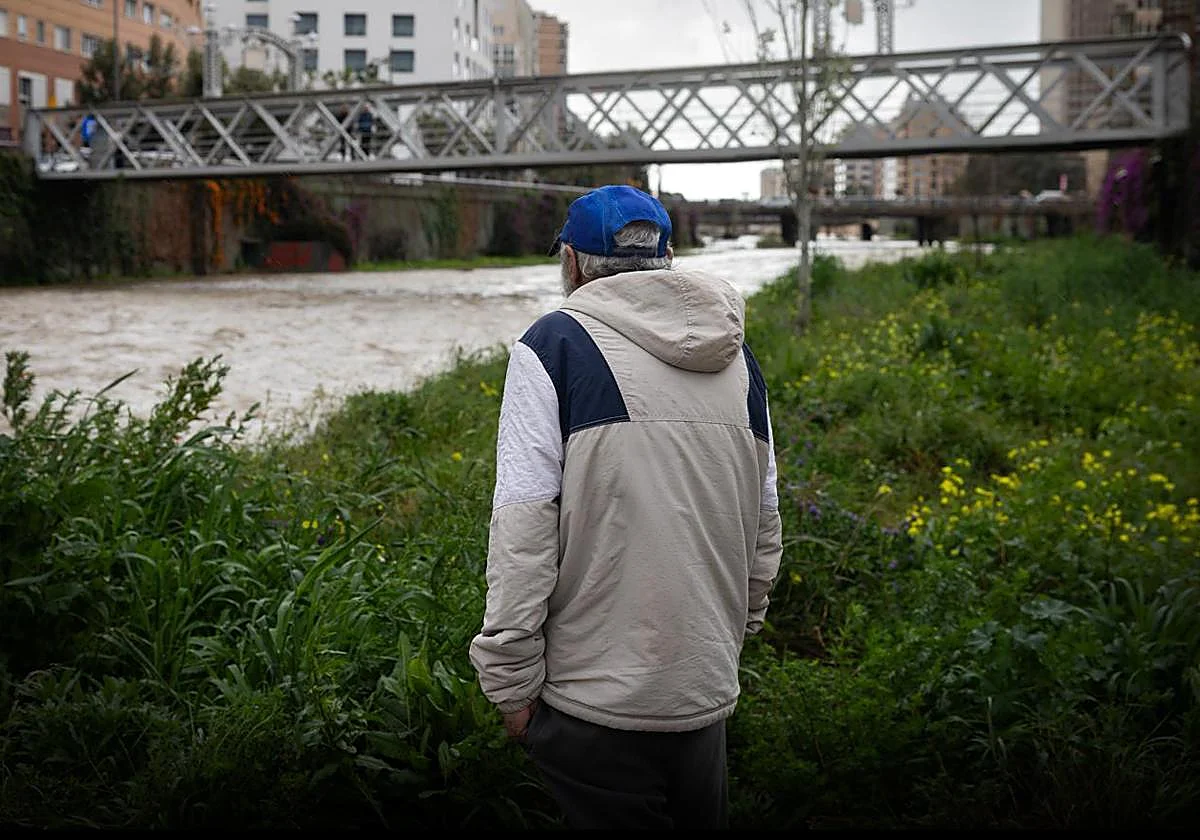
Until a few weeks ago, he sheltered under the Puente de la Esperanza, next to one of the veterans of the street, who has made this space his home, with suitcases hanging from the protruding rocks and even a guard dog. On days of torrential rains or when the El Limonero dam's floodgates are open, one has to jump over the wall that borders the riverbed and walk about 50 metres through the undergrowth to get there.
The German Shepherd does its job and tries to frighten the stranger. The owner shouts at the dog in an attempt to calm it down, but tells SUR: "I don't want to talk. When I did, I ended up being thrown out of here and they didn't give me any solution." He has a Canarian accent, although he has been living in Malaga for a decade. He sells the scrap metal he finds in the surrounding area. That's all he says.
While he cooks, washes and sleeps, hundreds of tourists cross the bridge to stay in one of the city's most exclusive hotels, probably unaware that just a few metres away lies the other, more inhospitable side of Malaga. At other points along the banks of the river, from the La Rosaleda bridge to the Carmen bridge, next to Paseo Marítimo Antonio Machado, there are mattresses, food and belongings stored in bags. There is almost no one, but there is a trace of them.
Yassine arrived in Ceuta a little over a year ago from Morocco after an eight-hour swim. "I prepared and trained a lot for it," he says. Like so many other children, he arrived with the hope of a better future. Now, at the door of the Santo Domingo dining hall, in the La Trinidad district, he admits that he is doing "bad, very bad". "I've asked for help, but I have to wait a long time. I want work, I'm looking for work," Yassine says. For the moment, he spends his nights in a tent under the Tetuán bridge, with little hope left.
The city council says that it provides care for the homeless people in Malaga, offering available resources, including shelter places, clothes and laundry. The authorities also take preventive measures when torrential rains and/or very low temperatures make living outside impossible. "When rain is forecast, they work in collaboration with the Local Police and Civil Protection to monitor the points where homeless people usually settle, such as bridges."
At the age of 73, José was caught off guard by the rising waters of the Guadalmedina river and had to leave, barely able to walk. "As best I could, I crossed the river and went to Puerta Única to talk to my assistance centre so that they could give me a solution."
Can a pension cover the cost of living in Malaga?
For many elderly residents like those interviewed by SUR, a basic state pension is insufficient to cover the rising cost of rent in Malaga - even for a shared room - forcing individuals who worked their entire lives into social exclusion.
Although he says he dedicated his life to construction and a fruit shop, he has been homeless for about three years and hasn't had contact with his sister for almost 40. His pension isn't enough to rent even a shared room and cover his other expenses. But he doesn't even consider asking for help. "I'm not going to admit I'm in this situation; I've never been in it before and it's shameful."
Like José, many have thrown in the towel and no longer expect a helping hand. Pablo calls it "being realistic." "I think that in many cases it's practically impossible to escape social exclusion." At 56 and with a disability, a setback in his career sent him spiraling into social exclusion. For over two decades, he worked as a security guard, but "a minor legal issue" led to the loss of his badge and a year in jail. "That's where it all started, one thing after another."
He found himself sleeping on the streets. Although for the past few months he's been resting in an armchair at the Cáritas night shelter, he knows it's a temporary solution. He tries not to dwell on it, "just live day by day", because returning to the municipal shelter isn't an option for him or for many others who have been there. "They have rooms for six people. The lights are on all night, people are using drugs, shouting, going from one room to another. It's madness," Pablo says.
"The street is a five-star hotel"
Everyone agrees that nobody forgets their first night on the street. You search for the safest spot, some company and, with one eye half-open, you count the hours until the sun rises again. "It's not just tough, it's brutal," says Badar, who arrived in Spain eight years ago from Tangier in a small boat, still just a child. He's the only one in his family making a living on the other side of the Mediterranean and he doesn't want to "worry them".
For the last two and a half months, he's been sleeping rough because of a lapse in judgment. "I didn't renew my papers properly and I lost my job as a waiter," he says. Now he fears that if the situation continues, his family will end up asking him about it. "I always send them 200 euros a month and right now I can't," he states.
It was precisely family problems that led Estefanía to the streets almost four years ago. She's nearing 30, though she looks like a child, sweet and shy. She lines up her cardboard box next to a shopping centre window. The shop's lights illuminate the area, which she shares with other homeless people, who have become like family to her.
Her story is difficult to understand: an unbearable living situation with her mother led Estefanía to leave home. Although she returns for periods of time, she always ends up leaving again. Visibly distressed and at times with tears in her eyes, the young woman from Colombia says that she has been in "all kinds of shelters". In the end, she always chooses the streets. "There are always people doing drugs there and I prefer to be here. I always try to take care of myself and avoid dangerous places," she says.
Just a few metres away, Kelli, her head resting on a backpack, writhes on a mattress next to a wheelchair. Her ankle has been broken since she fell down the train station stairs. Her father committed suicide 15 years ago and her mother died five years ago from Alzheimer's. With a disability and no family, she arrived in Malaga from Texas, the US, less than a month ago. With only her cat accompanying her, she came in search of a boy she had been chatting with online for two years.
"He called me and asked me to come here to Malaga. We were going to buy a house and all that," she says. When she landed, however, there was no sign of her online boyfriend, supposedly a "famous" guy. She stayed in a shelter and an argument with another girl landed her on the street. "They kicked me out because she said I had spat on her, but I hadn't," Kelli says. Since then, she has been spending her days and nights outdoors, trying to find a ticket back.
Brayan, on the other hand, has no plans to return to his native Colombia, even though things have not turned out as he had hoped. With relatives in other Spanish cities and the dream to enjoy one of the best climates in the country, the young man arrived in Malaga with 3,000 euros saved and a rented room. After a flatmate stole his money, he found himself on the street, with the lowest temperatures in recent years.
Despite being broken, he clings to staying in Malaga to keep trying. "I came here to fight and to achieve things. Sometimes they cost," he says. With a blanket on the ground to protect himself from the cold, under Avenida de Andalucía, the 20-year-old says that they also took his papers and mobile phone. Two backpacks and a suitcase is all he has left of his previous life.
Damaris still lives in the neighborhood where she grew up - La Trinidad. She no longer has a home there, after her release from prison. From Monday to Friday, from early morning until 5pm, she has breakfast, washes u, and even puts on make-up at a day centre. At night, she hustles to make ends meet. "I'm cold and just getting by as best I can. I try to face it with a smile," she says. Although she has breakfast and lunch covered, she wanders around the city centre singing songs by Estopa, Melendi or Camarón and asking for a few coins for dinner.
-What is your favourite song?
-I can't tell you now because I'm in a rush.
Hardly anyone ends up on the street because of a single problem, not even overnight. It usually happens because of a string of problems and lost social ties. Everybody who SUR speaks to agrees that this happens more easily than one would imagine.