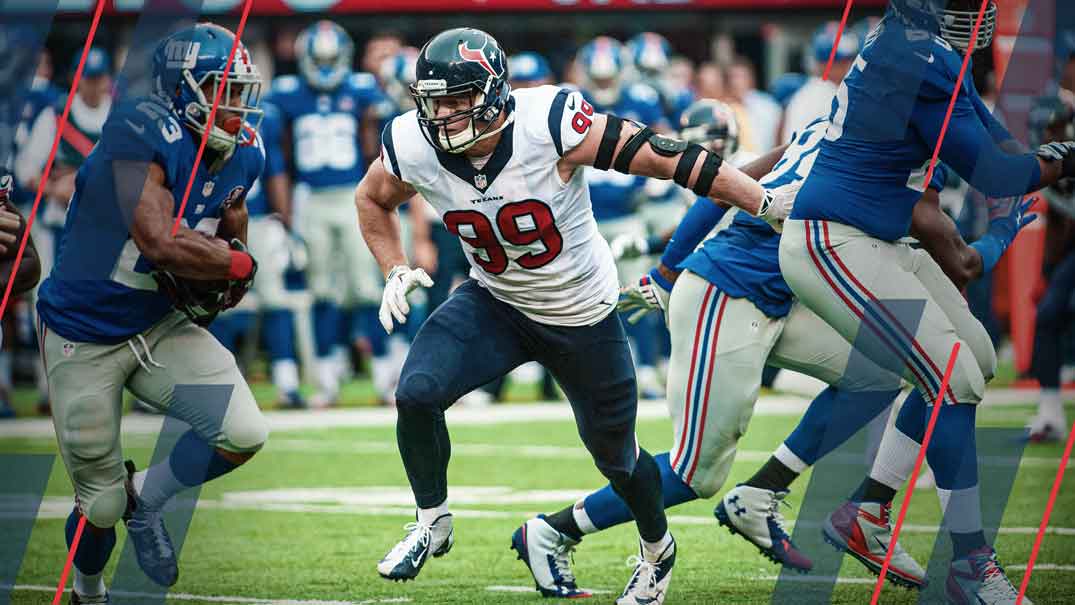
As part of PFF's celebration of 20 years of NFL data, we're building an All-Star team for every franchise, highlighting the best players at each position from the PFF era. This installment turns to theHouston Texans.
PFF's database dates back to the 2006 NFL season, providing a unique lens for evaluating and comparing players across eras. More details on the methodology used to construct these teams are available at the bottom of the page.
Offense
- QB: Matt Schaub (2007-2013)
- HB: Arian Foster (2009-2015)
- WR: Andre Johnson (2006-2014)
- WR: Nico Collins (2021-2025)
- Slot WR: DeAndre Hopkins (2013-2019)
- TE: Owen Daniels (2006-2013)
- TE: Dalton Schultz (2023-2025)
- LT: Duane Brown (2008-2017)
- LG: Wade Smith (2010-2013)
- C: Chris Myers (2008-2014)
- RG: Brandon Brooks (2012-2015)
- RT: Eric Winston (2006-2011)
The Texans' offense reached its peak between 2009 and 2012, producing four straight top-10 finishes in scoring. Unsurprisingly, nine of the 12 players selected for this team came from those offenses.
The two notable exceptions are DeAndre Hopkins and Nico Collins. Houston has consistently fielded one of the NFL's premier wide receivers, and this roster brings together three of the franchise's best. While none of the three were true slot receivers, each logged enough snaps inside to make the combination viable. Collins earned his place after helping lead Houston's 2025 offense to the second-highest scoring season in franchise history. Tight end Dalton Schultz is the only other representative from that unit.
C.J. Stroud has played a major role in Houston's recent success, but Matt Schaub matched that level of play over a much larger body of work. Deshaun Watson also has a strong case after several productive seasons with the Texans, though his tenure was ultimately shorter than Schaub's. The most difficult decision came at left guard, where Wade Smith and Chester Pitts stand apart from the rest of the field. The pair rank first and second in playing time at the position for Houston, but Smith's advantage of roughly 1,400 snaps ultimately gave him the edge.
Defense
- DI: J.J. Watt (2011-2020)
- DI: DJ Reader (2016-2019)
- ED: Will Anderson Jr. (2023-2025)
- ED: Jadeveon Clowney (2014-2018)
- LB: DeMeco Ryans (2006-2011)
- LB: Benardrick McKinney (2015-2020)
- SLB: Brian Cushing (2009-2017)
- CB: Johnathan Joseph (2011-2019)
- CB: Derek Stingley Jr. (2022-2025)
- Slot CB: Kareem Jackson (2010-2018, 2023)
- S: Jalen Pitre (2022-2025)
- S: Justin Reid (2018-2021)
The Texans have finished among the NFL's top five in points allowed three times — in 2011, 2018 and 2025 — and this defensive lineup draws contributors from each of those units. The 2025 team is especially well represented, an impressive feat given how young that roster remains. Will Anderson Jr., Derek Stingley Jr. and Jalen Pitre all earned spots despite having played four or fewer seasons.
Future Hall of Famer J.J. Watt serves as the centerpiece of the defense. Given his unique alignment, there is a reasonable argument for listing him at edge defender rather than on the interior. For the purposes of this team, however, Watt was moved inside to make room for Anderson and former teammate Jadeveon Clowney. Edge defender has been one of Houston's deepest positions throughout its history, with Mario Williams, Whitney Mercilus and Danielle Hunter all falling just short of making the roster.
Methodology
Selections were based on normalized PFF grades adjusted by season. To balance peak performance and longevity, only a player's five best seasons with a franchise from 2006-25 were considered. Any season with an overall PFF grade below 60.0 was excluded, ensuring that strong years helped a player's case while weaker seasons were not held against him. Postseason play was included, though all seasons were capped at a 16-game equivalent to maintain consistency across eras. At each position, the player with the highest score under this methodology earned the spot.
Each team consists of 12 offensive and 12 defensive players. Because 11 personnel and nickel defense were the league's most common alignments over the past two decades, those personnel groupings served as the foundation for every roster. Teams received either a second tight end or a fullback, depending on whether they used more 12- or 21-personnel. Defensively, teams received either a third interior defender or a third linebacker depending on whether they primarily operated from a 3-4 or 4-3 front.
Players who logged significant snaps at multiple positions during their tenure with a franchise were eligible at either spot. In most cases, those players were assigned to the position where they provided the greatest value, though their versatility occasionally influenced the final roster construction.
Unlike some All-Pro teams that group offensive linemen by position type, these rosters were built according to where players actually lined up. If a team's two best tackles both played exclusively on the left side, only the top left tackle was selected. One of the three wide receivers and one of the five defensive backs was also required to have significant slot experience. In a 4-3 defense, one linebacker needed experience at the Sam linebacker position, while in a 3-4 defense, one defensive tackle needed experience at nose tackle.
When multiple players are listed at the same position, the first name represents the top selection. Players designated as slot wide receiver, slot cornerback, nose tackle or Sam linebacker were selected specifically for those roles rather than as the third-best player within their broader position group.