June - Pride month
Husband and husband for the first time, from Spain to the NetherlandsA quarter of a century ago, the first homosexuals could proudly declare that they had a lawful spouse; the first Spaniard to enter into a same-sex marriage talks to SUR in English
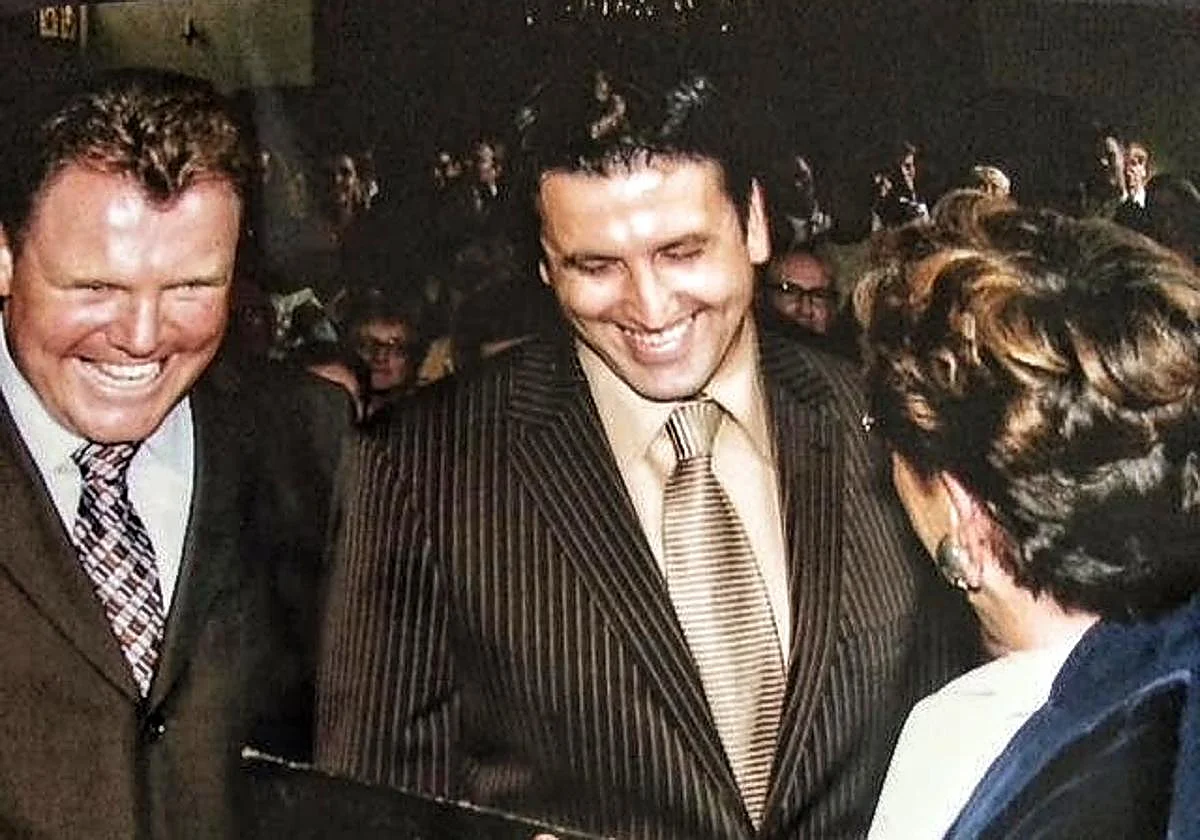
Añádenos en Google The two husbands and the mother-in-law at the end of the ceremony. (Family archive)Alekk M. Saanders
20/06/2026 a las 17:50h.Throughout human history, various forms of same-sex unions have existed, ranging from informal and unauthorised relationships to ritualised unions, including marriage.
Same-sex unions were known in Ancient Greece and Rome, Ancient Mesopotamia, certain regions of China, and during specific periods of ancient European history.
In modern history, the Netherlands became a pioneer in the legalisation of same-sex marriage when Queen Beatrix signed the relevant law in 2001.
The first Spaniards
There are references to same-sex marriages dating as far back as the 1st century AD. The first man to marry another man was none other than Nero himself. According to some accounts, the Roman emperor married a man more than once. However, on 16 December 342 AD, the Christian emperors Constantius II and Constans outlawed same-sex marriages.
The first man to marry another man was none other than Nero himself. According to some accounts, the Roman emperor married a man more than once
Seven centuries passed before an extraordinary event took place in Catholic Spain. Two courageous men broke with medieval tradition and entered into marriage.
In 1061, two Galicians, Pedro Díaz and Munio Vandilas, recorded in an official document their desire to live together and share their lives. They were married by a priest in a small chapel in the parish of Santa María de Ordes, corresponding to the present-day Rairiz de Veiga, in Ourense province, Galicia.
Historical documents relating to this church wedding were found in the monastery of San Salvador de Celanova. According to them the Spaniards undertook to care for one another, share their property and work as equals: "And if Pedro should die before Muño, he shall leave Muño the property and the documents. And if Muño should die before Pedro, he shall leave him the house and the writings." Subsequently, this was not regarded as a same-sex union, but as an adelphopoesis, a ceremony of spiritual brotherhood.
The first Spanish man
In April 2001, history was made in the Netherlands. The world’s first legally recognised same-sex marriage took place in Amsterdam on 1 April 2001.
It was in the Netherlands that the first Spanish man married his partner. The love story between José Antonio Femenía, a teacher in a secondary school, and Hans den Dikken, a flight attendant with the Dutch airline KLM, began in Barcelona.
"My future mother-in-law worked at the town hall in Haarlem as the civil servant in charge of marriages. She was about to retire and she really wanted us to get married."
Jose Antonio Femenía
“I’m originally from the south of Extremadura, from a village175 kilometres north from Seville. I moved to Barcelona to teach in schools, and that’s where I met Hans.
"For four years we travelled back and forth between the two countries and I spent all my holidays in the Netherlands. When we grew tired of the long-distance relationship, I decided to move. I found a job in the International School of Amsterdam and started teaching Spanish Language and Literature there.
"As soon as same-sex marriage was legalised in the Netherlands, Hans started proposing a wedding but I didn’t think it was necessary to marry (we were already registered as partners).
"Coincidentally, my future mother-in-law worked at the town hall in Haarlem as the civil servant in charge of marriages. She was about to retire and she really wanted us to get married. In dinners and family gatherings she was always saying she would never retire until she’d married her son to me…. That sort of ‘blackmail’ sped up the wedding”, José Antonio Femenía told SUR in English.
"I had to rack my brains over a so-called ‘single’ certificate. The thing is, such a document didn’t exist in Spain..."
Jose Antonio Femenia
The wedding preparations were full of good vibes but also accompanied by a few challenges, or rather, some curious moments.
“I was required to provide certain documents when applying for the marriage through the Spanish consulate. There were no problems with my birth certificate, but I had to rack my brains over a so-called ‘single’ certificate. The thing is, such a document didn’t exist in Spain. However, I enlisted the help of a friend in my hometown, and he helped me obtain confirmation that I had never been married before,” Jose Antonio recalled.
The wedding ceremony took place on 29 August 2003 in the Great Town Hall of Haarlem. Around 300 people attended the official part of the ceremony.
“After that a glass of cava was raised in the historic windmill ‘The Adrian’. Then a train and a boat took us to the wedding venue in the Sofitel Legend The Grand in Amsterdam where a hundred of our guests, including 40 people from my side, family and friends who had travelled from Spain, shared our happiest moment with us with dinner,” Jose Antonio said.
"It all went like a fairy tale, but the most important thing is that I still love that Dutch guy who stole my heart in Barcelona in 1992 and with whom we still live together as husband and husband..."
Jse Antonio Femenia
This wedding marked also a significant moment in Spanish history according to the correspondent of El País in The Hague at that time.
“I received a call from her, who congratulated me, saying that I had become the first Spanish man to marry an another man, as there was no notice about another case like this in the Netherlands or in in Belgium, the only two countries where same-sex marriage was possible at that time.
"She asked me some questions and she published a little note later in the national edition of the Spanish newspaper. It all went like a fairy tale, but the most important thing is that I still love that Dutch guy who stole my heart in Barcelona in 1992 and with whom we still live together as husband and husband,” added José Antonio.
As for Andalucia... the first wedding between two men took place in July 2005, just a few weeks after Congreso approved same-sex marriage in Spain.
Pedro and Cristóbal’s ceremony took place in Linares, in Jaén province, becoming the first documented same-sex marriage in Andalucía and marking an important milestone in the region’s history.