Erika Peters
Mar 04, 2026 ArticleListen to this audio excerpt from Paul Boehm, Orion crew support and thermal systems functional area manager:
0:00 / 0:00
Your browser does not support the audio element.
As the Artemis II astronauts fly around the Moon, they’ll rely on systems inside the Orion spacecraft to live, work, and keep them safe during their mission. At NASA’s Johnson Space Center in Houston, Paul Boehm, crew support and thermal systems functional area manager in the Orion Crew and Service Module Office, leads this work.
Boehm oversees life support systems, flight equipment, and Orion Crew Survival System suits worn during launch and re-entry. Developed, designed, and built by Boehm’s team, these systems are set to fly for the first time with crew aboard Orion on Artemis II.
Sustaining the crew in the harsh environment of deep space is no simple task, especially when it comes to a complex system like the environmental control and life support system (ECLSS).
Think about things that you do every day for 24 hours — those are the things the ECLSS has to support. We have to support all the crew’s human bodily functions, from breathing, to eating, going to bathroom, and temperature control.
Paul Boehm
Orion Crew Support and Thermal Systems Functional Area Manager
Developing these systems for Orion’s deep space missions to the Moon poses special challenges, such as mass and volume requirements faced when launching heavy spacecraft, and a need for systems that operate reliably without resupply.
“Orion’s ECLSS is unique for Artemis missions because we’re going into deep space,” said Boehm. “It’s a lot longer of a trip that you cannot return quickly from, like a mission on the International Space Station, which is only a couple hours away. Therefore, we try to make a lot of the life support systems regenerative, so you don’t have to carry a lot of consumables, and we also try to make them simpler.”
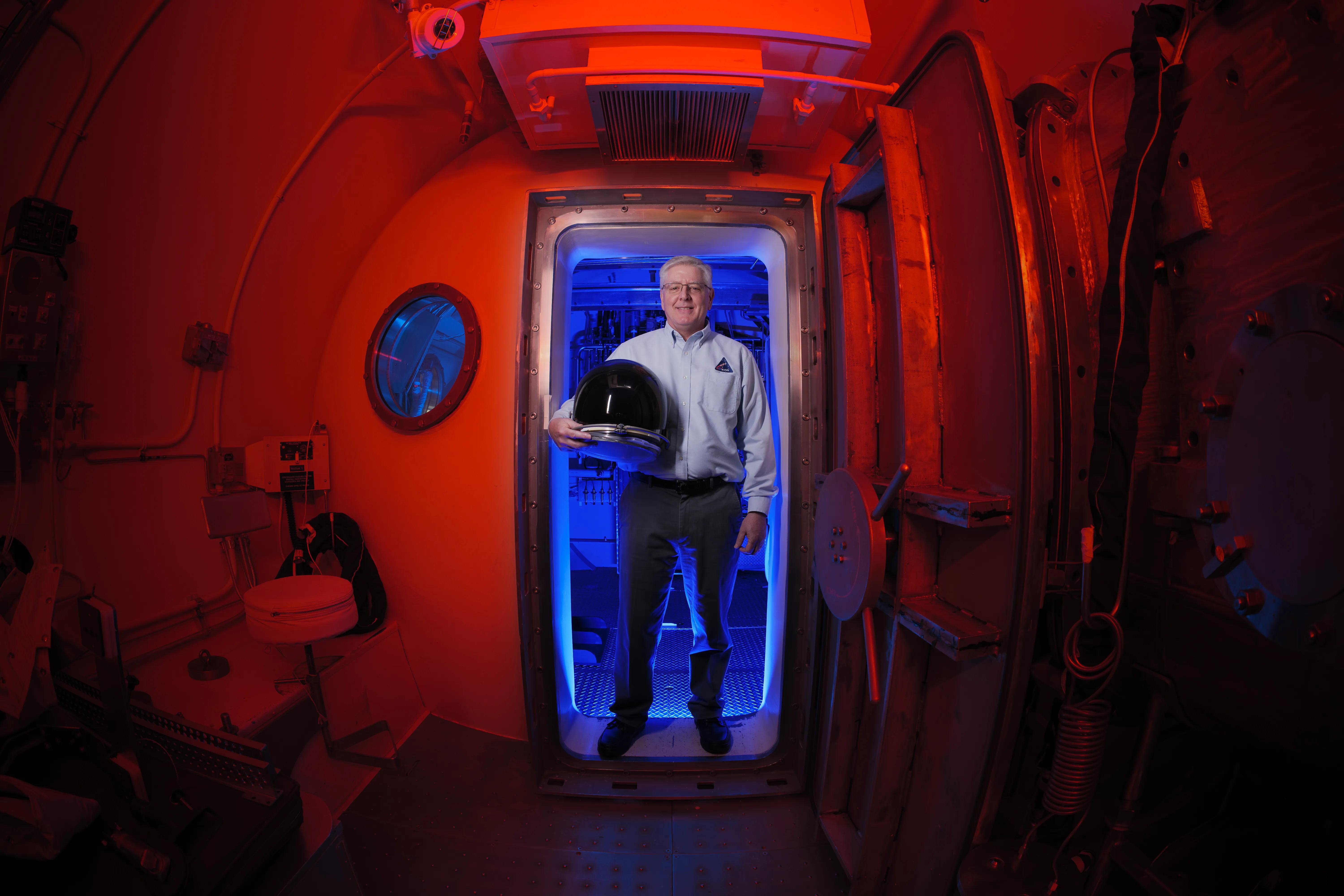
Paul Boehm, Orion crew support and thermal systems functional area manager, stands in the Orion Life Support Integration Facility (OLIF) at NASA’s Johnson Space Center in Houston. Teams have conducted integrated testing of Orion’s environmental control and life support system (ECLSS) and the Orion Crew Survival System Suit (OCSS) in the OLIF to validate the performance of these systems in preparation for the crewed Artemis II mission. NASA/Rad SinyakThe system also needs hardware to handle a range of variables that may come its way during the mission, according to Boehm.
“You’re dealing with fluids, you’re dealing with electrical, electronic, and electromechanical components — and you’re also dealing with the human variable of different metabolic situations. Everybody’s different. The ECLSS takes all that into account.”
It’s a challenge that Boehm welcomes and has worked toward throughout his career at NASA. Since starting at NASA Johnson 37 years ago, he has served in disciplines that work directly with crew members, including supporting the astronaut office, extravehicular activities for the space shuttle and space station, and the Orion Program since 2011.
I've always loved being able to be with systems that work with the crew.
Paul Boehm
Orion Crew Support and Thermal Systems Functional Area Manager
“And so, when I had the opportunity to work on Orion, ECLSS, and crew systems, I said that’s where I want to go, because that way I’ll still be able to help and be directly involved with supporting the crew,” Boehm said. “I’ve thoroughly enjoyed that.”
As NASA prepares to send crew members around the Moon on Artemis II, seeing Orion and its systems carry the crew will be the marker of a career that’s contributed to moving the future of human spaceflight forward.
“I think that’s why everybody is here working toward this mission — we know it’s for the betterment of humanity,” Boehm said. “Moving things forward for the next generation is something that we all take to heart, and that’s what we’re trying to really do here. We are taking the first step in making history with sending the crew back to the Moon.”
About the Author
Erika Peters
Share
Details
Last Updated Mar 04, 2026Related Terms
Explore More
6 min readLa NASA refuerza Artemis: añade una misión y perfecciona su arquitectura general
Article 18 hours ago 4 min readNASA Strengthens Artemis: Adds Mission, Refines Overall Architecture
Article 19 hours ago 4 min readArtemis II: What’s on the Menu?
Article 20 hours ago Keep ExploringDiscover More Topics From NASA
Missions
Humans in Space
Climate Change
Solar System