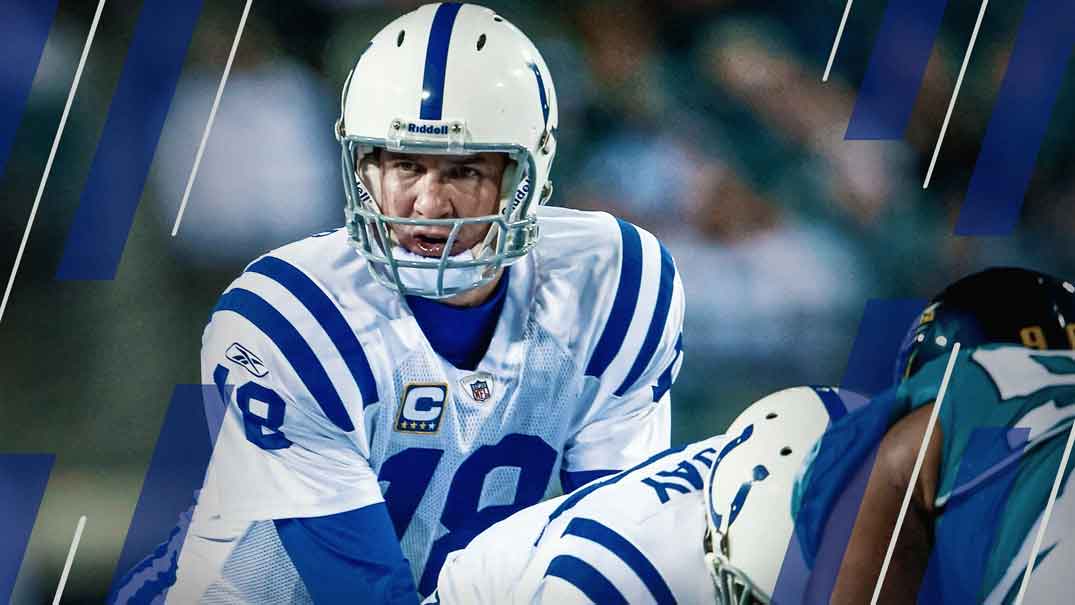
As part of PFF's celebration of 20 years of NFL data, we're building an All-Star team for every franchise, highlighting the best players at each position from the PFF era. This installment turns to theIndianapolis Colts.
PFF's database dates back to the 2006 NFL season, providing a unique lens for evaluating and comparing players across eras. More details on the methodology used to construct these teams are available at the bottom of the page.
Offense
- QB: Peyton Manning (2006-2010)
- HB: Jonathan Taylor (2020-2025)
- WR: Reggie Wayne (2006-2014)
- WR: Michael Pittman Jr. (2020-2025)
- Slot WR: T.Y. Hilton (2012-2021)
- TE: Dallas Clark (2006-2011)
- TE: Jack Doyle (2013-2021)
- LT: Anthony Castonzo (2011-2020)
- LG: Quenton Nelson (2018-2025)
- C: Jeff Saturday (2006-2011)
- RG: Mark Glowinski (2018-2021, 2024)
- RT: Braden Smith (2018-2025)
The Colts kicked off the PFF era with a Super Bowl victory, and lost a Super Bowl three years later. While we missed over half of Peyton Manning’s time with the Colts, he was the clear option at quarterback, with several of his teammates also making the roster. However, some of his other notable teammates — Edgerrin James, Marvin Harrison and Tarik Glenn — missed out after playing a combined four seasons in the PFF era in Indianapolis.
While recent Colts teams have struggled to find a quarterback, they are also well represented, with Jonathan Taylor, Michael Pittman Jr. and three-fifths of the offensive line.
One notable omission was Andrew Luck. While the gap between Manning and Luck was large, Luck still ranked 14th among all quarterbacks using this methodology. We looked at quarterbacks' top five seasons, and Luck played exactly five full seasons for Indianapolis. Among quarterbacks who did not earn a spot on their franchise's team, Luck ranked highest in this system. He was followed by Justin Herbert with the Los Angeles Chargers and Tony Romo with the Dallas Cowboys.
Defense
- DI: DeForest Buckner (2020-2025)
- DI: Grover Stewart (2017-2025)
- ED: Robert Mathis (2006-2016)
- ED: Dwight Freeney (2006-2012)
- LB: Jerrell Freeman (2012-2015)
- LB: Bobby Okereke (2019-2022)
- SLB: Shaquille Leonard (2018-2023)
- CB: Vontae Davis (2012-2017)
- CB: Kelvin Hayden (2006-2010)
- Slot CB: Kenny Moore II (2017-2025)
- S: Antoine Bethea (2006-2013)
- S: Bob Sanders (2006-2010)
The Peyton Manning era Colts were known for their offense and for having an inconsistent defense, but they had a top-10 unit from 2007-2009. That defense is well presented on this team, including the edge rushing duo of Robert Mathis and Dwight Freeney, despite missing over half of Freeney’s double-digit sack seasons, as well as three-fifths of the secondary.
The defensive end duo is joined by another pair of longtime teammates in DeForest Buckner and Grover Stewart. Buckner and Stewart are two of the eight defensive tackles to play over 3,800 snaps with the same defense over the past six seasons.
Methodology
Selections were based on normalized PFF grades adjusted by season. To balance peak performance and longevity, only a player's five best seasons with a franchise from 2006-25 were considered. Any season with an overall PFF grade below 60.0 was excluded, ensuring that strong years helped a player's case while weaker seasons were not held against him. Postseason play was included, though all seasons were capped at a 16-game equivalent to maintain consistency across eras. At each position, the player with the highest score under this methodology earned the spot.
Each team consists of 12 offensive and 12 defensive players. Because 11 personnel and nickel defense were the league's most common alignments over the past two decades, those personnel groupings served as the foundation for every roster. Teams received either a second tight end or a fullback, depending on whether they used more 12- or 21-personnel. Defensively, teams received either a third interior defender or a third linebacker depending on whether they primarily operated from a 3-4 or 4-3 front.
Players who logged significant snaps at multiple positions during their tenure with a franchise were eligible at either spot. In most cases, those players were assigned to the position where they provided the greatest value, though their versatility occasionally influenced the final roster construction.
Unlike some All-Pro teams that group offensive linemen by position type, these rosters were built according to where players actually lined up. If a team's two best tackles both played exclusively on the left side, only the top left tackle was selected. One of the three wide receivers and one of the five defensive backs was also required to have significant slot experience. In a 4-3 defense, one linebacker needed experience at the Sam linebacker position, while in a 3-4 defense, one defensive tackle needed experience at nose tackle.
When multiple players are listed at the same position, the first name represents the top selection. Players designated as slot wide receiver, slot cornerback, nose tackle or Sam linebacker were selected specifically for those roles rather than as the third-best player within their broader position group.