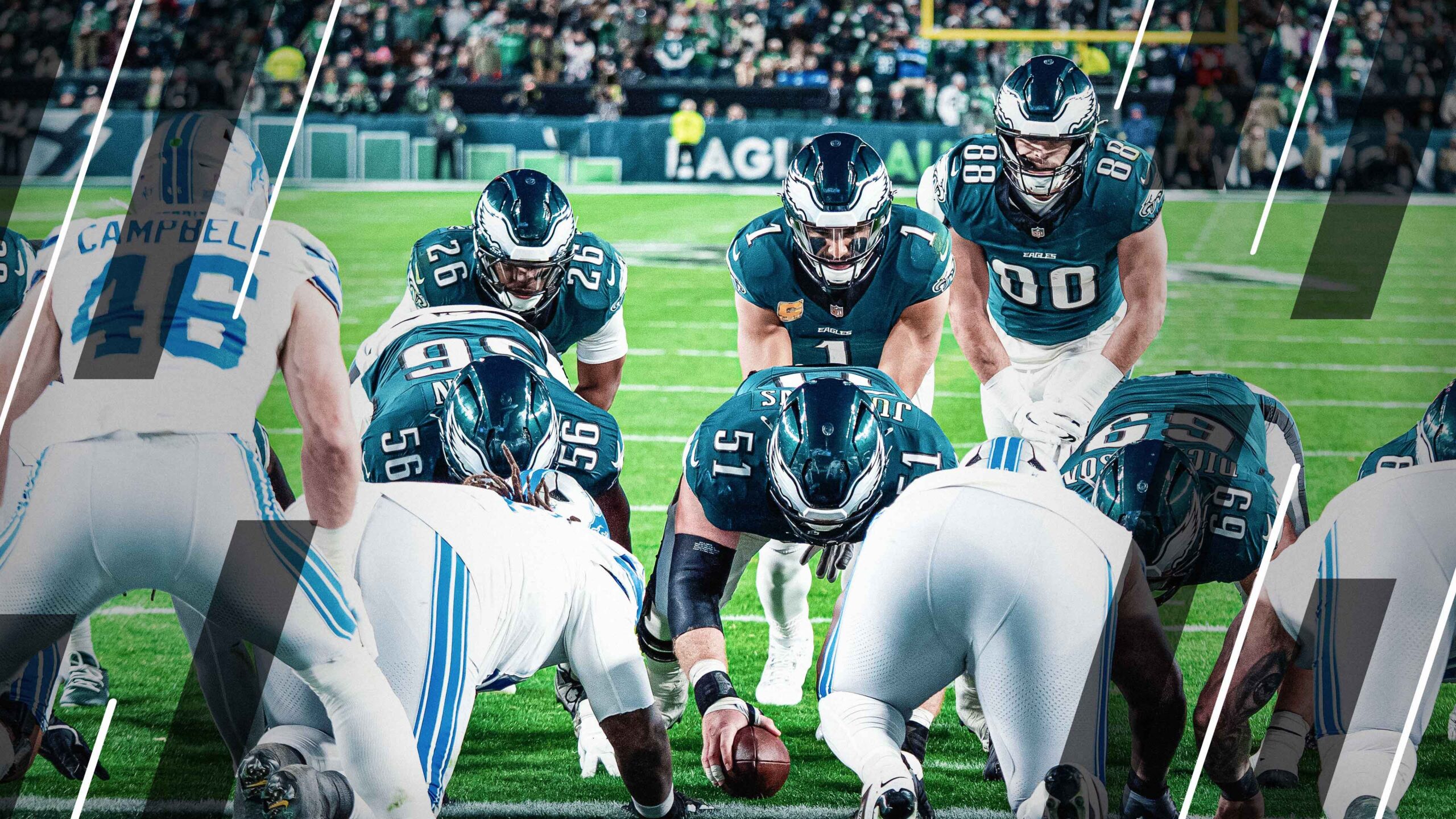
The quarterback sneak has become one of the NFL’s most contentious concepts in recent seasons. No team has influenced the modern reputation of the play more than the Philadelphia Eagles. Their infamous “tush push” turned a relatively balanced play into a near-automatic conversion tool, forcing the rest of the league to either copy it, prepare for it or argue that it should be removed from the game entirely.
That argument nearly won out during the 2025 offseason, when a proposal to ban the tush push fell just two votes short. One year later, there has been no renewed proposal to outlaw it, meaning the sneak looks set to remain part of NFL offenses for at least another season.
With the play still legal, the more important question is whether the tush push is showing any signs of slowing down. Just as more offenses begin to implement adapted versions of the quarterback sneak, defenses now spend additional time practicing to stop quarterbacks from winning in short-yardage situations.
This article will examine how effective quarterback sneaks have become in recent years, whether usage is beginning to slow and whether defenses are finding better answers. On top of that, we’ll examine which teams are leaning into quarterback sneaks, while others continue to leave it out of their close-range gameplan.
We will start with the prime culprits. The Philadelphia Eagles have called 163 total sneaks since the first adaptations of the tush push in 2022. On average, the rest of the league has called 36 sneaks over those four seasons.
The league’s other frequent user is the Buffalo Bills. With 109 sneaks over the last four years, they bridge the enormous gap between the Eagles and the rest of the NFL.
The Bills were an early adopter of the tush push. However, their variation typically involves just one player in the backfield driving Josh Allen forward, as opposed to the duo of pushers in Philadelphia.
Most quarterback sneaks since 2022
Team Sneaks Philadelphia Eagles 163 Buffalo Bills 109 San Francisco 49ers 73 Pittsburgh Steelers 63 Denver Broncos 60At the opposite end of the spectrum lies the Kansas City Chiefs. They’ve called just three sneaks since 2022, and none of those have involved Patrick Mahomes. Kansas City prefers to align with Mahomes in shotgun before sending a tight end in motion to under center, which catches defenses off guard in short-yardage situations.
After sustaining a knee injury on a sneak in 2019, Andy Reid vowed not to put his star quarterback in jeopardy that way ever again. Now returning from a torn ACL, it’s safe to say we won’t see Mahomes involved in a tush push anytime soon. That comes despite the relatively low injury rates for quarterbacks on the play, who are effectively walled off from all tacklers.
While Kansas City may never implement the formation into its offensive gameplan, the Chiefs’ defense is no stranger to Philadelphia’s tactics. Since the Eagles first implemented the tush push, they’ve employed it against the Chiefs more than any other opponent.
Of the 16 sneaks against Kansas City, 14 have moved the chains, and five have netted touchdowns. The two sides have faced each other in each of the last four years, including two Super Bowls. It’s in these pivotal situations where the Eagles revert to their almost unstoppable play.
Despite the 130 instances of the Eagles succeeding on quarterback sneaks, they have failed 33 times. Interestingly, the team that has performed best against the tush push was the organization that advocated for the play getting banned. The Green Bay Packers have faced nine tush pushes from Jalen Hurts and the Eagles. Only five were converted, meaning a 55.6% success rate on a play the Eagles otherwise convert 81.2% of the time.
The Packers haven’t done anything differently to defend the play. Like all others, their strategy involves a wedge of four or five defensive lineman over the ball, with linebackers flying over the top of the pile to try and knock back the quarterback. Defenses are incredibly limited in the different methods they can employ here.
The league’s approach to stop the play has involved plenty of groupthink. Defenses are quick to roll out the tendencies of other units, such as aligning a defensive lineman almost sideways above the ball. While this certainly looks interesting, it hasn’t proved any more effective.
Other defenses have tinkered with the idea of a reverse push, with the goal of timing the snap and essentially calling the exact same play as the offense, just without the ball. Linebackers pushing defensive lineman in the opposite direction should work in theory, but the split-second head start from the center — and some very contentious alignments in the neutral zone — continuously work in favor of the offense.
However, there is some late optimism that Philadelphia’s tush-pushing dominance may be slowing down. A stretch of play from Week 11 until the end of the regular season saw the Eagles convert just three first downs on nine tush-push efforts. Granted, one of these snaps was on first-and-10 on the doorstep of their own end zone against the Bills, but even that play didn’t gain any more than a few inches.
This span included a trio of stops courtesy of the Detroit Lions’ defense. Similarly, the Chicago Bears forced a fumble and turned the ball over somewhere inside the pile of bodies. The Eagles’ offense was held to 15 and 16 points in these two late-season games. Perhaps unsurprisingly, the Lions and Bears were the highest and third-highest-graded defenses in the league in short-yardage situations last season, respectively.
Philadelphia Eagles' Tush Push First Down Rate
Season Tush Push First Down % 2022 88.1% 2023 83.7% 2024 77.6% 2025 65.5%Of course, this story extends beyond just the Philadelphia Eagles. Offenses all across the league have implemented their own variations of football’s most divisive play. The league-wide 75.8% first down rate on sneaks last season actually exceeded the Eagles’ own mark for the first time since they began implementing the tush push.
What was once deemed an inevitability is slowly becoming a real play again. It’s worth reminding ourselves that the goal is probably not for all short-yardage snaps to be converted a perfectly balanced 50% of the time. Offenses are meant to have the advantage in these situations. Over the last decade, only three teams have not generated positive EPA on quarterback sneaks — the Dolphins, Panthers and Texans.
Among the league’s most effective sneakers in 2025 were the Buffalo Bills, who converted 26 out of 30, and the 49ers, who succeeded on 20 of their 23 sneaks. Moreover, the Cincinnati Bengals were perfect, converting all 10 quarterback sneaks — only four of which involved the quarterback getting a push from behind.
The tush push will always divide opinion. Personally, I quite enjoy seeing it once or twice in a game. Defensive players are fuelled by genuine resentment for the tactics employed by their opponents. It’s a play that everybody in all levels of football proficiency understands to an equal degree.
There is no science behind the tush push, and there never will be. It is collective stubbornness condensed into one yard of the field. Defenses have had years to study, yet the answers remain scarce.
The Eagles have pushed the quarterback sneak into a new era, but the league’s defenses are beginning to quite literally push back. As it stands, the play will remain present on NFL Sundays, but its automatic reputation will not.