3 min read
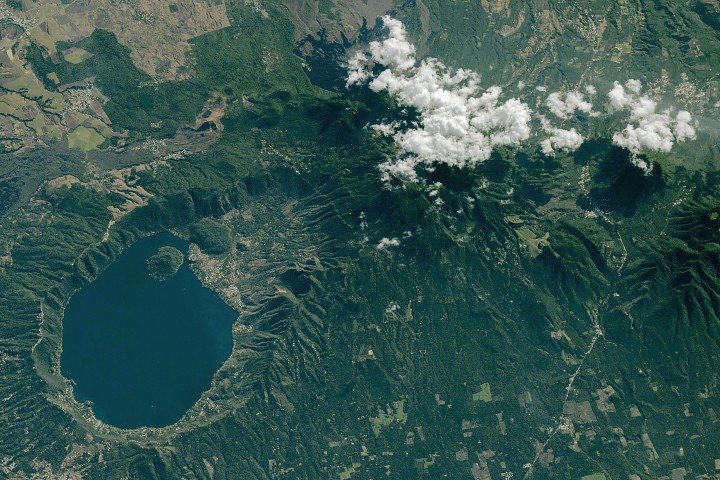
Lake CoatepequeImage of the Day for March 9, 2026Set amid El Salvador’s modern, active volcanic landscape, tranquil blue waters fill a caldera formed by ancient eruptions.
NASA Earth Observatory
Mar 09, 2026 ArticleJust inland from the Pacific coast of El Salvador, the striking blue waters of Lake Coatepeque fill part of a caldera of the same name. An astronaut aboard the International Space Station took this photo of the lake and surrounding terrain on February 10, 2026, as the station passed over Central America.
The caldera formed during a series of explosive eruptions between 72,000 and 51,000 years ago. After the caldera’s formation, additional eruptions produced several lava domes along its western side, including one that became Isla del Cerro (Isla Teopán). According to the Smithsonian Institution’s Global Volcanism Program, there have been no reported eruptions from the caldera during the Holocene (the past 11,700 years).
Today, homes, restaurants, boathouses, and other structures line the lakeshore. This human footprint extends westward toward the caldera’s steep rim, which abuts the eastern flank of Santa Ana—El Salvador’s tallest volcano. Unlike Coatepeque, Santa Ana remains active, with small to moderate explosive eruptions recorded since the 16th century. Its most recent severe eruption occurred in 2005.
Although the lake appears its usual blue in this photo, it can occasionally take on a strikingly different hue. At times, the water temporarily shifts to bright turquoise, prompting questions about its cause. In 2024, scientists reported that while pigments from microalgae and cyanobacteria can affect the lake’s color, the turquoise episodes are likely the result of natural mineralization.
The broader landscape around the lake and Santa Ana Volcano is a mosaic of urban areas, agricultural fields, and even more volcanic terrain. The city of Santa Ana lies about 15 kilometers (9 miles) to the north, while San Salvador, also nestled amid volcanoes, lies 40 kilometers (25 miles) to the east. The volcanic landscape stretches more than 1,000 kilometers (600 miles) along Central America’s Pacific coast, from Guatemala to Panama, composing the Central American Volcanic Arc.
Astronaut photograph ISS074-E-312810 was acquired on February 10, 2026, with a Nikon Z9 digital camera using a focal length of 400 millimeters. It was provided by the ISS Crew Earth Observations Facility and the Earth Science and Remote Sensing Unit at NASA Johnson Space Center. The images were taken by a member of the Expedition 74 crew. The images have been cropped and enhanced to improve contrast, and lens artifacts have been removed. The International Space Station Program supports the laboratory as part of the ISS National Lab to help astronauts take pictures of Earth that will be of the greatest value to scientists and the public, and to make those images freely available on the Internet. Additional images taken by astronauts and cosmonauts can be viewed at the NASA/JSC Gateway to Astronaut Photography of Earth. Story by Kathryn Hansen.
Downloads
February 10, 2026
JPEG (25.38 MB)
References & Resources
- Atlas Obscura (2024, November 12) Lago Coatepeque. Accessed March 5, 2026.
- La Prensa Grafica (2022, August 24) The turquoise color once again takes over Lake Coatepeque. Accessed March 5, 2026.
- NASA Earth Observatory (2023, October 14) San Salvador: A City Among Volcanoes. Accessed March 5, 2026.
- Smithsonian Institution Global Volcanism Program Coatepeque Caldera. Accessed March 5, 2026.
- Universidad de El Salvador (2024, October 3) Marine Toxins Laboratory presents study results on the turquoise coloration phenomenon of Lake Coatepeque. Accessed March 5, 2026.
You may also be interested in:
Stay up-to-date with the latest content from NASA as we explore the universe and discover more about our home planet.
A Northwest Night Awash in Light 3 min readThe glow of city lights, the aurora, and a rising Moon illuminate the night along the northwest coast of North…
Article The Galaxy Next Door 3 min readThe Large Magellanic Cloud—one of our closest neighboring galaxies—is a hotbed of star formation that is visible to both astronauts…
Article Lake Eyre Blushes 3 min readRounding out a remarkable year, the outback lake displayed distinct green and reddish water in its two main bays.
Article Keep ExploringDiscover More from NASA Earth Science
Subscribe to Earth Observatory Newsletters
Subscribe to the Earth Observatory and get the Earth in your inbox.
Earth Observatory Image of the Day
NASA's Earth Observatory brings you the Earth, every day, with in-depth stories and stunning imagery.
Explore Earth Science
Earth Science Data
Open access to NASA’s archive of Earth science data