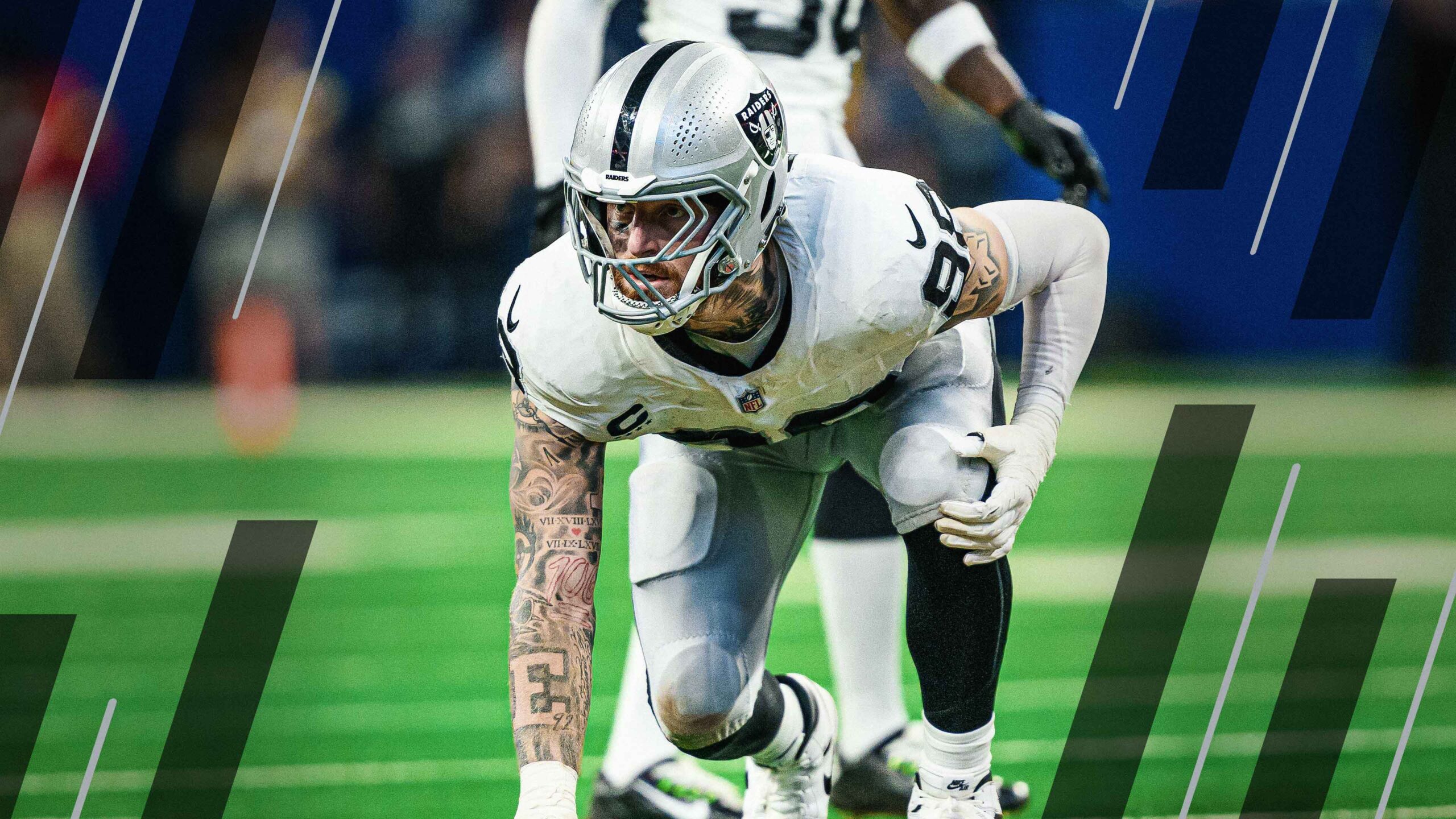
- Offensive line flexibility helped solve roster challenges: Positional versatility from Gabe Jackson and Cooper Carlisle allowed both standout guards to fit on the roster despite having spent much of their careers at the same position.
As part of PFF's celebration of 20 years of NFL data, we're building an All-Star team for every franchise, highlighting the best players at each position from the PFF era. This installment turns to the Las Vegas Raiders.
PFF's database dates back to the 2006 NFL season, providing a unique lens for evaluating and comparing players across eras. More details on the methodology used to construct these teams are available at the bottom of the page.
Offense
- QB: Derek Carr (2014-2022)
- HB: Josh Jacobs (2019-2023)
- FB: Marcel Reece (2009-2015)
- WR: Davante Adams (2022-2024)
- WR: Michael Crabtree (2015-2017)
- Slot WR: Hunter Renfrow (2019-2023)
- TE: Darren Waller (2018-2022)
- LT: Kolton Miller (2018-2025)
- LG: Gabe Jackson (2014-2020)
- C: Rodney Hudson (2015-2020)
- RG: Cooper Carlisle (2007-2012)
- RT: Cornell Green (2007-2009)
The Raiders' offensive core came together relatively easily, as nearly every selection sustained high-level play across multiple seasons. They were also one of just three teams to use more 21 personnel than 12 personnel during the PFF era, due in large part to Marcel Reece's versatility. That personnel preference ultimately left no room for Brock Bowers, despite his outstanding start to his career.
The offensive line presented a much greater challenge. Donald Penn graded as one of the top linemen on the roster but spent almost his entire Raiders career at left tackle. He briefly shifted to right tackle after the team drafted Kolton Miller, though the experiment was short-lived and unsuccessful. Similar positional overlap existed at guard, where Gabe Jackson and Cooper Carlisle spent most of their careers at right guard but logged enough time on the left side to fit together on the roster. Right tackle was also a surprisingly thin position. No Raiders player logged more than 2,500 snaps there during the PFF era, leaving Cornell Green as the clear choice based on both playing time and performance.
Defense
- DI: Richard Seymour (2009-2012)
- DI: John Henderson (2010-2011)
- ED: Maxx Crosby (2019-2025)
- ED: Lamarr Houston (2011-2013)
- LB: Kirk Morrison (2006-2009)
- LB: Denzel Perryman (2021-2022)
- SLB: Khalil Mack (2014-2017)
- CB: Nnamdi Asomugha (2006-2010)
- CB: Michael Huff (2006-2012)
- Slot CB: Nate Hobbs (2021-2024)
- S: Charles Woodson (2013-2015)
- S: Tyvon Branch (2008-2014)
The Raiders finished below league average in points allowed in 19 of the 20 seasons during the PFF era, making this one of the weaker defensive rosters in the series. The saving grace is at the top, where Khalil Mack and Maxx Crosby stand out as the two best defensive players in franchise history under this methodology. To maximize the roster, Mack was moved to strongside linebacker — a position he played during his rookie season — creating room for Lamarr Houston on the edge.
Safety was the deepest position on the defense. Charles Woodson, Tyvon Branch and Michael Huff all built strong cases for inclusion, though Huff's final season with the Raiders came at outside cornerback. Because he performed well in that role, moving him to cornerback produced the strongest overall lineup. Woodson also spent several seasons at cornerback in Oakland, but those came before the start of the PFF era. During his four qualifying PFF-era seasons with the franchise, he lined up exclusively at safety.
Methodology
Selections were based on normalized PFF grades adjusted by season. To balance peak performance and longevity, only a player's five best seasons with a franchise from 2006-25 were considered. Any season with an overall PFF grade below 60.0 was excluded, ensuring that strong years helped a player's case while weaker seasons were not held against him. Postseason play was included, though all seasons were capped at a 16-game equivalent to maintain consistency across eras. At each position, the player with the highest score under this methodology earned the spot.
Each team consists of 12 offensive and 12 defensive players. Because 11 personnel and nickel defense were the league's most common alignments over the past two decades, those personnel groupings served as the foundation for every roster. Teams received either a second tight end or a fullback, depending on whether they used more 12- or 21-personnel. Defensively, teams received either a third interior defender or a third linebacker depending on whether they primarily operated from a 3-4 or 4-3 front.
Players who logged significant snaps at multiple positions during their tenure with a franchise were eligible at either spot. In most cases, those players were assigned to the position where they provided the greatest value, though their versatility occasionally influenced the final roster construction.
Unlike some All-Pro teams that group offensive linemen by position type, these rosters were built according to where players actually lined up. If a team's two best tackles both played exclusively on the left side, only the top left tackle was selected. One of the three wide receivers and one of the five defensive backs was also required to have significant slot experience. In a 4-3 defense, one linebacker needed experience at the Sam linebacker position, while in a 3-4 defense, one defensive tackle needed experience at nose tackle.
When multiple players are listed at the same position, the first name represents the top selection. Players designated as slot wide receiver, slot cornerback, nose tackle or Sam linebacker were selected specifically for those roles rather than as the third-best player within their broader position group.