Society
Life on pause for the 'sandwich generation'Thousands of people bear the emotional, economic and professional cost of simultaneously caring for children and elderly or dependent parents
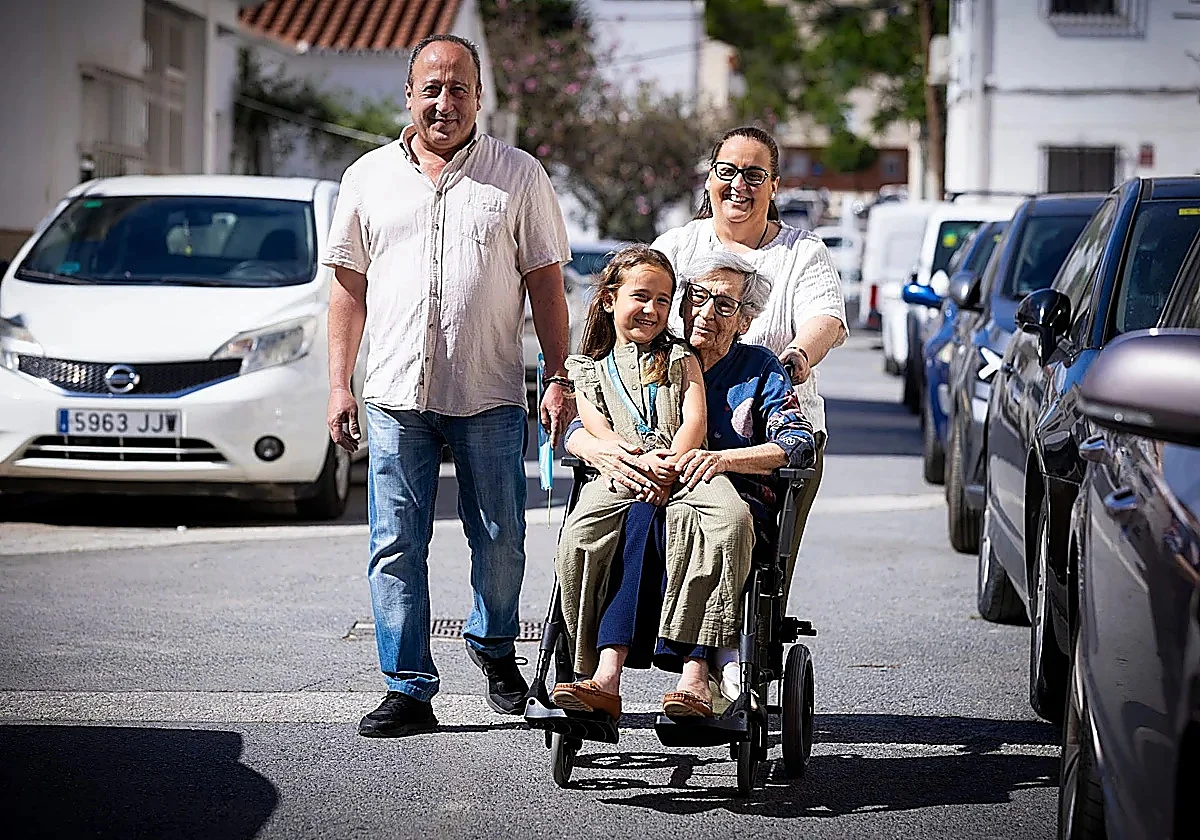
Añádenos en Google Eva Cruzado taking her mother for a walk, accompanied by her husband and daughter, in Malaga. (Marilú Báez)Cristina Zamora
08/06/2026 a las 14:07h.A son starting his day early to take his mother to the doctor, a woman answering emails while organising her father's medication, a couple juggling impossible schedules between the children and hospital visits. This is the daily reality for thousands of families, part of the so-called "sandwich generation".
Kentucky University Professor Dorothy A. Miller coined the term in 1981 to describe people between the ages of 40 and 55 who simultaneously care for their children and dependent parents.
In Andalucía, 56.6 per cent of caregivers experience this dual responsibility, according to Cinfa laboratories, with the endorsement of the Spanish society of geriatrics and gerontology (Segg). Almost eight out of ten combine caregiving with their jobs.
Those surveyed dedicate an average of 21.5 hours per week to caring for a family member and three out of four admit to having sacrificed parts of their lives: leisure, rest or time with friends and family. "We often talk about statistics, but behind them are people suffering," PhD in Psychology Rebeca Cáceres says. The strain, she points out, is not only physical: it affects relationships, life plans and self-perception.
One of the most frequent patterns in therapy is "tunnel vision". The needs of the dependent person end up consuming everything. "The most common risk is forgetting about oneself and that there is other life around," Cáceres says.
For this reason, she insists on the importance of maintaining a certain level of personal stability. "For all areas of life to be in balance, the caregiver must feel balance."
The cost is also professional and financial. Many people reduce their working hours or put professional projects on hold: 19.1 per cent admit they cannot afford another care option and 12.2 per cent face this responsibility alone.
The Cinfa survey finds that the majority of family caregivers are women in their late 40s and early 50s. Women represent almost two-thirds of those providing care, typically for parents over 81 years of age with some degree of dependency. Although Cáceres sees progress in male co-responsibility, she believes a cultural legacy persists.
The psychologist states that sustainable care is impossible without a support network comprised of family, friends, healthcare professionals, social workers and other caregivers. "Sharing with someone who understands what you're going through brings relief," she says, although also warning of the risk of becoming isolated solely within circles of caregivers.
Guilt, Cáceres adds, often arises when the caregiver tries to carve out time for themselves. "It's not about guilt, but about responsibility. If you don't take care of yourself, you won't be able to take good care of others."
President of Segg Francisco José Tarazona warns of the need to look after those who provide care. "Caring for the caregiver is also caring for our elderly."
It's been 38 years since Natividad Gambero married Fede. Barely a year had passed since their wedding when her parents began needing assistance. Living with them ceased to be a temporary arrangement and became a way of life. Since then, they have lived together, first in Seville, then in Malaga.
Nati is now 63 and her father is about to turn 100. Her mother passed away three years ago. Her 31-year-old daughter still lives at home and her 36-year-old son has already moved out. Nati's life has unfolded in that kind of silent balance that many families maintain without even realising it: caring for the children while the parents age at the same time.
"My parents have helped us immensely," she says. Especially when her husband worked away from home and she was left alone with the children. She studied law, but never practiced. "It wasn't something I decided on. Circumstances just lead you there," she says.
While her children were young, her parents still maintained their independence and, far from needing constant care, were a source of support and companionship. "They've witnessed my children's entire upbringing."
Over time came illnesses, surgeries and increasing dependence. At first, it was manageable. Then, everything became a priority. The family haven't gone on vacation in 12 years. "I wouldn't call it a sacrifice, but there are definitely many things to give up," Nati says.
Going out with friends, throwing a dinner party or simply having some time for themselves has become more difficult as caring for her father demands more attention.
Right now, she admits, they are going through a particularly difficult time. Her father now needs two people to move him and their daily routine revolves entirely around him: meals, personal hygiene, rest. "We live constantly aware of the schedules and needs of a man who is almost 100 years old," she says. There is exhaustion, though she avoids making a big deal of it.
Sometimes, even when she manages to get out for a few hours, the guilt creeps in. "You're always thinking, 'Is she okay?'" she says. "People say it's like taking care of a child, but it's nothing like that. A baby is a life just beginning, here you're watching a person's abilities gradually diminish."
Nati speaks little of herself and much of others, especially her husband. "The credit here is his," she repeats several times during the conversation. "They aren't his parents and without him, this would be impossible." He has been by her side throughout these years of living and caring for her, first with both of his in-laws and now with a man approaching 100. Despite the strain, he has no regrets. "I would do it all again."
At 4am, before dawn in Malaga, Eva Cruzado is already awake. While her husband gets ready for his shift at a warehouse, she prepares lunch, tidies the house and organises the day before waking her seven-year-old daughter. "Time can't be bought," she says. In her routine, time is always short.
Eva is 51 years old. Just a few months ago, she finished her degree in Education at Malaga University. She started at 25, but had to abandon her studies. Her life has revolved around the needs of others.
First, it was her father, who had lung cancer. Then her mother, whom she remembers as having been ill "for as long as [she] can remember". Next came the high-risk pregnancies, four miscarriages and, finally, her daughter Daniela, born in 2019, when Eva was 43.
A few months after giving birth, in the midst of the pandemic, her mother suffered two strokes and had to temporarily move into her home. The little girl was just a baby. Eva remembers those months as a succession of emergencies, sleepless nights and constant fear of not being able to cope. "If one of them got sick, they both would," she says.
She speaks quickly, as if she's still organising tasks while talking to SUR. She describes schedules, calls, commutes and small, everyday decisions that end up taking up all her time. Leaving her daughter at preschool for longer hours so she can go to the doctor. Rushing out of the emergency room before her husband starts work. Thinking every night about how to fit in the next day.
Although her mother no longer lives with her, Eva spends a good part of the day looking after her. She coordinates medication, medical appointments, visits and the times when her mother can be alone for the shortest time possible. Her brother covers nights. A home care aide comes for a few hours a day. Eva handles the rest herself.
Every afternoon, Eva's husband picks up their daughter from school. After lunch, Eva returns to her mother's house. Sometimes with the little girl. Sometimes alone. She comes back at night. "When you get home at 8pm or 9pm, you're no longer a person," she says.
She recounts times when she barely slept, worrying about how to cope with the next day. She says she's turned down jobs because she felt like she was abandoning her mother. Even now, while taking a training course to qualify for a job with the 061 emergency services, she still grapples with the guilt. "I think I have to give myself that chance, but it's complicated."
The strain has also taken a physical toll. She has suffered from health problems since her pregnancy and admits that for years she always put herself last. "You take care of your daughter, your mother and whoever else needs it. Only when you can't take it anymore, then you listen to yourself."
By 9am, she's already gone in and out of the living room several times. First, she leaves her mother sitting with her novel, then she gets the little girl ready for school. Before closing the door, she glances back inside. "I won't be long," she tells her mother, even though she knows any errand can get delayed.
Carmen is 37 years old and lives in Malaga with her three children, ages 13, 12 and six, and her mother, who has been under her care for over a decade. Since her father's death, her mother has fallen into a deep depression that, over the years, has led to episodes of disorientation and memory loss.
While recalling particularly difficult periods, Carmen links dates and delicate moments in hospitals. She also mentions her own health problems: vertigo, anxiety, dizziness and a recognised disability. "I don't know where I get the strength," she says. But she does.
For years, raising her children coincided with her mother's declining health. The hardest moment came when her youngest child was hospitalised for a month with severe respiratory problems. While she slept in a hospital chair, watching over him, her mother had an accident at home. "She fell asleep cooking and burned her face and arm," Carmen says. Carmen cried in the hospital, thinking that if she had been with her, it wouldn't have happened.
Often, these responsibilities fall on a single person, mostly women, leaving little room for rest, work or personal life. In Carmen's case, this also applies to employment. Her last job was cleaning offices in downtown Malaga, but she ended up leaving. "I couldn't leave the children alone with her," she says. Today, the family's finances depend on her mother's widow's pension and the disability assistance she receives. Between them, they barely exceed 1,500 euros a month for five people.
The sacrifices extend to the most basic things. Carmen says she hasn't gone out for years for anything other than solving problems. She's spent periods wearing the same shoes because she preferred to spend the money on her children or her mother's medication.
Her eldest daughter, now a teenager, keeps urging her to go out for a while, even if it's just for a coffee. Carmen listens to the suggestion, but admits that she always ends up thinking about schedules, doctors and childcare. "My mind is always on my children and my mother. Nothing else matters to me."