Zoom
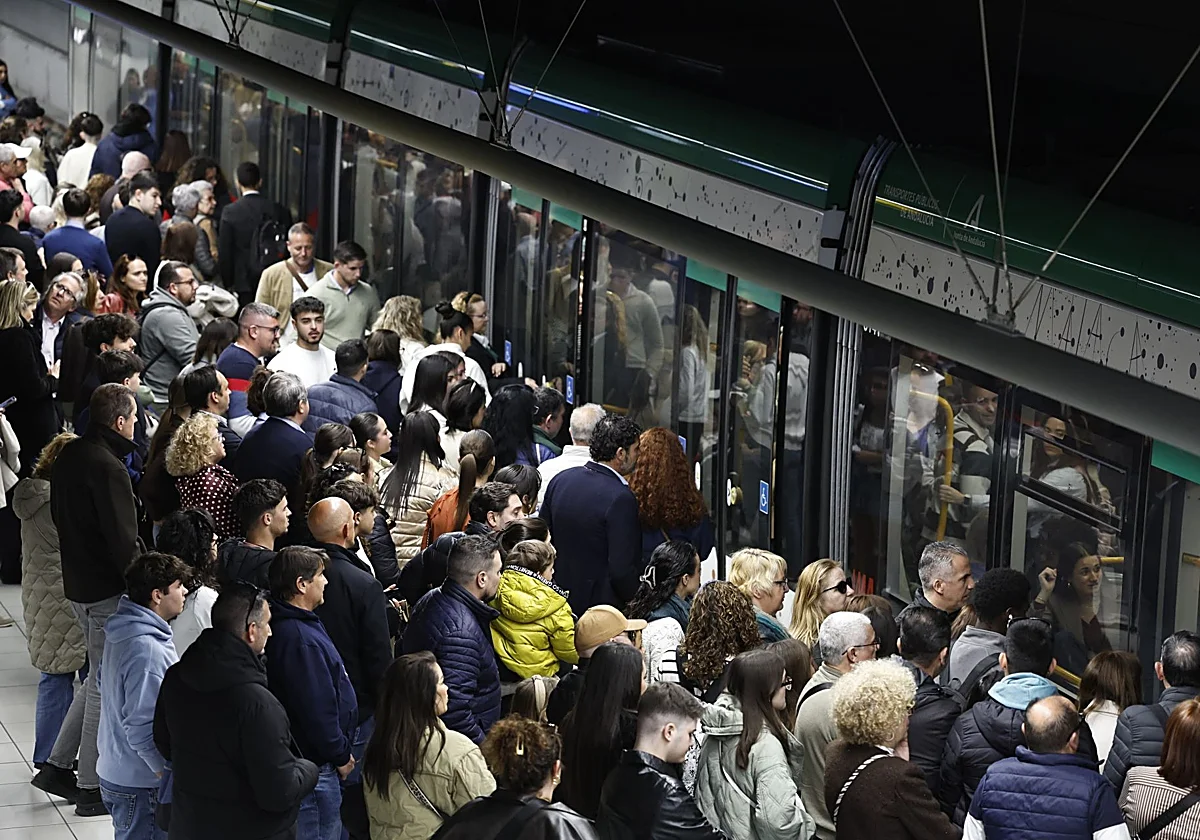
Crowds of passengers trying to get on the metro at the Palacio de los Deportes. SALVADOR SALAS Easter train strikes Long queues and overcrowding at Malaga metro as Easter Monday strikes disrupts travelTravellers reported waiting for multiple trains or abandoning their journeys altogether
Málaga
Tuesday, 31 March 2026, 13:20
The disruption came on one of the busiest days of the year for the metro system, which acts as an essential travel link to the Semana Santa processions. Holy Week 2025 set the record for highest number of users on a single day, with a total of 113,880 - figures unlikely to be surpassed this year due to the partial workers’ strike.
Despite the regional government imposing minimum service levels of 60% during strike hours (5:30 pm to 8:30 pm), passengers reported significant delays and overcrowding throughout the network.
At La Luz- La Paz station, trains were arriving already full, with no one getting off and only a few of those waiting on the platform managing to get on.
On Holy Wednesday, the strike will be from 5pm to 8pm, and on Maundy Thursday, from 6pm to 9pm.
Many passengers waited for several trains to pass before finding space, while others left in search of alternative means of transport. Some even gave up altogether and went home to watch the processions on TV.
Others adopted tactics such as travelling in the opposite direction (to Palacio de los Deportes) in order to secure a seat when the train turned back toward the centre.
“We knew there was a strike today, we came with plenty of time but now we are going to go to Martin Carpena, because when the train comes we won’t fit” said Isabel and Antonia. "On the Cercanías it is also impossible to get on, I suffered it last year".
Travelling against the flow
Families were particularly affected. Miguel was trying to travel with Loli and Leo, who is experiencing his first Semana Santa. "We haven't even tried to get on the one that came before, let alone with a pushchair," he said, adding that a few extra carriages would make a significant difference given the length of the platforms.
The situation was no better further down the line, at the Palacio de los Deportes on the end of line 2, even bigger crowds had gathered . At this time of day two groups converge: those entering through the station entrance, both local residents, and commuters from the Greater Malaga area who have parked their cars in the stadium car park and intend to travel into the city centre by underground.
Witnesses describe a very similar situation on line 1, at the above-ground stops on the University of Málaga campus, which many people are also using these days as a car park for connections.
The workers’ partial strikes are scheduled twice more during Holy Week: on Holy Wednesday (1 April), from 5 pm to 8 pm, and on Maundy Thursday (2 April), from 6 pm to 9 pm. On both days, staff will gather at El Perchel station, next to María Zambrano.
At a rally on Easter Monday, Alexis Martín, president of the Málaga metro works council (CSIF), set out the union's position. "The company does not want to sit down with the workers," he said. "It made a proposal last Thursday that was worse than the one already rejected by 70% of the workforce two weeks earlier. We are forced to go on strike on Easter Monday — the busiest day on the metro — but the company has shown no intention of negotiating, and neither has the Junta de Andalucía, which does not appear to be mediating."
Evaristo Castillo, the CCOO representative and the official calling the strikes, said that with minimum services set at 60% and a planned frequency of four and a half minutes, strike action had more than doubled waiting times. "On Line 2 it's eight and a half minutes — probably going to nine or ten, because there are quite a lot of people. And on Line 1 it's seven and a half minutes. People at Palacio de Deportes can no longer get on, and the same thing is happening on Line 1 on the surface section."