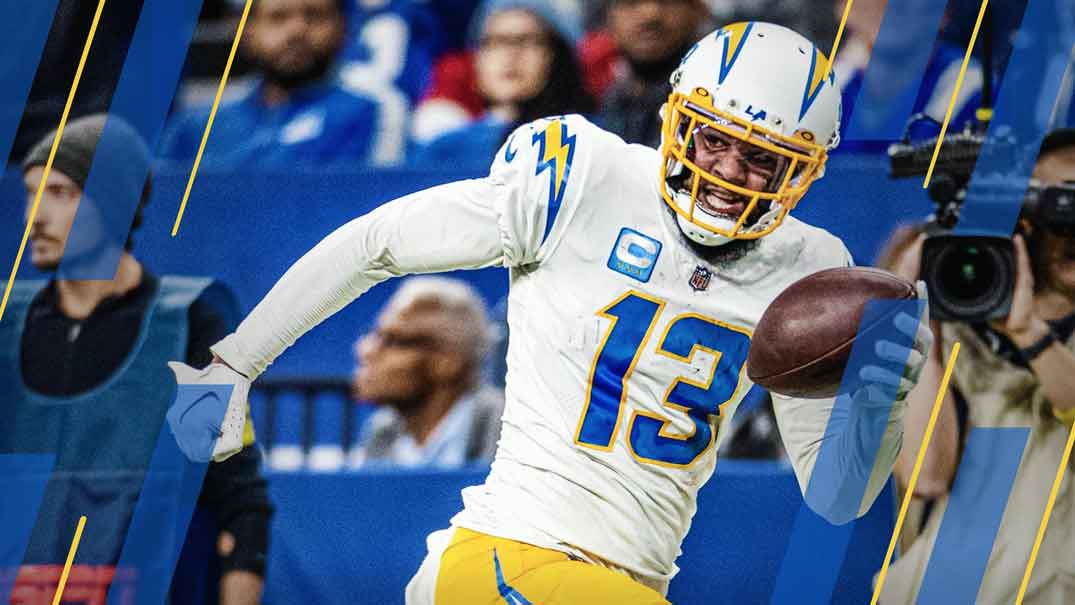
- Austin Ekeler earned a surprising nod over LaDainian Tomlinson: Despite Tomlinson's Hall of Fame résumé, much of his prime occurred before the PFF era, while Ekeler's rushing efficiency and receiving production strengthened his case.
- Joey Bosa headlines a defense built around pass rush and secondary play: Bosa, Khalil Mack, Derwin James Jr. and Eric Weddle anchor a unit shaped by the Chargers' long-term investment in premium defensive positions.
As part of PFF's celebration of 20 years of NFL data, we're building an All-Star team for every franchise, highlighting the best players at each position from the PFF era. This installment turns to the Los Angeles Chargers.
PFF's database dates back to the 2006 NFL season, providing a unique lens for evaluating and comparing players across eras. More details on the methodology used to construct these teams are available at the bottom of the page.
Offense
- QB: Philip Rivers (2006-2019)
- HB: Austin Ekeler (2017-2023)
- WR: Vincent Jackson (2006-2011)
- WR: Malcom Floyd (2006-2015)
- Slot WR: Keenan Allen (2013-2025)
- TE: Antonio Gates (2006-2018)
- TE: Hunter Henry (2016-2020)
- LT: Rashawn Slater (2021-2024)
- LG: Kris Dielman (2006-2011)
- C: Corey Linsley (2021-2023)
- RG: Mike Goff (2006-2008)
- RT: Jeromey Clary (2007-2013)
The Chargers are one of the few franchises to sustain elite quarterback play throughout the PFF era, making this one of the more difficult offensive rosters to assemble. Philip Rivers ultimately earned the nod over Justin Herbert thanks to both a higher peak and a longer track record. Rivers authored the Chargers' two highest-graded quarterback seasons in 2009 and 2010, and while Herbert's floor has been higher, this methodology places greater emphasis on each player's five best seasons.
That same dynamic played out across much of the offense. Players who spent the bulk of their careers catching passes from Rivers often held advantages in both longevity and cumulative production, allowing Vincent Jackson and Malcom Floyd to edge out Mike Williams for the outside receiver spots.
Running back produced the roster's biggest surprise. Austin Ekeler earned the position over Hall of Famer LaDainian Tomlinson, though the comparison comes with an important caveat. Tomlinson's first five NFL seasons occurred before the start of the PFF era and therefore were not included in the evaluation, excluding four of his six All-Pro campaigns.
Even so, Ekeler's résumé compares favorably. He averaged 4.4 yards per carry during the PFF era compared to Tomlinson's 4.3, despite receiving less help from his offensive line. Tomlinson averaged 1.9 yards before contact per attempt and 2.4 yards after contact, while Ekeler averaged 1.3 yards before contact and 3.0 yards after contact. Ekeler also provided significantly more value as a receiver, finishing with more than twice as many receiving yards and more than four times as many receiving touchdowns.
Defense
- DI: Luis Castillo (2006-2011)
- DI: Poona Ford (2024)
- NT: Jamal Williams (2006-2009)
- ED: Joey Bosa (2016-2024)
- ED: Khalil Mack (2022-2025)
- LB: Denzel Perryman (2015-2020, 2024-2025)
- LB: Brandon Siler (2007-2010)
- CB: Casey Hayward Jr. (2016-2020)
- CB: Quentin Jammer (2006-2012)
- Slot CB: Desmond King (2017-2020)
- S: Eric Weddle (2007-2015)
- S: Derwin James Jr. (2018-2025)
The Chargers invested heavily in the secondary and pass rush throughout the PFF era, often at the expense of linebacker and defensive tackle. As a result, some positions featured clear-cut selections, while others produced some of the closest debates on the roster.
Joey Bosa was an easy choice as the top front-seven defender, earning a 91.5 PFF grade across more than 5,000 defensive snaps. The second edge spot, however, was far more competitive. Shaun Phillips, Melvin Ingram III and Khalil Mack all built strong cases, but Mack ultimately earned the nod on the strength of his elite play. His pressure rate (14.4%) exceeded those of Ingram (13.6%) and Phillips (10.1%), and he also held a clear advantage as a run defender.
Quentin Jammer narrowly secured the final cornerback spot over Jason Verrett. While Verrett reached a higher peak and ranked among the NFL's best cornerbacks when healthy, injuries limited both his playing time and résumé. Jammer's longevity ultimately proved decisive.
Poona Ford was one of the rare players to make one of these teams after spending just a single season with the franchise. Such a selection typically requires both an exceptional individual season and limited competition at the position. Ford delivered the former, earning an 85.4 PFF grade in his lone year with the Chargers — the highest mark by any Chargers interior defender with at least 600 snaps during the PFF era. Jamal Williams was the only other interior defender to record a season grade above 70.0.
Methodology
Selections were based on normalized PFF grades adjusted by season. To balance peak performance and longevity, only a player's five best seasons with a franchise from 2006-25 were considered. Any season with an overall PFF grade below 60.0 was excluded, ensuring that strong years helped a player's case while weaker seasons were not held against him. Postseason play was included, though all seasons were capped at a 16-game equivalent to maintain consistency across eras. At each position, the player with the highest score under this methodology earned the spot.
Each team consists of 12 offensive and 12 defensive players. Because 11 personnel and nickel defense were the league's most common alignments over the past two decades, those personnel groupings served as the foundation for every roster. Teams received either a second tight end or a fullback, depending on whether they used more 12- or 21-personnel. Defensively, teams received either a third interior defender or a third linebacker depending on whether they primarily operated from a 3-4 or 4-3 front.
Players who logged significant snaps at multiple positions during their tenure with a franchise were eligible at either spot. In most cases, those players were assigned to the position where they provided the greatest value, though their versatility occasionally influenced the final roster construction.
Unlike some All-Pro teams that group offensive linemen by position type, these rosters were built according to where players actually lined up. If a team's two best tackles both played exclusively on the left side, only the top left tackle was selected. One of the three wide receivers and one of the five defensive backs was also required to have significant slot experience. In a 4-3 defense, one linebacker needed experience at the Sam linebacker position, while in a 3-4 defense, one defensive tackle needed experience at nose tackle.
When multiple players are listed at the same position, the first name represents the top selection. Players designated as slot wide receiver, slot cornerback, nose tackle or Sam linebacker were selected specifically for those roles rather than as the third-best player within their broader position group.