Business
Malaga business owners fear lack of housing hinders economic growthThey have urged the authorities to design "a medium and long-term investment model" to prevent the "paralysis" of Malaga's development
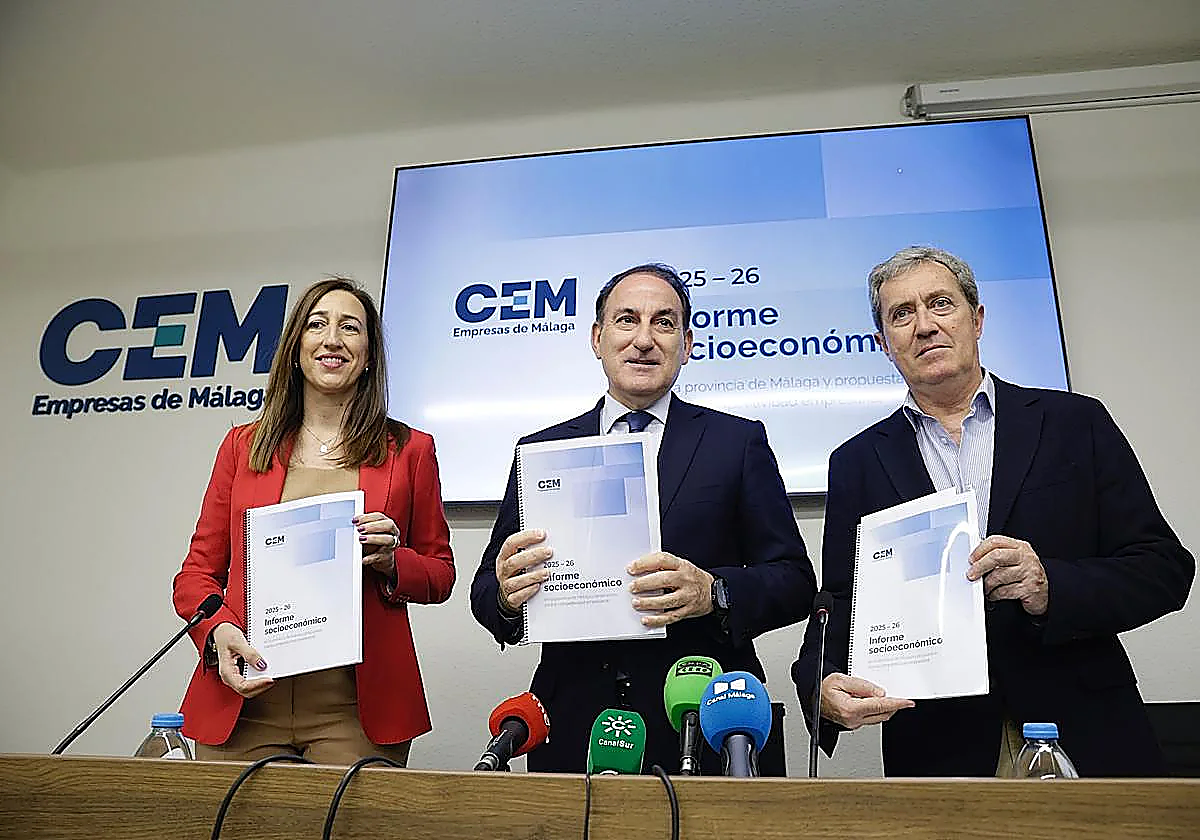
Añádenos en Google The CEM association's executive team in Malaga. (Migue Fernández)Cristina Vallejo
21/05/2026 a las 16:22h.Malaga province's business owners fear that the lack of housing is hindering economic growth and development.
"The difficulty of accessing housing is becoming a major economic and social problem, impacting the ability to attract talent, business development and even territorial cohesion," deputy executive president of the confederation of Malaga business owners (CEM) Natalia Sánchez said during a report presentation on Thursday.
Sánchez highlighted the organisation's proposed solutions to the housing crisis facing Malaga and the entire country. "It is essential to increase the housing supply, streamline urban planning procedures, generate legal certainty, incentivise private collaboration and alleviate the current tax burden on housing," she said.
Sánchez denounced that "25 to 30 per cent of the price of a home is taxes". According to the CEM's calculations, this is well above the average tax on the matter in all OECD countries.
Sánchez pointed out that, although the construction sector is still showing capacity to generate activity and employment, "very relevant structural problems persist, especially with the lack of housing". She highlighted "the scarcity of productive and residential land, administrative slowness and the need to improve energy and transport infrastructures".
Housing wasn't the only issue the Malaga employers' association raised. "The summary of our report highlights Malaga's current strength, its dynamism, a province that is growing and generating economic activity. However, it also includes data that is concerning to us: Malaga's growth is not guaranteed. The pace of development in a province cannot be guaranteed without ambition, planning and a long-term vision. We cannot rely solely on inertia," CEM president Javier González de Lara said.
He called for "building a future with the next ten or 20 years in mind". "What we lack is future planning, like what happened 15 or 18 years ago when major infrastructure projects emerged in our province. Without a medium- and long-term investment model, provinces and territories stagnate," González said.
He reiterated his demands: resolving the congestion on the eastern ring road, the stifling of the Axarquía district in terms of travel to Malaga and advances in the coastal train project.
The CEM is also interested in the airport expansion project. "It's almost at its operational limit. If they're talking about 2032 or 2034, Malaga risks growth stagnation," he said.
González also addressed the energy situation. "More than a year ago, the CEM brought to the public's attention that Malaga was on the verge of its electrical grid being overloaded. This has now been confirmed."
The paradox is that Andalucía is the second largest producer of renewable energy in Spain, but it lacks the capacity to distribute it. The energy grid is saturated. González urged Red Eléctrica (the Spanish electricity grid operator) to recognise the importance of investment in dynamic provinces such as Malaga.
González addressed public institutions, asking them to respond to Malaga's generosity with reciprocity. He highlighted the province's success in creating jobs, with 50,000 new contributors to social security in just two years.
"There is no province in Spain that surpasses Malaga, except for Madrid and Barcelona. Malaga is generous, it creates jobs, it creates economic activity. Will we be able to sustain this rate of growth? We have our doubts," González stated.
The meeting stressed that the province's population is growing fast, which demands additional planning, investment and implementation capacity.
Natalia Sánchez stated that the province had once again demonstrated a strong capacity for economic growth in 2025, with GDP growth of 3.7 per cent, the highest in Andalucía and above the regional, national and European averages. This is all the more remarkable given the international context marked by geopolitical uncertainty, trade tensions and volatile energy prices.
Malaga was able to create more than 8,000 companies last year, placing it third in the national ranking. This has led to over 60,000 companies registered with Social Security and 143,000 self-employed workers.
Sánchez also mentioned record exports and Malaga's consolidation as a leading hub in Southern Europe for artificial intelligence, microelectronics, cybersecurity and semiconductors. However, she also pointed out the challenges facing the agricultural sector.
The CEM predicted that this year Malaga will register a moderation of growth to 2.5 per cent. "Malaga will continue showing positive performance, but in a more uncertain environment, conditioned by geopolitical tension, international conflicts, trade difficulties and the risks associated with energy costs," it concluded.