Society
Malaga pioneers publicly funded property administrators for low-income residential blocksAround 20 blocks in the Las Flores and Palma-Palmilla districts already benefit from this scheme, which organisers hope to roll out across Andalucía
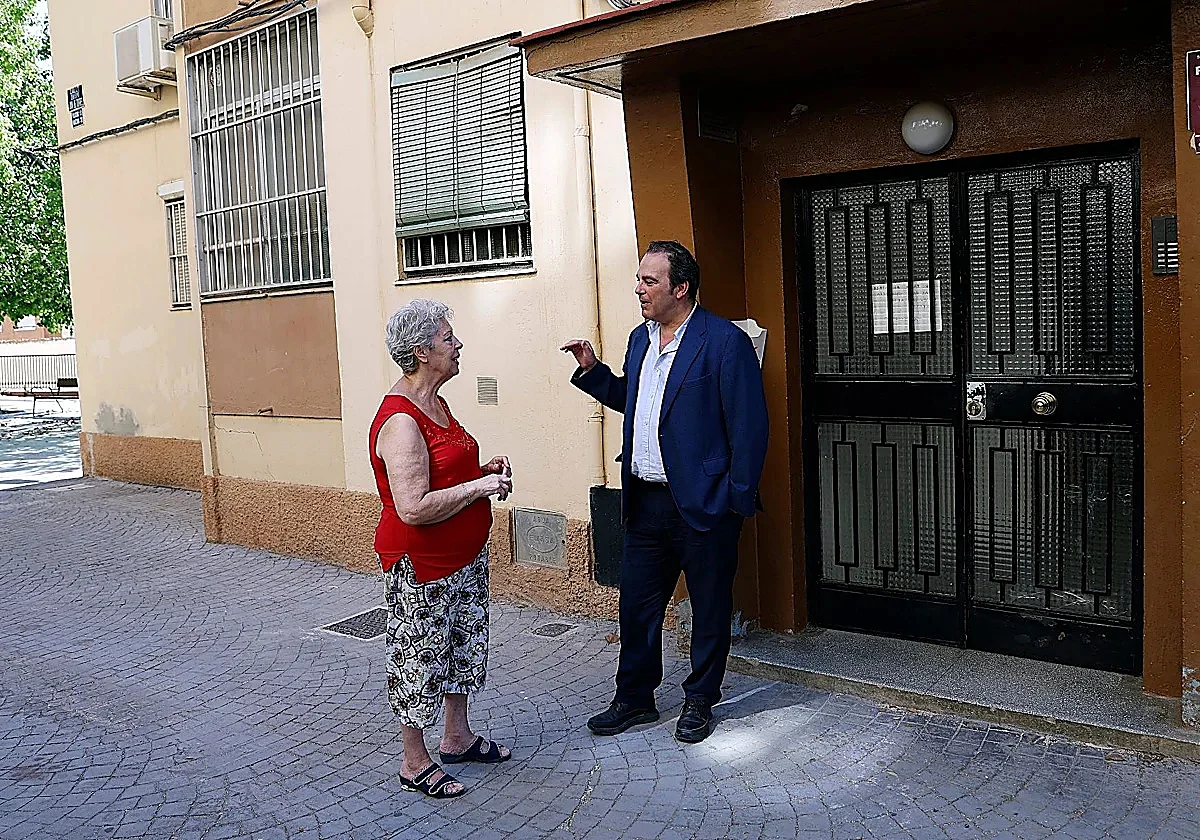
Añádenos en Google Property manager Sergio Álvarez talking to Carmen Ruiz, former president of a homeowners' association in the Las Flores district. (Migue Fernández)Susana Zamora
13/07/2026 a las 14:29h.Exactly one year ago, on 14 July 2025, Malaga city council and the Malaga and Melilla association of property administrators signed a groundbreaking agreement to launch Spain's first scheme providing publicly funded property administrators for owners' associations in low-income residential blocks.
The association says the initiative has proved a success. Every available property administrator has been assigned, the funding has been fully committed and the first buildings to join the scheme now operate smoothly.
The programme helps residential blocks with limited financial resources establish or revive their owners' associations. Many of the buildings, particularly in districts such as Palma-Palmilla and Las Flores, had long struggled with maintenance issues and poor management.
The scheme provides a qualified property administrator to organise the finances, oversee the day-to-day running of the building, call residents' meetings, prepare minutes, regularise payments and apply for public grants for building refurbishment, drainage works and water supply improvements.
President of the Malaga and Melilla association of property administrators Manuel Jiménez is delighted with the response. The scheme has reached capacity because the available funding has already been allocated to cover its full four-year duration.
The city council awarded the association a direct grant of 250,000 euros. The funding covers the service on a sliding scale: residents pay nothing in the first year, then contribute 25 per cent of the fees in the second year, 50 per cent in the third and 75 per cent in the fourth. Jiménez says that each time a new block joins the scheme, the association must set aside enough funding to cover the full four years.
"We can't spend all the money this year and then tell a building in its third year, when it's entitled to 50 per cent funding, that we can't pay because we've run out of money," Jiménez said.
A total of 25 property administrators joined the scheme during its first year. Most manage one residential block, while a few oversee two. The programme now supports 27 residential blocks in total.
"Two administrators withdrew after realising how much work the role involved, although we'd already allowed for that possibility," Jiménez said.
Their role goes far beyond attending meetings or keeping the accounts. Before paying their fees, the association audits each administrator's work. They must provide evidence of everything they have done, including meeting notices, minutes, financial statements, tax returns and grant applications. They also upload all the documentation to a digital platform that the municipal housing institute can access, allowing the city council to monitor how public funds are being used.
One of the first property administrators to join the scheme is Sergio Álvarez, an economist who has run his own property management practice since 1999. He joined in February and took over the management of a ten-flat block on Calle Obispo Juan de Torres, in Las Flores, which had never employed a professional property administrators.
Álvarez held his first meeting with residents that same month. He explained how the scheme worked, outlined the owners' rights and responsibilities, and described the benefits of professional management.
According to Álvarez, tackling unpaid service charges became his first priority. When he took over, residents owed 3,415 euros in outstanding fees. "Three months later, we've reduced the debt to just 110 euros without taking legal action," Álvarez said.
Álvarez credits that success to greater financial transparency and independent administration. Once he reviewed the accounts and clearly showed owners what they owed, many began settling their arrears.
"The building functioned reasonably well, but we needed to organise the budgets, accounts and outstanding debts, as well as adjust the service charge to reflect the building's actual costs," he said.
The residents have already applied for a municipal grant to install individual water meters and carry out repairs to the drainage system and soil pipes. They approved the application on 7 May and submitted the paperwork on 20 May.
"We're still waiting for a decision, but by then we hope to have built up enough reserves to cover the small contribution the residents will have to make. The work costs 25,000 euros. Without the grant, these buildings simply couldn't afford a one-off levy of that size," Álvarez said.
A vital role
Residents say they welcome both the appointment of a professional manager and the prospect of individual water bills.
"It's only fair that each family pays for the water it actually uses instead of sharing the cost through the service charge. Without a grant, we simply couldn't afford it," Carmen Ruiz, who chaired the residents' association for five years, said.
Jiménez believes this highlights one of the scheme's greatest strengths. Without professional management, many vulnerable apartment blocks miss out on public funding. Applying for grants, managing building work and accounting for the money afterwards demands expertise that many residents simply don't have.
He also points out that Malaga became the first city in Spain to introduce a municipal scheme of this kind. The region of Valencia already operates a similar programme at regional level and the Andalusian association of property administrators hopes to introduce the model across Andalucía as part of future building refurbishment schemes.