Traffic
Malaga province issues 250,000 traffic fines every yearOver the past decade, speeding has accounted for three out of every four fines, while alcohol use is down and drug use is up
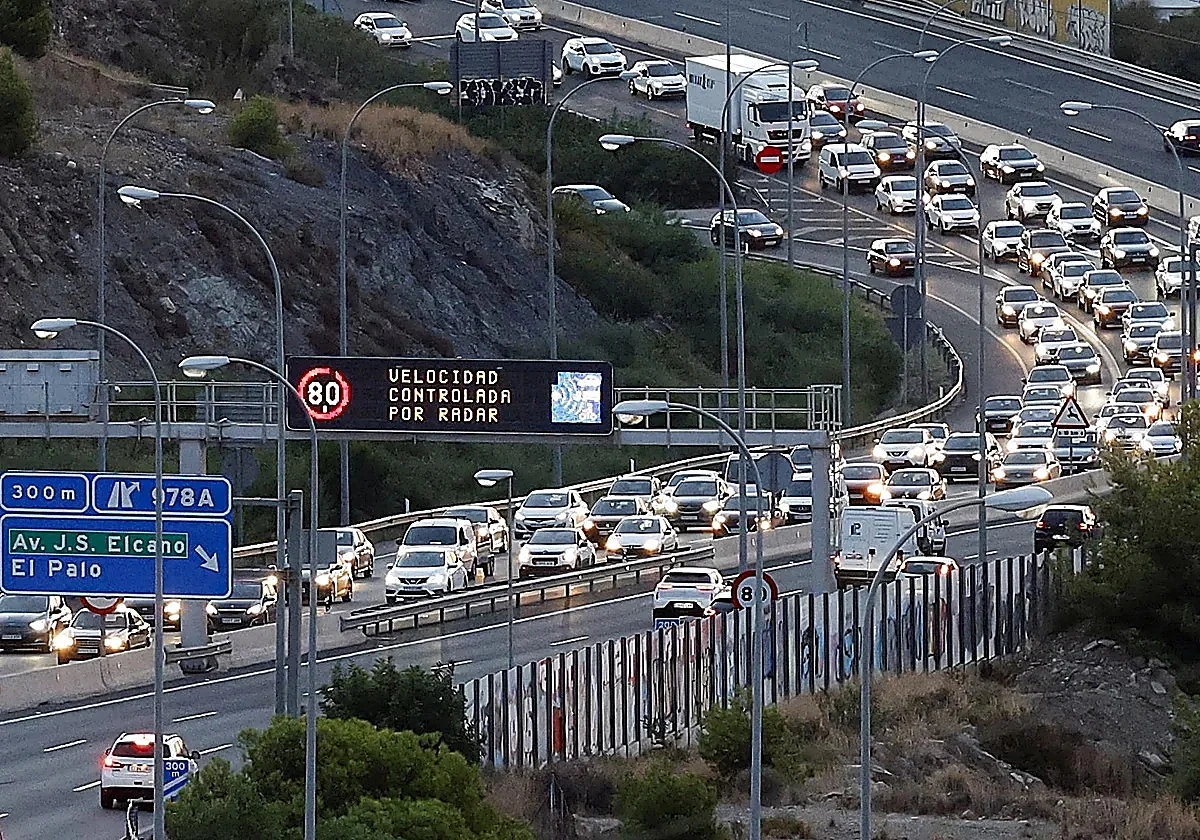
Añádenos en Google The speed camera on the eastern ring road between the Cerrado de Calderón and El Palo interchanges is one of the devices with the highest number of issued fines in Malaga province. (SUR)Chus Heredia
09/06/2026 a las 10:08h.Malaga is one of the provinces with the highest number of fines for irresponsible driving. Statistics from the DGT traffic authorities confirm this.
Cameras and police patrols catch around 800 drivers every day. Last year, the total number of fines was 282,163. This, however, represents a 14 per cent decrease.
In 2024, the province of Malaga recorded 331,520 traffic violations. Although this represents a slight decrease compared to the record in 2023 (344,111 fines), the volume of fines is significantly higher than pre-pandemic figures, with 171,870 cases in 2019.
What are the most common traffic violations? SUR has analysed the records of the last decade, between 2015 and 2024, to be precise. The first conclusion is obvious: speeding accounts for 76 per cent of fines.
Speeding remains, by a wide margin, the most common traffic violation in the province. Automatic speed cameras and vehicle inspections account for the majority of fines.
Fixed speed cameras issued 221,209 fines in 2024, representing 66 per cent of all fines. Mobile speed cameras issued 31,934 fines, showing a significant increase compared to previous years.
Driving with an expired or failed vehicle inspection (ITV) also accounts for a significant portion of fines, with 27,433 drivers reported in 2024.
Further down the list are violations linked to lacking or having an invalid driving licence or permit: 7,472 fines.
In 2024, the DGT issued up to 5,023 fines for driving without the required mandatory insurance. Their portion has been increasing over the last decade.
Other relevant infractions in 2024 included the use of a mobile phone (4,942); not wearing a seat belt (4,045); and the failure of the vehicle owner to identify the driver (3,693).
The number of traffic fines in Malaga over the last decade has fluctuated. In 2015, the province recorded 324,362 fines, a figure that dropped drastically in 2016 (225,083), mainly due to reduced effectiveness of fixed speed cameras that year. The lowest number, however, was in 2019, with only 171,870 total fines.
Starting with the year of the lockdown, a four-year escalation began. In 2020, fines rose to 229,311 despite reduced traffic, driven by the use of overhead speed cameras. Subsequently, the province exceeded 300,000 fines annually for three consecutive years (2022, 2023, and 2024).
One statistic that worries authorities is the trend in sanctions for substance use. While positive alcohol tests have shown a downward trend or stabilisation (falling from 4,986 in 2015 to 3,113 in 2024), drug use related fines reached an all-time high in the province in 2024, with 1,917 reports, almost double the number from a decade ago.
Overall, the average driver in Malaga is most frequently penalised for speeding or neglecting basic vehicle maintenance, such as expired vehicle inspections (ITV) and insurance. Meanwhile, continuous enforcement (averaging 4,000 to 5,000 fines annually) maintains pressure on motorcyclist to avoid mobile phone use and ensure their seatbelts are fastened.
Nationally, Malaga remains one of the hotspots for drivers in Spain. According to data from the DGT, the province collected 14.1 million euros in fines for speeding in 2024. This made it the second-highest revenue-generating province in the country, surpassed only by Madrid.
In 2025, the province remained at the forefront of traffic enforcement, ranking fifth nationally with over 12.6 million euros in fines. During this period, only Valencia, Madrid, Cadiz and Alicante surpassed Malaga.
These figures underscore the intensive activity of speed cameras on Malaga's road network, particularly on high-traffic routes like the A-7. Nationally, Malaga has solidified its position as a strategic pillar in traffic fine revenue, reflecting the consistently high traffic volume characteristic of the Costa del Sol.
According to the DGT's report from 17 April 2026, there are a total of 59 operational speed cameras in the province of Malaga. Of these, 30 are mobile speed cameras. They cover varying sections of roads such as the A-366, A-397 and N-340.
There are also 19 fixed speed cameras on roads such as the A-7, A-45 and MA-20. There are also ten average speed cameras, which measure average speed, notably those located on the A-7, A-45 and MA-20.
Surveillance cameras
There are also 17 cameras monitoring other types of driving offences. Unlike in some provinces, where cameras enforce stop signs or solid white lines, all the devices in Malaga serve a single purpose: checking seat belt use.
These AI-powered camera systems capture high-resolution images and automatically detect whether drivers and passengers are wearing seat belts. The Mediterranean motorway (A-7) has the highest concentration of cameras, although monitoring also extends to roads entering Malaga city and conventional roads with high accident rates.