Transport
Malaga rail: investigation into Álora AVE derailment calls for rigorous slope and extreme rainfall monitoringThe CIAF railway accident investigation commission, which also identified excessive speed as a factor, took more than a year and a half to publish its findings
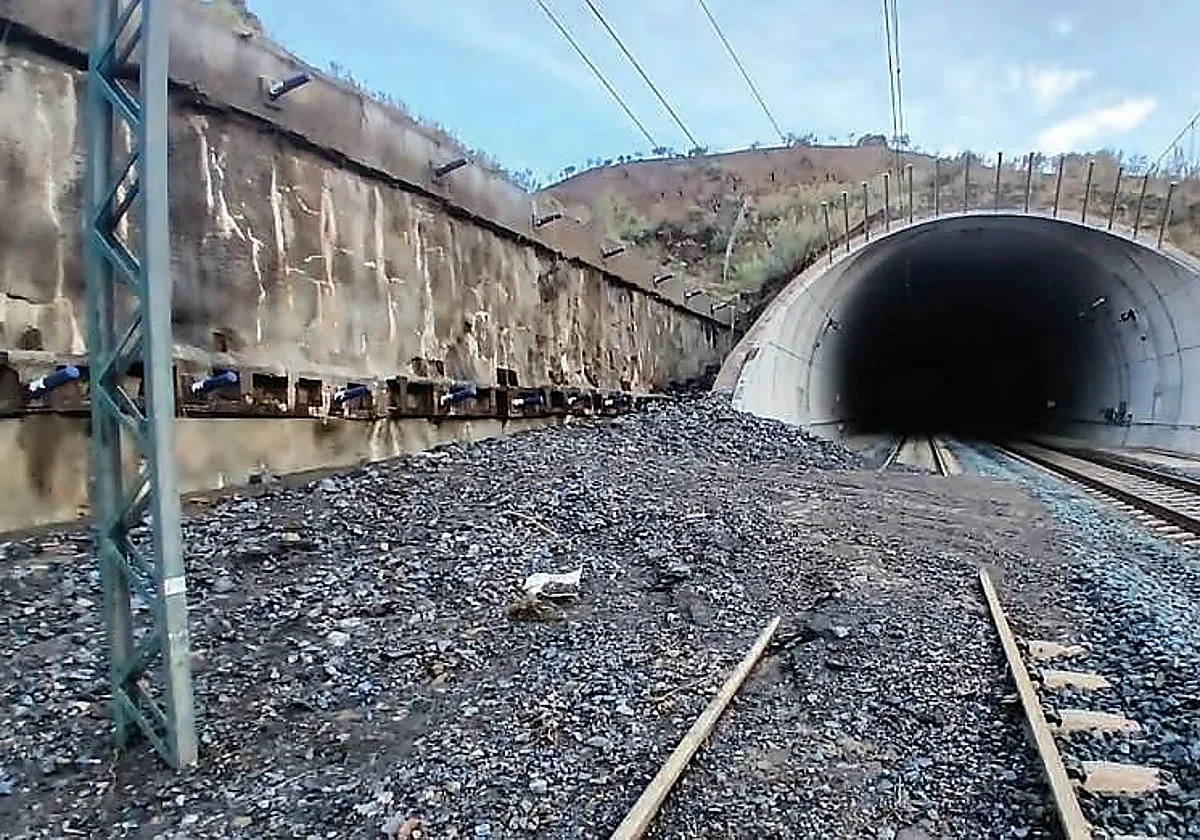
Añádenos en Google Photo from the CIAF rail accident investigation commission's report showing the state of the rail following the accident in Álora. (SUR)Chus Heredia
06/06/2026 a las 16:31h.Valencia remembers 29 October 2024 for the devastating 'dana' tragedy. Malaga province also suffered the consequences of those rains, although on a very different scale.
On that day, an AVE high-speed train derailed in the municipality of Álora, The derailment caused no deaths or injuries but highlighted the vulnerability of railway infrastructure in this area during extreme weather.
The CIAF railway accident investigation commission took more than a year and a half to clarify the events. It had to collect extensive climate data to assess the need to improve drainage systems and to monitor extreme weather and earth embankments.
CIAF warns of the need to apply technology to improve safety. It also criticises the response after a previous train reported an impact on the track. A speed reduction was imposed, but investigators say it was not enough.
The analysis of the accident focuses exclusively on improving railway safety and preventing similar incidents in the future, without any judicial purpose and without assigning blame or responsibility.
The derailment occurred at 12.10pm on 29 October 2024, at kilometre point 124/573 on line 030, between the Malaga high-speed junction and the María Zambrano station. Renfe's high-speed train 02123 travelling towards Madrid with 276 passengers on board was moving at around 200km/h when it struck a sudden accumulation of soil and rocks that had invaded the track on the right-hand side, at the northern exit of the Álora tunnel.
As a result of the impact, the first axle of the leading bogie derailed. The train continued for no less than 1.563 kilometres while derailed, carried forward by inertia, before coming to a stop. It remained upright and did not obstruct the adjacent track.
The day was marked by exceptionally intense rainfall, reaching a total of 169mm. Records from the Azud de Paredones station (downstream of the Guadalhorce reservoirs) show that the storm intensified, with 68mm falling in just one hour and 15 minutes, coinciding with the passage of the previous train.
Prior warning
Iryo train 06119 passed through the same point at 280km/h about 25 minutes before the incident. Its driver reported a strong impact on the right-hand axle to the control centre. The traffic manager imposed a temporary speed restriction of 200km/h for the Renfe train.
"However, another 10mm fell in those 25 minutes, which, combined with an erodible mid-slope terrain, caused a massive runoff flow onto the railway platform," the report states.
The investigation concludes that setting a 200km/h restriction was not sufficient to prevent the derailment and identifies a poor application of track deformation procedures. It states: "The most prudent measure would have been to order 'proceed at sight' for the next train, moving very slowly under visual control of the track, checking on site that no risk remained before gradually increasing speed."
Another key issue concerns the inclusion of extreme weather forecasts in operational manuals. The commission recommends new safety protocols that include real-time access to weather data, improved drainage design checks, better slope monitoring, and clearer procedures for extreme weather events.
CIAF, which will continue operating until the creation of a unified authority for railway, maritime and air accident investigation, urges regular clearing of drainage ditches and real-time access for control centres to CCTV systems. It also proposes monitoring technology for slopes to predict landslides, the installation of automatic rain gauges, and the review of obstacle-detection systems to eliminate blind spots.
The impact forced the closure of line one between Los Prados and Álora for a total of 65 hours and 15 minutes. The disruption affected 161 Renfe trains with 2,112 minutes of delay; 66 Avant services with 1,268 minutes; and 51 Iryo trains with 471 minutes.
Total material damage is estimated at 866,388 euros, of which 483,596 relates to rolling stock and 382,791 euros to infrastructure.
Following the derailment, state railway infrastructure company Adif increased monitoring and designated the northern tunnel mouth as a specific risk point. It also revised its incident protocol, establishing four levels of severity and requiring "proceed at sight" at a maximum of 40km/h in cases of very severe anomalies.
This is linked to the 2017 derailment between El Sorbito and Arahal (Seville), as well as a landslide in the same area on 4 February 2026, which halted direct high-speed services to Málaga for seven weeks (four months until full restoration).