Water welfare
Malaga's new wells save up to a third of reservoir water and protect the city against future droughtsHydrogeologists from Malaga University are monitoring the large aquifer of the Bajo Guadalhorce at 70 points to preserve its chemical quality and avoid depleting it
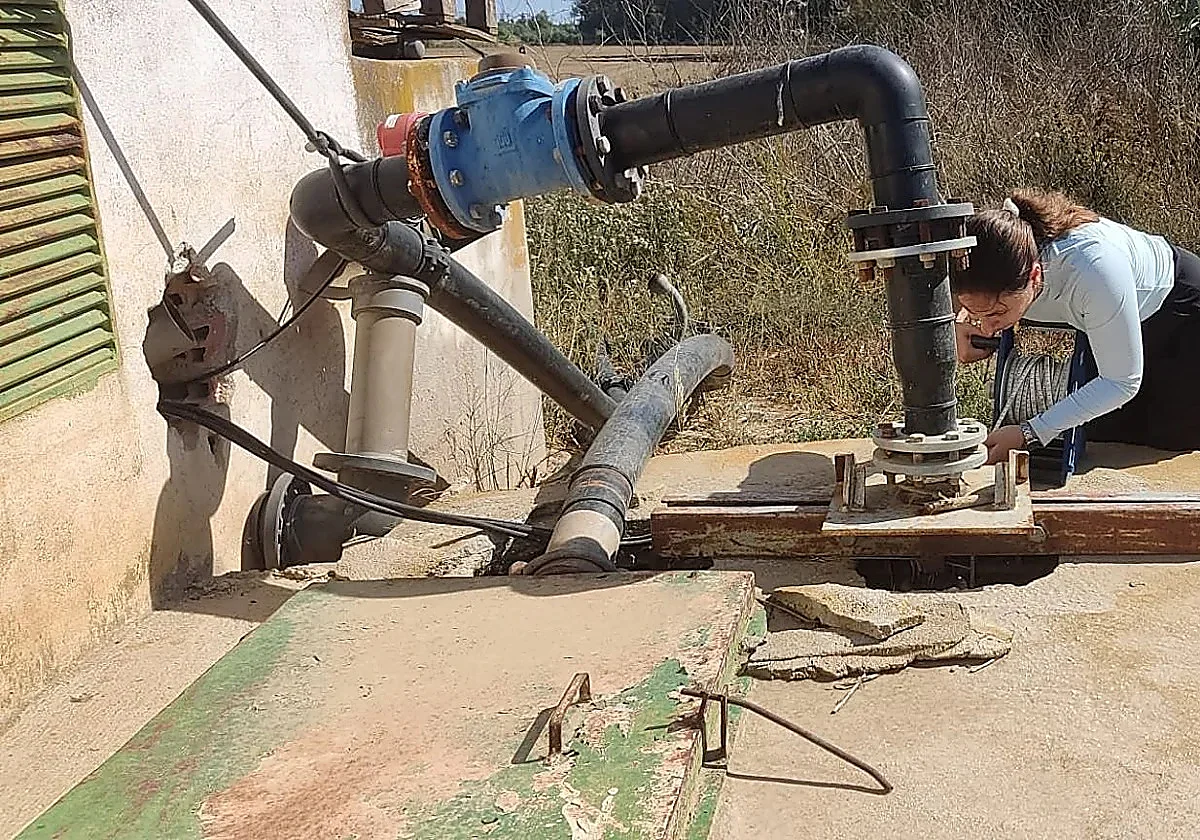
Añádenos en Google Monitoring tasks at one of the active wells in Malaga. (CehiUMA)Chus Heredia
08/06/2026 a las 10:56h.Groundwater has finally entered the political agenda, with years of severe drought driving investment in new water resources. Malaga had already embarked on a long-term strategy with the activation of the Fahala-Aljaima well system in Cártama, just downstream from where the Grande river joins the Guadalhorce. When river flows allow, the system also captures surface water through a weir.
Unfortunately, this weir cannot store water. Its operation consists of a diversion pipe that discharges water into a reservoir, which in turn receives the flow from the wells. All the water that cannot be used immediately flows downstream to the sea. To make better use of these resources, authorities would need to revive the Cerro Blanco reservoir project or at least build a larger-capacity weir further upstream, although that is a separate issue.
Related story
Water welfare
Chus Heredia
The city has a total of 21 active wells, some reaching depths of up to 60 metres. Others are much shallower. Maintaining them requires constant effort because river floods and successive storm systems cause overflows, silt accumulation and damage. Operators must keep the system running efficiently at all times to guarantee supply.
The latest major investment focuses on the Bajo Guadalhorce aquifer, backed by more than 16 million euros, most of it funded by the Andalusian regional government. The project has restored the old Puente del Rey and Perales wells, located near Malaga Airport and the Santa Teresa industrial estate.
Together, these wells can supply up to 800 litres per second, equivalent to half the city's water demand. However, experts warn against "killing the goose that lays the golden eggs", so they closely monitor the aquifer to ensure sustainable management.
Although the aquifer's potential supply could rival that of a reservoir the size of El Limonero or Casasola, hydrogeologists avoid describing it as an "underground reservoir". Water does not exist as one large continuous body but moves through fractures, fissures, voids, pores, gravel beds and sand deposits.
Preliminary water analyses confirm that quality is not among the best, although it does not differ greatly from water from other sources. The desalination plant is processing it successfully.
Municipal water company Emasa works closely with Malaga University's hydrogeology centre (CehiUMA), led by professor Bartolomé Andreo. The company says preliminary test results show that water quality remains acceptable despite some limitations. However, it considers it prudent to wait for longer data series before drawing firm conclusions, particularly under normal operating conditions.
This highlights one key advantage: having a reverse-osmosis treatment plant equipped with ultrafiltration and ozone technology is like having a state-of-the-art water treatment system, capable of producing water of almost uniform quality regardless of the condition of the incoming resources.
Emasa is working towards a target of sourcing at least 25 per cent of Malaga's water from alternatives to reservoirs. This is not a fixed figure. Operators adjust supply sources according to changing circumstances. For example, if water arriving from the reservoirs becomes too turbid, they can increase extraction from wells.
In recent weeks, the Bajo Guadalhorce aquifer has supplied around 250 litres per second on some days. Combined, when possible, with the 300 litres per second provided by the Aljaima weir, these resources can cover roughly one-third of Malaga's demand, estimated at 1,500 litres per second.
CehiUMA notes that current extraction at Puente del Rey, near the airport, amounts to 21,600 cubic metres per day, enough to supply around 84,000 people.
The Bajo Guadalhorce wells form part of one of the province's most important aquifers. Water managers used them for public supply until the 2010s, and they have recently restored five of them.
To ensure the long-term viability of the project, Emasa has commissioned a detailed study of the Bajo Guadalhorce aquifer, with a duration of 38 months. Researchers will estimate the total volume of available resources, determine sustainable extraction rates that do not compromise environmental functions, analyse the groundwater's physical and chemical characteristics and develop an early warning system capable of identifying potential threats to water quality.
The hydrogeology team carries out quarterly monitoring campaigns, measuring groundwater levels and chemical quality at more than 70 locations stretching from Álora to the coast.
At each site, specialists collect samples for chemical and isotopic analysis. These tests reveal the origin and age of the water, its evaporation history, its vulnerability to pollution and the possible presence of dissolved metals.
At sites close to the coast, technicians also measure groundwater mineralisation and temperature at different depths to understand interactions between the aquifer and the sea and assess the degree of seawater intrusion.
At the same time, teams monitor flows and collect surface-water samples from the Guadalhorce and its tributaries, including the Grande, Fahala and Campanillas rivers, to study the relationship between surface and groundwater systems and how they affect one another's quality.
At every monitoring point, specialists analyse chemical and isotopic composition and check for dissolved metals.
Preliminary results show a gradual increase in groundwater salinity from interior areas towards the coast, reaching particularly high levels in the Guadalhorce river mouth nature reserve.
Apart from this coastal sector, water mineralisation remains suitable for human consumption.
Nitrates and sulfates
Potential future droughts complicate the picture. Water from the increasingly saline Guadalhorce reservoir can double its conductivity during dry periods, forcing treatment plants to work harder.
Salt is not the only concern. Other chemical parameters also affect water quality, including nitrate concentrations and sulphates.
Technicians have installed equipment at several restored supply wells to monitor water quality continuously and in real time. The systems measure electrical conductivity, temperature, pH, dissolved oxygen, oxidation-reduction conditions and nitrate concentrations.
This data will underpin mathematical models designed to develop a sustainable abstraction strategy capable of guaranteeing both water quality and supply volumes under different climate and operating scenarios.
Demanding maintenance
Among the facilities that must be maintained are the eight pumps at the Aljaima weir (400 litres per second) and the 16 active wells in this area. These wells range in depth from ten to 29 metres and the pumps have capacities from 30 to 160 litres per second.
Malaga supplies Cártama with approximately 100 litres per second from this area.
The Lower Guadalhorce contains the deepest wells in the network. Some reach depths of 60 metres and use pumps capable of delivering up to 110 litres per second. The pumping stations that transfer water through the system exceed 300 litres per second in total capacity.
At Perales 3, the borehole diameter exceeds 6.5 metres, while Perales 1 measures more than 4 metres across. The pumping station that sends water to El Atabal for treatment stands near Malaga Airport, close to Runway 2.