Urban planning
Marbella's architectural rooftop over the yearsThe future 43-metre obelisk on the Milla de Oro will become the highest monument in Marbella
Añádenos en Google (Encarni Hinojosa)José Carlos García
Marbella
26/05/2026 a las 12:55h.The obelisk that Marbella town hall is planning to build on the so-called Golden Mile will become the tallest architectural landmark in the province's second-largest municipality.
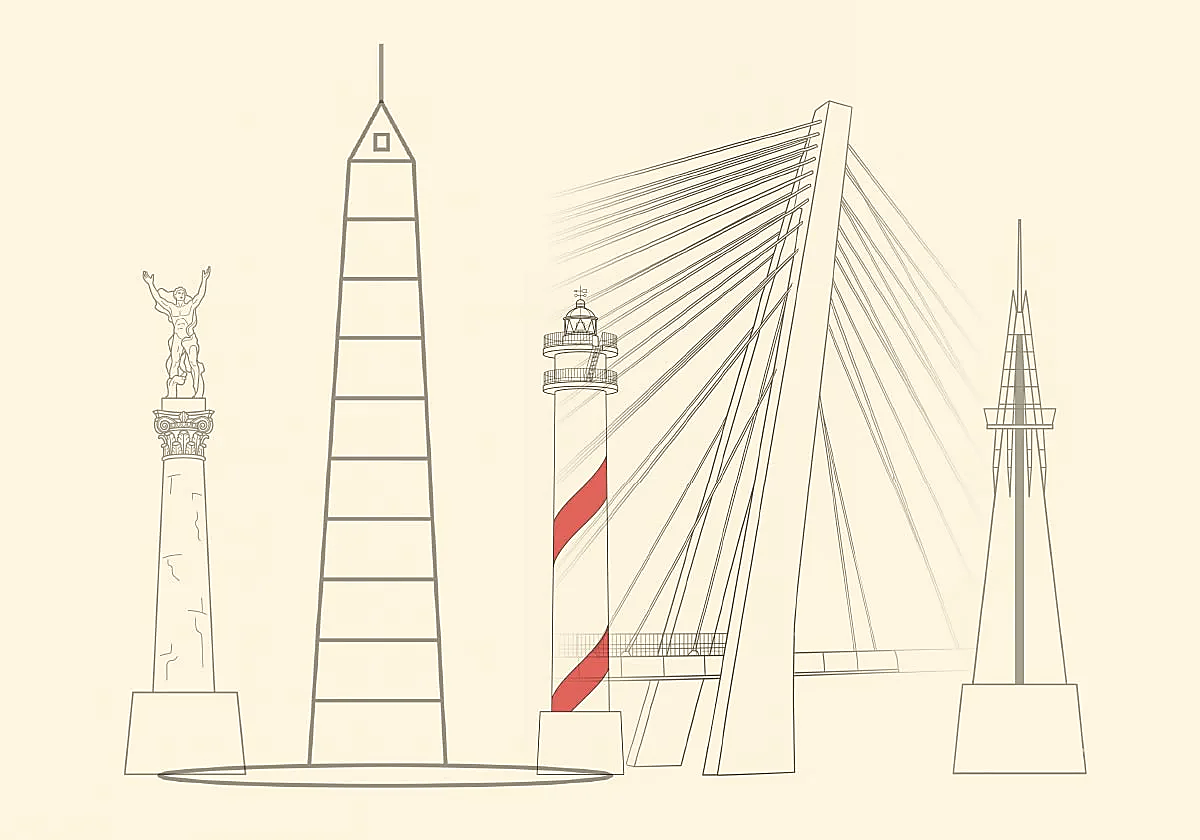
It will reach 40 metres in height, the same as the Santo Cristo del Amor bridge, but its lightning rod will raise its silhouette three metres higher, surpassing the bridge and the rest of the municipality's monumental landmarks.
Obelisk, 2027, 43 metres
It is part of the Marbella 'boulevard' municipal project, which is currently out to tender and has a ten-month construction period, meaning it should be ready in 2027.
The obelisk will be on a roundabout at the junction of the N-340 and the Istán road (A-7176).
The monument will reach a height of 40 metres, 43 including the three-metre lightning rod that will crown the structure.
It will have a hollow, truncated pyramid shape, with a 7x7-metre square base and a 3.5x3.5-metre top section. It will be built of reinforced concrete, clad in white Athena marble.
The Cristo del Amor bridge, 1988-1991, 40 metres
Located above La Represa park and built between 1988 and 1991, the Cristo del Amor bridge is currently Marbella's tallest landmark.
This unique cable-stayed bridge, which connects the Leganitos area in the upper part of the town with Santa Marta in the centre, consists of a slightly offset and inclined central reinforced concrete pylon, 800 square metres in area, reaching a height of 40 metres.
A total of 38 cables, protected by galvanised steel tubes, support a deck that defines the bridge's dimensions: 105 metres long and ten metres wide.
El Piruli, 1992, 33 metres
Designed by architects Elisa Cepedano and Roberto Barrios, El Piruli was born as the focal point of Plaza Monseñor Rodrigo Bocanegra, the intersection of Bulevar Príncipe Alfonso de Hohenlohe, Avenida Ricardo Soriano and Avenida Cánovas del Castillo.
Its shape made it virtually impossible for it not to be popularly known as El Pirulí (The Lollipop). Former mayor Jesús Gil commissioned the 33-metre structure in 1992 by Jesús Gil.
To ensure no one forgot his authorship of the project, the former mayor commissioned an inscription at its base: 'Programa Gil. 1992'.
La Victoria, 1995, 30 metres
The Russian statue, the result of a 1995 agreement between Marbella town hall, then-mayor of Moscow Yuri Luzhkov and sculptor Zurab Tseretelli, was the subject of a high-profile legal case that was eventually dismissed.
At 30 metres, it welcomes visitors to Puerto Banús at the roundabout connecting Avenida de las Naciones Unidas and Avenida Julio Iglesias.
The lighthouse, 1864, 29 metres
The construction of the lighthouse was commissioned in 1861. Its purpose was to guide ships arriving at the Marbella Port, from where agricultural products and, above all, the ore from the Sierra Blanca mines were shipped.
It was first lit on 15 March 1864, using olive oil wicks, which were replaced in 1882 by paraffin and later by kerosene. In 1974, it was replaced with a longer-range wick, eventually becoming a modern, automated lighthouse whose light can be seen from over 40 kilometres away.
Rotonda Ashmawi, 2021, 25 metres
The Spanish flagpole at the roundabout where Avenida Ashmawi and Avenida Príncipe Alfonso de Hohenlohe meet reaches a height of 25 metres. The roundabout was completed in 2008, but the enormous national flag was installed in 2021, as a tribute to the victims of the Covid-19 pandemic, adding it to the list of Marbella's tallest buildings.
Torre del Cable, 1957, 20 metres
This tower is the last remaining structure from Marbella's mining cable car system, which linked the magnetite processing plant with the open-cast mines of Peñón and Peñoncillo in the Sierra Blanca mountains and El Cable beach.
Workers began building the cable car in 1955, inaugurated it in 1957 and kept it running until 1974. The tower, also popularly known as Poste del Cable, formed part of the 260.85-metre section where the cable car extended out into the sea, allowing medium-sized cargo ships to dock.
Arco de Marbella, 1993, 14 metres
Another symbol of the Gil era, Marbella built the 14-metre-high arch in 1993 to welcome visitors entering the town from the N-340 road. Years later, national television crews frequently used it as a backdrop when reporting on the collapse of Jesús Gil's political and business empire. The arch also had a "twin brother" in San Pedro Alcántara, although authorities dismantled that structure in 2010.