Zoom
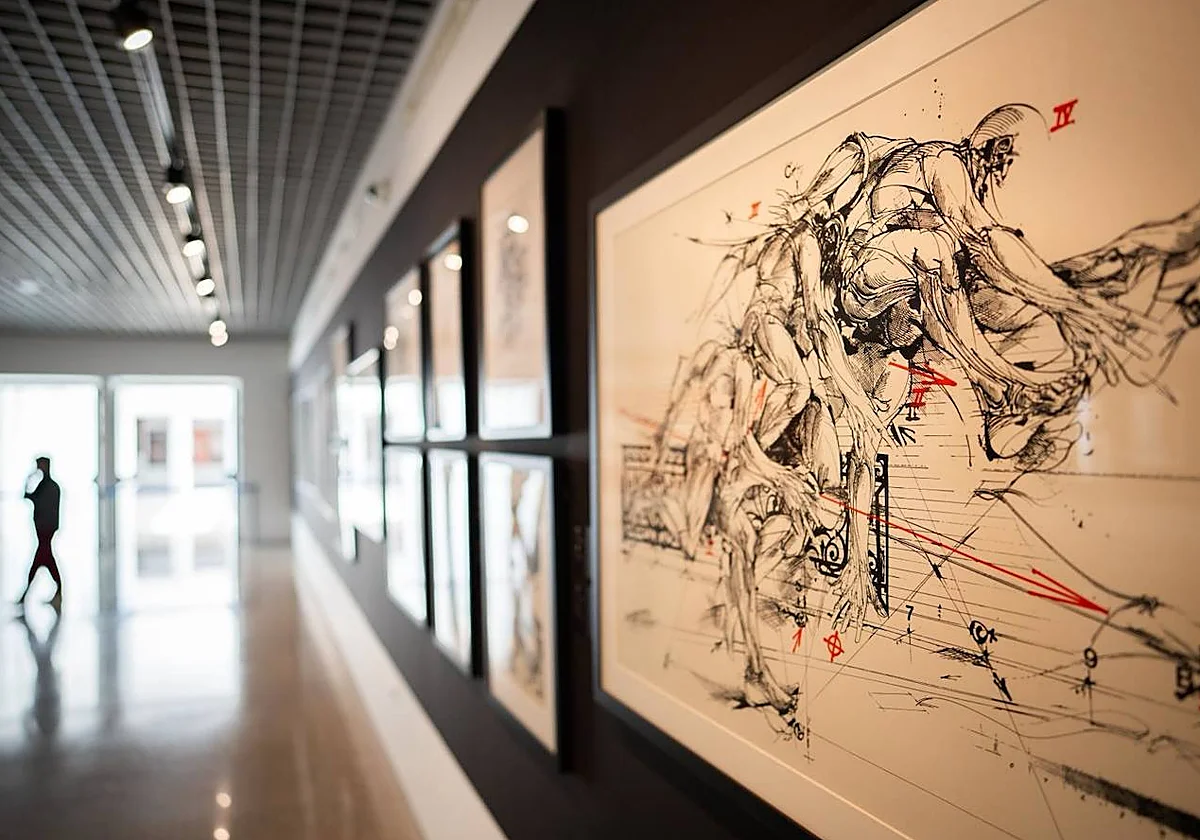
Anatomical study of a fall as seen by Vladimir Velickovic. Ñito Salas Culture MEET unveils Velickovic, the artist marked by the Nazis and obsessed by human sufferingThe Tabacalera exhibition space exhibits the strength of the Serb's graphic work which, through characters on the run, shows the flight from death
Málaga
Friday, 27 March 2026, 11:30
To speak of the painter Vladimir Velickovic (1935–2019), it is essential to begin by quoting Rilke. The work of the most influential Serbian artist of the second half of the 20th century cannot be understood without reference to the country that was his childhood - a cursed and desolate place that left a lasting mark on everything he created.
That mark came from two sources. First, a Belgrade razed to the ground by the Nazis, which gave rise to his pictorial obsession with death, violence and human suffering. And second, the anatomy books he discovered in his family home - the home of a librarian mother and a doctor father - which shaped his unflinching, almost clinical gaze at the human body.
From the union of these two worlds emerged a disturbing and powerful body of work, now coming to Málaga's Espacio Expositivo Tabacalera (MEET) - which shares a building with the Russian Museum - in an exhibition that reveals how his apparent scientific approach to the human form is ultimately devoured by drama and anguish; an anguish that traps, moves and unsettles the viewer.
Zoom
'El Cuerpo en Pedazos'. Ñito Salas"Velickovic's work is marked by existential reflection and a look at humanity, reflecting the death of innocence, the triumph of the basest instincts and the inability of reason to avoid disaster," illustrates the curator Carlos Ferrer, who presented the exhibition on Monday and explained that we are dealing with "the most important artist in his country" during the second half of the last century.
A prestige that went beyond his inclusion in the narrative figuration of the 1960s thanks to the strength of his anatomical studies which, in addition to the human being, extended to an animalarium populated by dogs, rats and birds.
His work inspired by Nazi barbarism is still relevant today with the "triumph of catastrophe" in Ukraine, Gaza or Iran
Characters that transmit tension and aggressiveness in the artist's brush, of which the MEET is exhibiting some 60 graphic works that, like his pictorial production, show his interest and mastery of drawing. Figures and bodies fleeing from their own destiny are what Velickovic strives to capture with his athletic models in continuous movement and torsion.
"Vertigo pervades everything, flight and fall, the certainty of the inevitable does not prevent fear and a glimmer of hope from leading the human being to flee from his own death," described the curator Carlos Ferrer, who added that the artist's training as an architect also appears in the engravings with annotations and marks that are more typical of house plans than of human portraits.
Zoom
Self portrait of Vladimir Velickovic, in the exhibition. Ñito SalasOne of the most evident influences on Vladimir Velickovic is the chronophotography of Eadweard Muybridge. He borrowed Muybridge's decomposition of movement, the breaking down of action into successive snapshots, to create series in which contortionism and the sequencing of gestures carry a powerful symbolic and expressive charge, generating a deep sense of unease.
His sporting or apparently scientific "treatises", then, convey neither coldness nor simple anatomical description. Rather, as the curator notes, they serve as a warning that "human nature is enough to sow chaos and feed barbarism." The curator underlines the current relevance of an artist marked by the sight of his compatriots' bodies in the streets of Belgrade during the Nazi occupation, victims he suggests are comparable to those of today in Ukraine, Gaza or Iran. "Today, as yesterday, the triumph of catastrophe is assured," he added.
Hitler's book
The exhibition is hard to miss for visitors to the old Tabacalera building. Beyond the impact of the work itself, it occupies two of the building's main transit spaces, one of which is the large entrance hall on the first floor, transformed here into an exhibition room displaying a selection of screen prints and lithographs that stop visitors in their tracks.
The works come from a private collection in Malaga. The curator, who also heads Cultural Programming at the Public Agency for the Management of the Casa Natal de Pablo Ruiz Picasso and associated museum and cultural facilities, explains that while Velickovic's work remains relatively little known in Spain, his international standing was considerable, particularly after his move to France, where he was awarded the Legion of Honour.
Zoom
An example of 'Mein kampf', altered by Velickovic himself, who suffered under the dictator.The influence of Nazi horror is also present in a copy of Hitler's 'Mein Kampf' whose texts served as a basis for artists such as the Serbian painter himself to drown the dictator's hate speech under his drawings.
Also visible in the exhibition is the influence of Francis Bacon and his decomposed figures, particularly in the series 'Orators', which date from the late 1960s and show faces that scream and eyes that bulge out of their sockets.
"They are exalted figures, shouting empty slogans and screams, based on television characters," explains Carlos Ferrer, who was accompanied at the presentation by the director of the Agency, Luis Lafuente.
Zoom
Some of the works on display on the first floor of MEET. Ñito SalasThe exhibition traces the artist's work across the 20th century, with one notable exception in tone: the more sporting pieces, commissioned works that retain his characteristic interest in movement but step back from his usual dramatism.
Among these is his work for Belgrade's bid to host the 1992 Olympics, a bid that ultimately lost out to Barcelona. Later, at the request of the IOC, Velickovic also produced a design for the Spanish host city, in which he introduced colour, as he did in other works from the 1990s that are also on display.
Zoom
Carlos Ferrer y Luis Lafuente, en la presentación este lunes de la exposición. Ñito SalasThe exhibition, which runs until November, extends into the museum itself, where visitors can watch a video documenting the Serbian artist's creative process, alongside another of his major series, inspired by Matthias Grünewald's Crucified.
Death, once again, presides over Velickovic's work. In this series it reaches a paroxysm of violence and tragedy through one of the most powerful and unambiguous iconographies in world art. "In his case without its religious meaning, but with all its symbolic and expressive force," the curator concluded, of a creator whose work remains as intense as it is disturbing.