Water
Melting snow in Sierra Nevada causes Rules dam to burst its banks for first time in 16 yearsThe Granada province reservoir is at 99.8 per cent of its capacity and growers have complained that most of the discharge is going straight into the sea instead of being piped onto the fields
Añádenos en GoogleMJ Arrebola
Granada
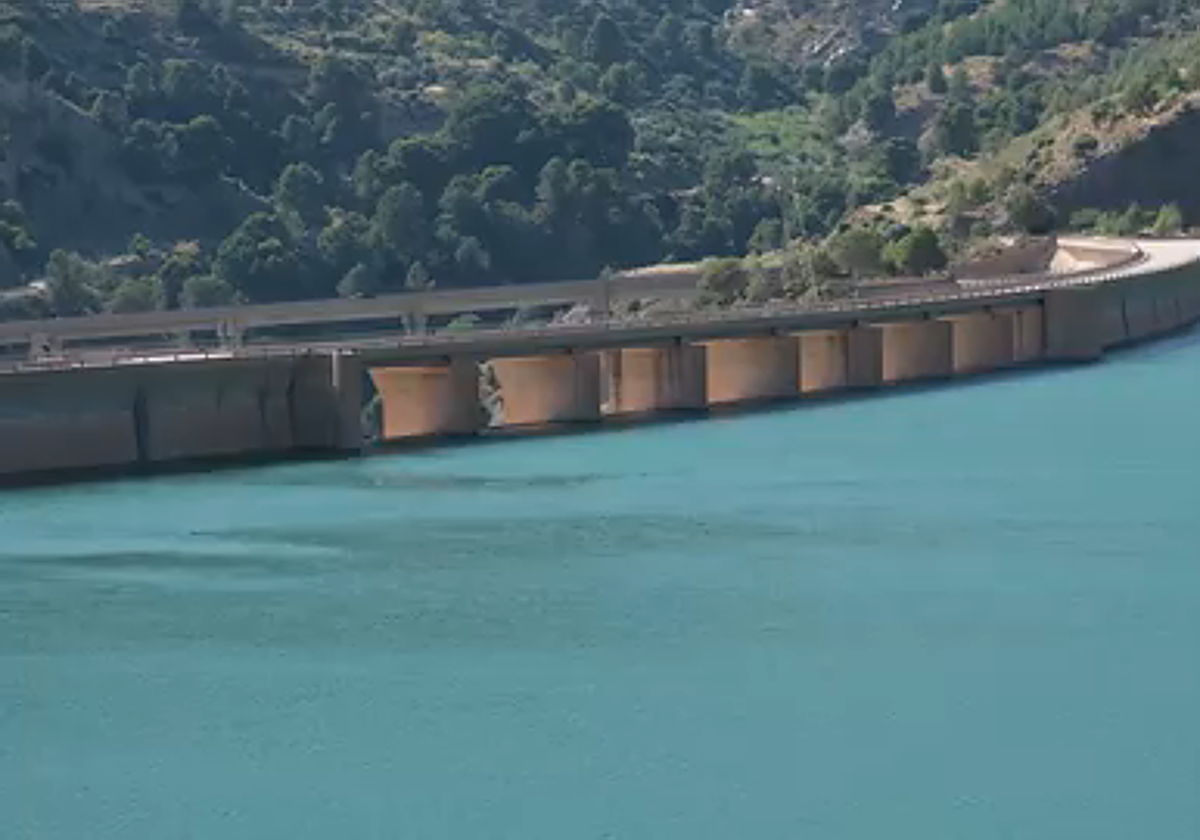
29/05/2026 a las 15:15h.Drivers have been stopping their cars in the Rules dam car park in Granada province for several days now to take photos or videos as ... the melting snow and ice from the nearby Sierra Nevada mountains enters the reservoir which has caused it to burst its banks for the first time in 16 years.
The data offered on Wednesday 28 May by the Hidrosur network showed that the reservoir was at 99.89 per cent of its capacity, equivalent to some 105.24 cubic hectometres of water, compared to the 103.05 it accumulated last week and well above the 91.19 it had this time last year. The reservoir, designed to store up to 111 cubic hectometres, was full to bursting.
The dam began to spill water at around 2am, but it was not until 7am that the maintenance and operation workers closed the bottom outlet to let the water begin to flow out at a rate of around 6,070 litres per second. At dawn, the flow was also diverted through the Cuerva pipe, through which 3,800 litres per second began to flow, so as not to leave Motril, Almuñécar and Salobreña without water for irrigation.
Some ten thousand litres per second reach the Cañizares distributor, from where the water is distributed for domestic supply, the Motril treatment plant, irrigation and aquifer recharge. No one knows yet how long this situation will last. Technicians estimate that the reservoir could continue to overflow during June and July, until the level of the reservoir drops to approximately 80 per cent of its capacity.
The last time this situation occurred was on 23 July 2010. While the technicians monitor the data, the reservoir offers dozens of windsurfers to take advantage of the combination of water and wind. In addition, it is an area that is also used by foil windsurf enthusiasts, a practice that incorporates a hydrofoil, a piece similar to a giant fin located under the board, which allows the board to rise above the water when it reaches a certain speed.
Water directly into the sea
The Rules reservoir was completed in 2004, a project that cost 208 million euros and promised to change the lives of 15 municipalities and bring irrigation water to 19,000 hectares of land. The reservoir began to fill in 2007 but the pipes that were to deliver the water to the area never arrived.
It was on 12 April 2024 when, at last, farmers and politicians gathered under the bridge of the A-7 motorway near Lobres, to see the first pipes arrive. Work on the first section, which will serve to supply 150,000 residents and 200,000 visitors and bring water to 700 hectares, is progressing according to schedule and promises to be ready in June.
"It is incomprehensible and outrageous that in 2026 we continue to see thousands of cubic metres of water being lost to the sea while the Costa Tropical continues to wait for pipelines that have been promised for decades," said Maxi Prados, president of the community of growers in the Lower Guadalfeo. "The paradox is absolute. We have water, we have full reservoirs and we have an agriculture that needs water stability, but we still lack the necessary infrastructures to take advantage of our own natural resources," he added.
Ramón Fernández-Pacheco, the Junta de Andalucía's acting spokesperson on water, agriculture and fisheries, also regretted that the water does not reach the growers, but has to be poured into the sea because the channelling of this infrastructure has not been completed due to the "negligence" of the Spanish government. "The Andalusian government maintains its commitment to collaborate in its execution, although bearing in mind that it is in the general interest of the State", said Fernández-Pacheco.
While the pipes are, literally in the pipeline, last winter's rainfall left the reservoir at around 85 per cent of its capacity at that time. Added to this is the melting snow and ice from the Sierra Nevada and the overflow from the Rules dam mainly going straight into the sea instead of being channelled onto the fields.