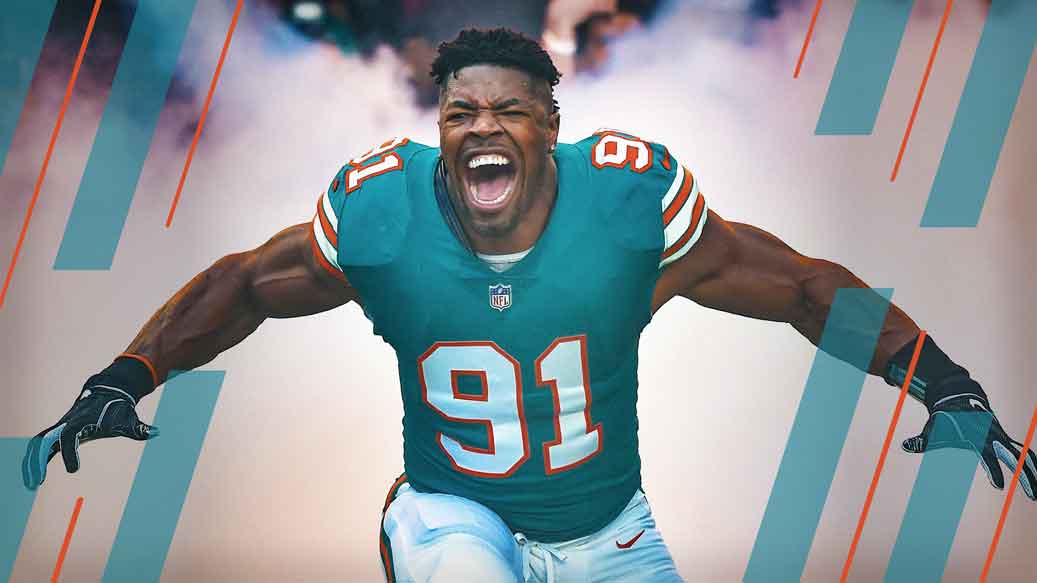
- Cameron Wake leads Miami’s defense: Wake was an original PFF favorite with 33 pressures on 135 pass rushes in his first season before five double-digit sack seasons.
- Longevity separates Miami's top interior players: Zach Sieler and Christian Wilkins edged Ndamukong Suh, while Mike Pouncey held off Aaron Brewer thanks to a larger body of quality play.
As part of PFF's celebration of 20 years of NFL data, we're building an All-Star team for every franchise, highlighting the best players at each position from the PFF era. This installment turns to theMiami Dolphins.
PFF's database dates back to the 2006 NFL season, providing a unique lens for evaluating and comparing players across eras. More details on the methodology used to construct these teams are available at the bottom of the page.
Offense
- QB: Ryan Tannehill (2012-2018)
- HB: De’Von Achane (2023-2025)
- WR: Tyreek Hill (2022-2025)
- WR: Jaylen Waddle (2021-2025)
- Slot WR: Jarvis Landry (2014-2017)
- TE: Anthony Fasano (2008-2012, 2017)
- TE: Mike Gesicki (2018-2022)
- LT: Jake Long (2008-2012)
- LG: Richie Incognito (2010-2013)
- C: Mike Pouncey (2011-2017)
- RG: Robert Hunt (2020-2023)
- RT: Vernon Carey (2006-2011)
The Dolphins have spent much of the last 20 years as a middle-of-the-pack NFL team. They haven't advanced past the wild-card round since 2000, and their best offensive players were spread across different eras rather than concentrated on a single contender. Miami fielded an excellent offensive line early in the PFF era but lacked stability at quarterback. Later, the Dolphins found that stability with Ryan Tannehill, though the supporting cast around him wasn't strong enough to elevate the offense.
More recent Dolphins teams produced Miami's most explosive offenses, led by Tyreek Hill, Jaylen Waddle and De'Von Achane, but they still lacked enough overall talent to make a deep playoff run.
The closest position battle came at center. Mike Pouncey delivered several strong seasons and ultimately earned the spot based on longevity, despite never posting a PFF grade above 80.0. Current center Aaron Brewer recorded an outstanding 89.8 offensive grade last season after earning a solid 76.1 grade in 2024. If peak performance carried more weight than longevity, Brewer likely would have claimed the position.
Defense
- DI: Zach Sieler (2019-2025)
- DI: Christian Wilkins (2019-2023)
- ED: Cameron Wake (2009-2018)
- ED: Jason Taylor (2006-2011)
- LB: Karlos Dansby (2010-2012)
- LB: Koa Misi (2010-2016)
- SLB: Andrew Van Ginkel (2019-2023)
- CB: Xavien Howard (2016-2023)
- CB: Brent Grimes (2013-2015)
- Slot CB: Will Allen (2006-2011)
- S: Reshad Jones (2010-2019)
- S: Jevon Holland (2021-2024)
The Dolphins' defense enjoyed a brief peak from 2011-13, ranking among the NFL's top 10 in points allowed in three consecutive seasons. Seven of the 12 defenders on this roster were part of those teams.
The interior defensive line proved just as competitive as the offensive line. Six interior defenders logged more than 2,500 snaps for Miami during the PFF era, and three earned defensive grades above 75.0. Zach Sieler and Christian Wilkins ultimately claimed the two spots, with Ndamukong Suh narrowly missing the cut. Suh reached the highest peak of the group but spent only three seasons in Miami. The combination of longevity and consistently strong play from Sieler and Wilkins ultimately gave them the edge.
Methodology
Selections were based on normalized PFF grades adjusted by season. To balance peak performance and longevity, only a player's five best seasons with a franchise from 2006-25 were considered. Any season with an overall PFF grade below 60.0 was excluded, ensuring that strong years helped a player's case while weaker seasons were not held against him. Postseason play was included, though all seasons were capped at a 16-game equivalent to maintain consistency across eras. At each position, the player with the highest score under this methodology earned the spot.
Each team consists of 12 offensive and 12 defensive players. Because 11 personnel and nickel defense were the league's most common alignments over the past two decades, those personnel groupings served as the foundation for every roster. Teams received either a second tight end or a fullback, depending on whether they used more 12- or 21-personnel. Defensively, teams received either a third interior defender or a third linebacker depending on whether they primarily operated from a 3-4 or 4-3 front.
Players who logged significant snaps at multiple positions during their tenure with a franchise were eligible at either spot. In most cases, those players were assigned to the position where they provided the greatest value, though their versatility occasionally influenced the final roster construction.
Unlike some All-Pro teams that group offensive linemen by position type, these rosters were built according to where players actually lined up. If a team's two best tackles both played exclusively on the left side, only the top left tackle was selected. One of the three wide receivers and one of the five defensive backs was also required to have significant slot experience. In a 4-3 defense, one linebacker needed experience at the Sam linebacker position, while in a 3-4 defense, one defensive tackle needed experience at nose tackle.
When multiple players are listed at the same position, the first name represents the top selection. Players designated as slot wide receiver, slot cornerback, nose tackle or Sam linebacker were selected specifically for those roles rather than as the third-best player within their broader position group.