4 min read
Moon Mascot: NASA Artemis II ZGI Design ChallengeThalia K. Patrinos
Dec 18, 2025 ArticleContents
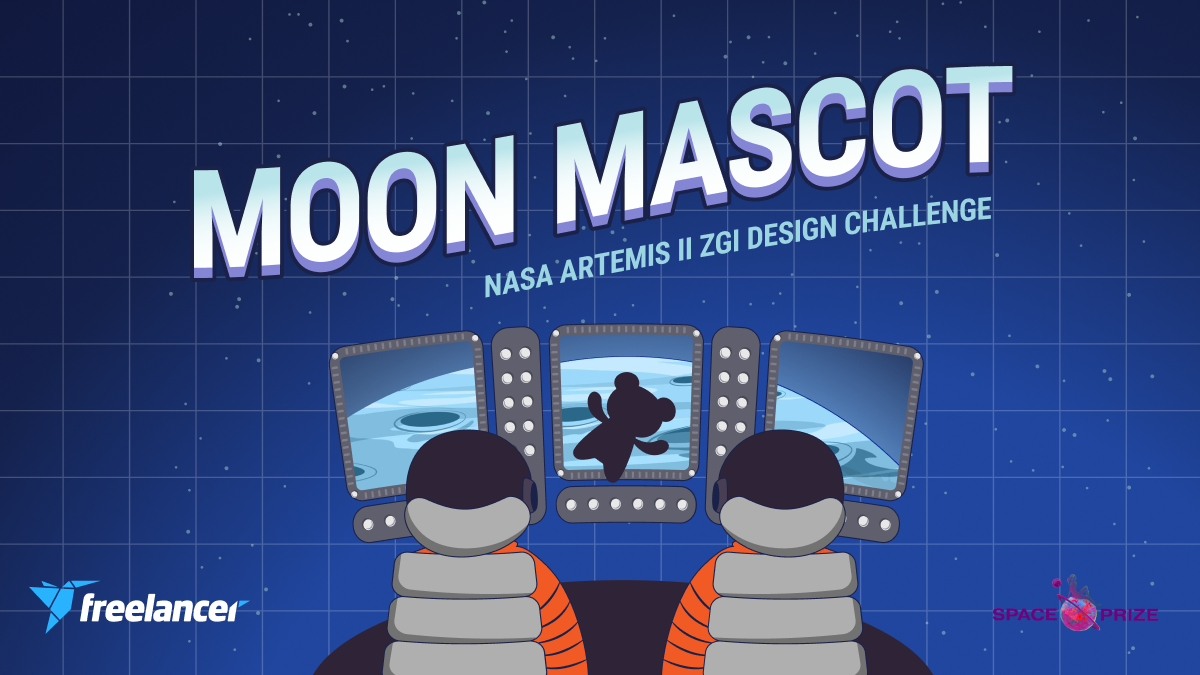
- A graphic for the Moon Mascot: NASA Artemis II ZGI Design Challenge. Freelancer
Whose Moon Mascot design will join the Artemis II astronauts on their historic voyage around the Moon in early 2026?
Between March 7 and Jun. 16, 2025, NASA worked with crowdsourcing company Freelancer to seek design ideas from global creators for a zero gravity indicator that will fly aboard the agency’s Artemis II test flight.
Zero gravity indicators are small, plush items carried aboard spacecraft to provide a visual indication of when the spacecraft and its crew reach space.
For the first eight minutes after liftoff, the crew and their indicator nearby will still be pushed into their seats by gravity, and the force of the climb into space. When the main engines of the SLS (Space Launch System) rocket’s core stage cut off, gravity’s restraints are lifted, but the crew will still be strapped safely into their seats – their zero gravity indicator’s ability to float will provide proof that they’ve made it into space.
Artemis II marks the first time that the public has had a hand in creating a crew’s mascot.
The Mission
Over the course of about ten days, four astronauts will travel approximately 685,000 miles from Earth, venture around the Moon, and return home. The flight will—for the first time with astronauts—test NASA’s human deep space exploration capabilities, including the agency’s Exploration Ground Systems, SLS (Space Launch System) rocket, and Orion spacecraft.
NASA has a long history of flying zero gravity indicators for human spaceflight missions. Many missions to the International Space Station include a plush item. A plush Snoopy rode inside Orion during NASA’s uncrewed Artemis I mission.
NASA astronauts Reid Wiseman, Victor Glover, and Christina Koch, and CSA (Canadian Space Agency) astronaut Jeremy Hansen will venture around the Moon and back. The mission is the first crewed flight under NASA’s Artemis campaign and is another step toward missions on the lunar surface and helping the agency prepare for future human missions to Mars.
The Contest
The Artemis II astronauts attended SXSW 2025 on March 7, 2025, and sat on a panel to discuss their upcoming mission around the Moon and answer questions from the audience. During the panel, commander Reid Wiseman showed the audience his zero gravity indicator from his Expedition 40 mission to the International Space Station. His zero gravity indicator was a toy giraffe named Giraffiti. Wiseman’s mother gifted Giraffiti to his oldest daughter when she was born. When Wiseman embarked on his first mission to space, his kids gave him Giraffiti to take with him to space.
“This little guy spent every day with me in my crew quarters,” said Wiseman. “It was a connection back home to my kids.”
June 4, 2014NASA Astronaut Reid Wiseman photographed in front of the Cupola windows during his Expedition 40 mission with his zero gravity indicator, Giraffiti.NASA March 7, 2025NASA astronaut Reid Wiseman shows the zero gravity indicator, “Giraffiti” used during his launch to the International Space Station as he and fellow Artemis II astronauts announce that NASA is seeking design ideas from global creators for a zero gravity indicator that will fly aboard the agency’s Artemis II test flight, Friday, March 7, 2025, at SXSW in Austin, Texas.NASA/Bill Ingalls March 7, 2025NASA astronaut Reid Wiseman shows the zero gravity indicator, “Giraffiti” used during his launch to the International Space Station as he and fellow Artemis II astronauts announce that NASA is seeking design ideas from global creators for a zero gravity indicator that will fly aboard the agency’s Artemis II test flight, Friday, March 7, 2025, at SXSW in Austin, Texas.NASA/Bill IngallsThen, Wiseman and the other crew members revealed that they were opening up the opportunities to people of all ages from all over the world to design the zero gravity indicator for the Artemis II mission around the Moon.
What better way to fly a mission around the Moon than to invite the public inside NASA’s Orion spacecraft with us and ask for help in designing our zero gravity indicator?
Reid Wiseman
NASA Astronaut and Commander of the Artemis II Mission
The Moon Mascot contest was hosted by the freelancing and crowdsourcing company Freelancer on behalf of the agency through the NASA Tournament Lab. The contest lasted about three months and received thousands of submissions from over 50 countries. Over the course of the contest, the agency hosted a Twitch stream on NASA’s Twitch channel to discuss zero gravity indicators and practice creating a design with a live artist. Adobe also released an Adobe Express template to help participants with their designs.
An Adobe Express template for the Moon Mascot competition. AdobeThe Finalists
On Aug. 22, NASA and Freelancer announced the 25 finalists of the contest. These designs – ideas spanning from Moon-related twists on Earthly creatures to creative visions of exploration and discovery – were selected from more than 2,600 submissions from over 50 countries, including from K-12 students. The finalists represent 10 countries including the United States, Canada, Colombia, Finland, France, Germany, Japan, Peru, Singapore, and Wales.
Lucas Ye | Mountain View, California“Rise” Kenan Ziyan | Canyon, Texas“Zappy Zebra” Royal School, SKIES Space Club | Winnipeg, Manitoba, Canada“Luna the Space Polar Bear” Garden County Schools | Oshkosh, Nebraska“Team GarCo” Richellea Quinn Wijaya | Singapore“Parsec – The Bird That Flew to the Moon” Anzhelika Iudakova | Finland“Big Steps of Little Octopus” Congressional School | Falls Church, Virginia“Astra-Jelly” Congressional School | Falls Church, Virginia“Harper, Chloe, and Mateo’s ZGI” Alexa Pacholyk | Madison, Connecticut“Artemis” Leila Fleury | Rancho Palos Verdes, California“Beeatrice” Oakville Trafalgar School | Oakville, Ontario, Canada“Lepus the Moon Rabbit” Avon High School | Avon, Connecticut“Sal the Salmon” Daniela Colina | Lima, Peru“Corey the Explorer” Caroline Goyer-Desrosiers | St. Eustache, Quebec, Canada“Flying Squirrel Ready for Its Take Off to Space!” Giulia Bona | Berlin, Germany“Art & the Giant” Tabitha Ramsey | Frederick, Maryland“Lunar Crust-acean” Gabriela Hadas | Plano, Texas“Celestial Griffin” Savon Blanchard | Pearland, Texas“Soluna Flier” Ayako Moriyama | Kyoto, Japan“MORU: A Cloud Aglow with Moonlight and Hope” Johanna Beck | McPherson, Kansas“Creation Mythos” Guillaume Truong | Toulouse, France“Space Mola-mola (aka Moon Fish) Plushie” Arianna Robins | Rockledge, Florida“Terra the Titanosaurus” Sandy Moya | Madrid, Colombia“MISI: Guardian of the Journey” Bekah Crowmer | Mooresville, Indiana“Mona the Moon Moth” Courtney John | Llanelli, Wales“Past, Present, Future”The Winner
Once the crew has selected a final design, NASA’s Thermal Blanket Lab will fabricate it for flight. The indicator will be tethered inside the Orion spacecraft before launch.
The winner of the contest and the design that will accompany the astronauts on their historic mission will be unveiled closer to launch. Launch is currently targeted for early next year, with launch opportunities as soon as February 2026.
About the Author
Thalia K. Patrinos
Share
Details
Last Updated Dec 18, 2025Related Terms
Explore More
9 min read2025 in Review: Highlights from NASA in Silicon Valley
Article 7 hours ago 3 min readNASA’s DiskSat Technology Demo Launches to Low Earth Orbit
Article 8 hours ago 10 min readNASA Langley Research Center: 2025 Year in Review
Article 1 day ago Keep ExploringDiscover More Topics From NASA
Missions
Humans in Space
Climate Change
Solar System