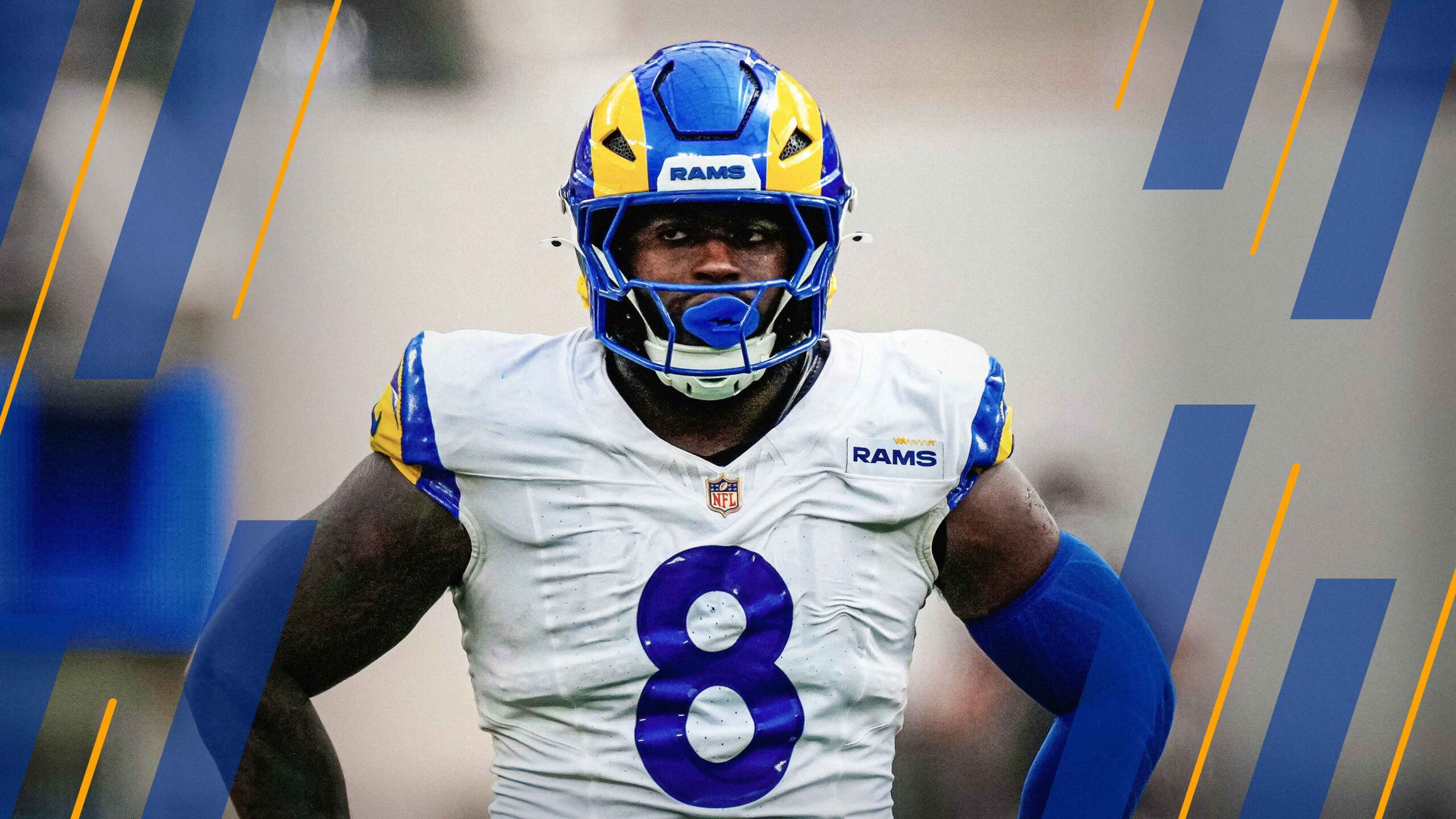
The Cleveland Browns traded Myles Garrett to the Los Angeles Rams on Monday in exchange for a 2027 first-round pick, a 2028 second-round pick, a 2029 third-round pick and, crucially, 25-year-old edge defender Jared Verse.
This move was an admission by the Browns that they are unlikely to be a highly competitive team in the immediate future. Comments from general manager Andrew Berry suggest the Browns were adamantly opposed to trading away the greatest defensive player in franchise history, but every player has a price. And from Cleveland's perspective, this return was too good to pass up.
Read more
Read moreLos Angeles Rams land Myles Garrett in blockbuster trade with Cleveland Browns
By Mark Chichester
(opens in new tab) →Even if several Browns players took major strides in 2026 and the organization nailed their quarterback pick at the top of the 2027 NFL Draft, the earliest they would likely be viewed as a genuine AFC playoff contender would be January 2029. By that point, Myles Garrett will be 33 years old.
Jared Verse, on the other hand, will still be playing on his rookie contract through his fifth-year option.
The timelines of the Browns franchise and Myles Garrett simply didn't align. That is likely the message Rams general manager Les Snead conveyed throughout the process. However, letting a first-round edge rusher of Verse's caliber leave just two years into his rookie contract would have been equally unprecedented.
Additional compensation aside, it's worth comparing Myles Garrett and Jared Verse directly. How much worse would the Browns be in 2026? How much better would the Rams become? It's easy to view Verse as a solid but unspectacular edge defender when compared to one of the greatest pass rushers in NFL history. However, before any trade speculation emerged, Verse was widely viewed as perhaps the most important defensive player on a Rams team considered the Super Bowl favorite.
Myles Garrett vs. Jared Verse: Pass-rush production since 2024
Myles Garrett vs Jared Verse 1,691 Snaps 1,959 984 Pass-rush snaps 1,182 94.2 Pass-rush grade 88.1 84.7 Run defense grade 73.9 166 Total Pressures 188 24.00% Pass-rush win rate 17.90% 17.80% Pressure rate 17.00% 5.64% Run-stop rate 8.31% 0.79 PFF WAR 0.34Verse has earned an 89.7 overall PFF grade since entering the league two years ago. Among edge defenders younger than 28, only Aidan Hutchinson, Micah Parsons and Will Anderson Jr. have posted higher grades over that span. None of those players were realistic options for the Browns. So, in that regard, they landed the next best thing.
Myles Garrett vs. Jared Verse: Pass Rushing
These two pass rushers lead the league in total pressures over the last two seasons. Verse is quite significantly further ahead, though, with 188 pressures compared to Garrett’s 166. This comes with the caveat that Jared Verse has played more snaps than Garrett — and anybody else, for that matter — over the last two years.
Verse has been on the field for 1,959 snaps over the last two years, the most by any defensive lineman in the league. He surpasses the 2,000-snap mark when you include his 78 special teams snaps in 2025 — a role he did not play in Year 1.
But Verse isn’t just on top of the league’s total pressures leaderboard due to sheer volume of play. His 17.0% pressure rate is just a smidge off Myles Garrett’s 17.8% rate over the last two seasons, and some distance clear of Garrett’s 12.2% pressure rate from his first two seasons in the league.
In fact, the only defensive linemen to post higher pressure rates than Verse over their first two seasons in the league in the PFF era (since 2006) are Micah Parsons (19.2%), Von Miller (17.8%), and Nick Bosa (17.7%).
nfl defensive linemen: Most snaps played since 2024
-47.0 513.3 1073.5 1633.8 2194.1 1959 Jared Verse 1919 Zach Allen 1917 Byron Young 1865 T.J. Watt 1815 Kobie TurnerSo, if Verse is generating pressure as effectively as some of the greatest pass rushers in modern NFL history, why isn't he viewed in the same tier? The answer is straightforward: pressure is only part of the equation. Verse consistently gets into the backfield, but he hasn't converted those pressures into sacks at nearly the same rate as the league's elite pass rushers.
Despite having the most pressures of any player through their first two seasons in the PFF era, Verse is all the way down in 30th place for sacks, below names like Kayvon Thibodeaux, George Karlaftis, Jaelan Phillips, and tied with former teammates Byron Young and Braden Fiske (who is now separated from Verse for the first time since before their Florida State days).
Myles Garrett, on the other hand, is coming off perhaps the greatest pressure-to-sack conversion season we have ever seen. Garrett recorded a sack on 27.4% of his pressures last season, an incredible rate for the future Hall of Famer. Meanwhile, Verse converted just 8.5% of his pressures into sacks, marking a second straight season in which he struggled to turn pressure into quarterback takedowns.
Some external factors didn’t help Verse’s case here. In some instances, teammates Byron Young (12 sacks) and Kobie Turner (7) simply got to the quarterback first. There’s an element of luck involved, too. Verse logged 27 quarterback hits last year, the most of any edge defender, and twice as many as Myles Garrett. These are plays where Verse arrived a split-second too late for the football. There is, of course, some technique to finishing plays too, which the veteran Garrett has clearly mastered.
The opposing play styles of Garrett and Verse can also explain this difference in sack efficiency. Verse has always been more of a pocket-squeezer. While he plays with wonderfully consistent leverage, he doesn’t possess the cat-like agility of Myles Garrett, who teleports around opposing offensive linemen and finds clear lanes to the quarterback.
Verse wins more often by pushing offensive tackles into their quarterback’s lap. While the highlight reel may not look quite as attractive, Verse’s disruption acted as a force multiplier for the Rams defensive front. By causing quarterbacks to drop their eyes and navigate a crowded pocket, Verse allowed for his teammates to clean up — the Rams finished sixth in sacks last season despite the struggles of their marquee edge rusher.
Wins Above Replacement
Jared Verse · ED
-0.01 0.07 0.15 0.23 0.32 2024 2025 2024 · 0.05 WAR · Rank 9 of 199 at ED 2024 · 0.05 WAR · Rank 9 of 199 at ED 0.05 2025 · 0.28 WAR · Rank 8 of 215 at ED 2025 · 0.28 WAR · Rank 8 of 215 at ED 0.28 Player WAR Positional avg Hover a season for WAR rank Avg ED (200+ snaps)Myles Garrett vs. Jared Verse: Run Defending
Believe it or not, it’s in the run game where the difference between Verse and Garrett becomes more apparent. Garrett has grown into a very solid run defender in recent years, while Verse is still figuring things out.
After four consecutive PFF run-defense grades below 71.0 from 2019 to 2022, Garrett has posted strong marks of 83.7, 78.4 and 82.5 against the run over the past three seasons.
Verse came out of the gates quickly as a run defender. It was an area of his game that lagged slightly behind at Florida State, but his 81.0 PFF run-defense grade as a rookie was promising. However, his play against the run took a noticeable step back in Year 2, as evidenced by his 62.0 grade.
In particular, Verse has struggled at the point of contact with ball carriers. He has missed 21 tackles against the run through two seasons. Meanwhile, Garrett has just 19 missed tackles against the run across his nine-year career.
While Garrett has become a model of consistency on rushing downs, Verse appears far more boom-or-bust. Over the past two seasons, Verse has generated nearly twice as many positively graded run plays as Garrett but more than three times as many negatively graded run plays. Garrett has been far more consistent from snap to snap.
It is worth considering whether this is related to Verse's struggles finishing plays against quarterbacks. He may simply be less refined when it comes to getting opponents to the ground. While that is not a common issue at this level, it is one that could likely be corrected given his outstanding athletic profile.
Jared Verse: PFF metrics and ranks (2025)
Metric Rank Overall Grade 80.8 15 Pass-rush grade 81.3 14 Run-defense grade 62.4 65 Tackling grade 29.7 T-116 Total pressures 100 T-2 Defensive stops 39 6 Missed tackles 18 129 Missed tackle rate 22.5% T-107Among 130 qualifying edge defenders (postseason play included).
Does Verse really have youth on his side?
Verse may be only two years into his NFL career, but it’s worth remembering that he was an older prospect. He went virtually unrecruited out of high school and had to grind through the pandemic years during what ultimately became a five-year college career.
As a result, Verse will turn 26 in November, raising questions about how much developmental runway remains. He was widely viewed as a high-floor prospect entering the NFL, with far fewer concerns about his long-term viability than many first-round edge defenders.
The Browns will hope this is not a case of “what you see is what you get.” It is difficult to gauge the Rams' true assessment of Verse’s developmental ceiling, given their willingness to sacrifice future assets for immediate impact players like Garrett.
This is one of the most fascinating trades in recent NFL history. Both players have significant chapters of their careers still to be written, and perceptions of each front office could be shaped by how this deal unfolds.
For Andrew Berry, the work is far from done. Meanwhile, Les Snead will watch to see whether the Rams' pursuit of immediate contention pays off once again.
One interesting point is that when Snead traded future draft picks for established stars, there was rarely a clear line of accountability. Because the Rams never made those selections, nobody could know with certainty whether those picks would have become stars or disappointments elsewhere.
That is not the case here. Jared Verse represents a tangible outcome of one of Snead’s aggressive roster-building decisions. He is more than a future draft pick or theoretical asset.
If Verse develops into a bona fide star and the Browns ultimately emerge as the long-term winners of this deal, the trade will be remembered very differently than it is today.