3 min read
NASA’s Dryden Aeronautical Test Range Supports Flight, Space MissionsJay Levine
NASA Armstrong Public Affairs Specialist
May 06, 2026 ArticleContents
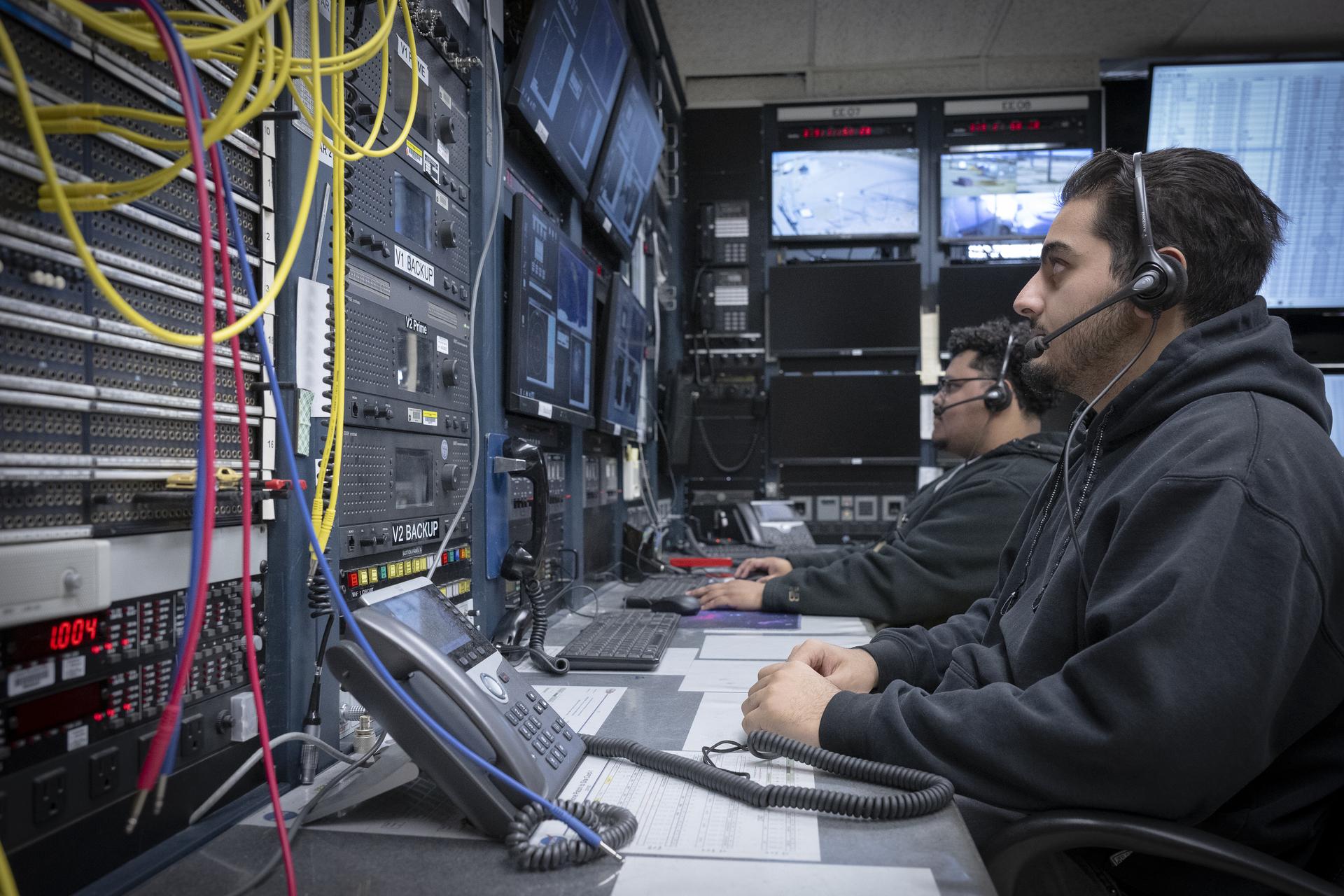
- Range operators at the Dryden Aeronautical Test Range at NASA’s Armstong Flight Research Center in Edwards, California, provide voice and tracking support to the International Space Station. In this Friday, Dec. 6, 2025, photo, Alex Oganesyan, left, and Deming Ingles are at their workstations, where they support communications backup for space station missions. NASA/Christopher LC Clark
NASA advances aeronautics and space technologies through experimental aircraft and flight research at the agency’s Armstrong Flight Research Center in Edwards, California. Behind those efforts is the Dryden Aeronautical Test Range (DATR), which provides the communications, tracking, and data services that enable safe and effective missions.
For most NASA Armstrong research flights, the DATR supplies communications, radar, and telemetry. The range’s video capabilities can also capture ground footage as well as long-range coverage for flights. Modernization efforts started in the early 2020s expanded those capabilities and prepared the range to support efforts such as test flights of NASA’s X‑59 quiet supersonic research aircraft, as well as spaceflight communications.
“The DATR provides real‑time data, tracking, and situational awareness that help keep flight research safe and efficient,” said Tara McCoy, acting deputy director for DATR Mission Operations at NASA Armstrong. “The range also supports science missions, works with industry partners, and provides capabilities used for International Space Station operations.”
Ongoing upgrades include new very high frequency (VHF) ground antennas, updated electronic components, and software improvements for tracking the International Space Station and visiting spacecraft. NASA installed additional antennas to ensure backup coverage.
The range’s ability to processes and display real‑time radar, telemetry, and video data is critical for monitoring research flights, such as NASA’s Crossflow Attenuated Natural Laminar Flow (CATNLF) wing model. CATNLF, a scale-model wing attached under a NASA F-15B research jet, is designed to improve the smooth flow of air known as laminar flow, reducing drag and lowering fuel costs for future commercial aircraft.
The DATR also supports aircraft platforms that enable science missions, such as the ER-2 high-altitude aircraft and the C-20A aircraft.
NASA’s X-59 quiet supersonic research aircraft first flight travels from Lockheed Martin’s Skunk Works facility in Palmdale, California, to NASA’s Armstrong Flight Research Center in Edwards, California, on Tuesday, Oct. 28, 2025. The control room at NASA Armstrong enabled engineers to monitor real-time flight data, maintain communication, and view video throughout the mission, demonstrating the capabilities of the center’s Dryden Aeronautical Test Range. NASA TelevisionPreparing for future flights
The range is developing multiple approaches to streamline and shorten the time it takes to process and validate raw flight data for researchers, saving time and resources.
“The faster we can get data to the project engineers to review, the faster they can determine whether certain test points need to be repeated, or future test points can be skipped,” said David Tow, DATR chief engineer. “We are working these efforts simultaneously because each one has the potential to drastically improve how long it takes to deliver post-processing data.”
One NASA approach is to automate and consolidate the data processing steps from five down to one. Another approach leverages an existing partnership with the U.S. Air Force to enable multiple computers to post-process data from separate missions simultaneously. The collaboration between the Air Force and DATR aims to reduce processing time for post-flight data from two hours to less than 30 minutes.
Mission operator Mike Webb sits at one of the radar stations used to track the International Space Station as it passes high above NASA’s Armstrong Flight Research Center in Edwards, California, on Sept. 30, 2025. Webb is part of the center’s Dryden Aeronautical Test Range, which provides voice and tracking support to the space station. NASA/Christopher LC ClarkSupporting space station operations
The DATR is part of NASA’s safety and communications infrastructure that supports International Space Station missions. Its capabilities are used for backup communications and telemetry during launches, dockings, and reentries.
NASA Armstrong is one of only two ground stations in the United States capable of sending and receiving messages on all space station frequencies. The other is NASA’s Wallops Flight Facility in Virginia. Armstrong has provided communications and radar tracking for the station since its first component launched in 1998 and continues to support commercial cargo and crew missions.
A telemetry antenna, right, and two radars are part of the Dryden Aeronautical Test Range at NASA’s Armstrong Flight Research Center in Edwards, California. NASA/Lauren Hughes Sonja Belcher and Zack Springer support research flights at the telemetry and radar acquisition processing system at NASA’s Armstrong Flight Research Center at Edwards, California. NASAAdvancing NASA's mission
The range operates within NASA’s Flight Demonstrations and Capabilities project in its Aeronautics Research Mission Directorate and remains positioned to support aeronautics, science, and International Space Station missions with communications, tracking, and data services.
Share
Details
Last Updated May 06, 2026 EditorDede DiniusContactJay Levinejay.levine-1@nasa.govLocationArmstrong Flight Research CenterRelated Terms
Explore More
4 min readNASA Fosters Development of Lunar Resource-Seeking Technologies
Article 2 days ago 4 min readThere’s No Place Like NASA’s New X-59 Hangar Home
Article 1 week ago 6 min readNASA Tech and Science Bound for Low Earth Orbit on Commercial Launch
Article 1 month ago Keep ExploringDiscover More Topics From NASA
NASA Armstrong Flight Research Center
Aircraft Flown at Armstrong
Aeronautics
Earth Science