NASA Hubble Mission Team
Goddard Space Flight Center
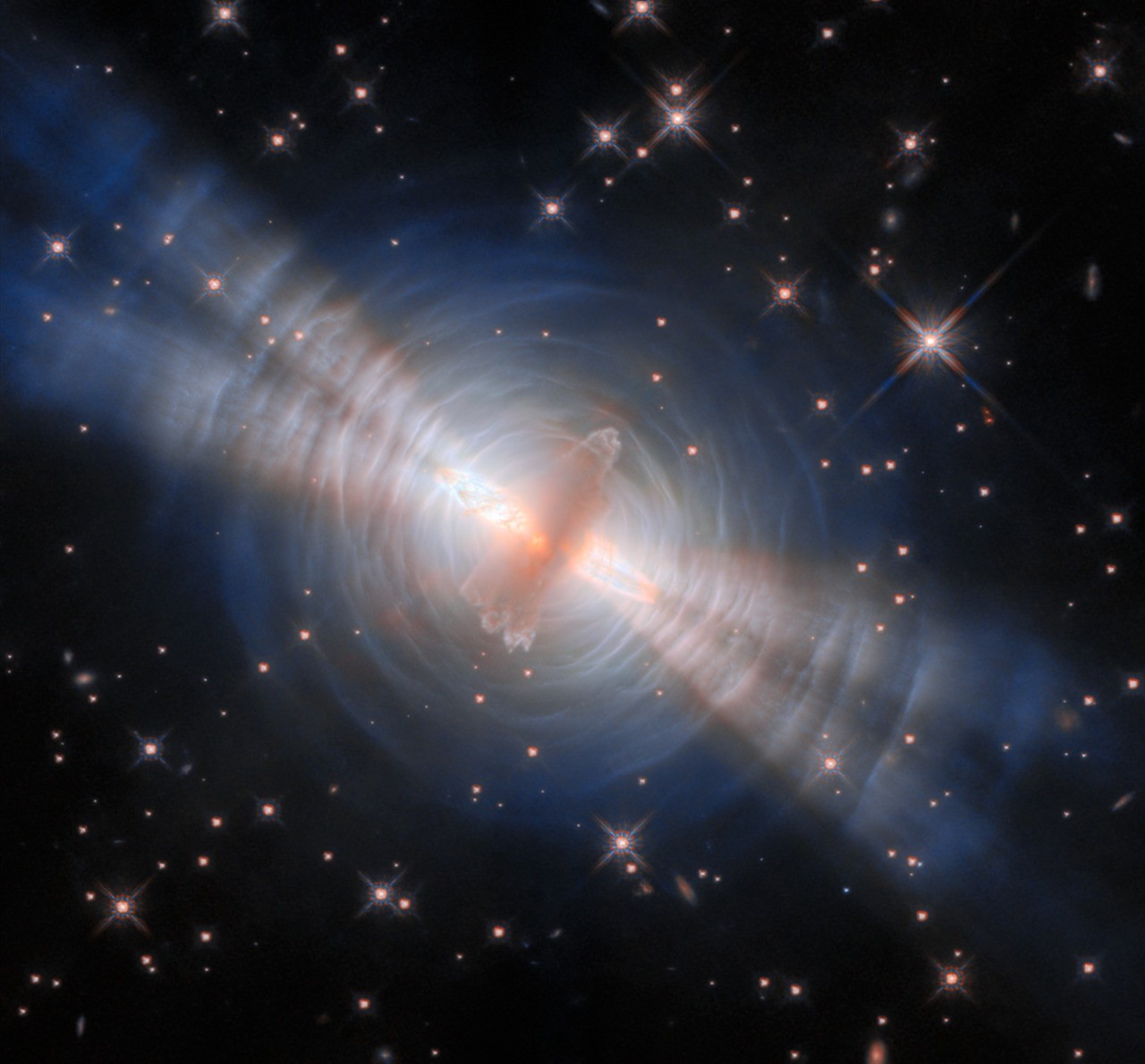
Feb 10, 2026 ArticleThis stunning image from NASA’s Hubble Space Telescope reveals a dramatic interplay of light and shadow in the Egg Nebula, sculpted by freshly ejected stardust. Located approximately 1,000 light-years away in the constellation Cygnus, the Egg Nebula features a central star obscured by a dense cloud of dust — like a “yolk” nestled within a dark, opaque “egg white.” Only Hubble’s sharpness can unveil the intricate details that hint at the processes shaping this enigmatic structure.
It is the first, youngest, and closest pre-planetary nebula ever discovered. (A pre-planetary nebula is a precursor stage of a planetary nebula, which is a structure of gas and dust formed from the ejected layers of a dying, Sun-like star. The term is a misnomer, as planetary nebulae are not related to planets.)
NASA’s Hubble Space Telescope reveals the clearest view yet of the Egg Nebula. This structure of gas and dust was created by a dying, Sun-like star. These newest observations were taken with Hubble’s Wide Field Camera 3.NASA, ESA, Bruce Balick (UWashington)The Egg Nebula offers a rare opportunity to test theories of late-stage stellar evolution. At this early phase, the nebula shines by reflecting light from its central star, which escapes through a polar “eye” in the surrounding dust. This light emerges from a dusty disk expelled from the star’s surface just a few hundred years ago.
Twin beams from the dying star illuminate fast-moving polar lobes that pierce a slower, older series of concentric arcs. Their shapes and motions suggest gravitational interactions with one or more hidden companion stars, all buried deep within the thick disk of stardust.
Stars like our Sun shed their outer layers as they exhaust their hydrogen and helium fuel. The exposed core becomes so hot that it ionizes surrounding gas, creating the glowing shells seen in planetary nebulae such as the Helix, Stingray, and Butterfly nebulae. However, the compact Egg Nebula is still in a brief transitional phase — known as the pre-planetary stage — that lasts only a few thousand years. This makes it an ideal time to study the ejection process while the forensic evidence remains fresh.
The symmetrical patterns captured by Hubble are too orderly to result from a violent explosion like a supernova. Instead, the arcs, lobes, and central dust cloud likely stem from a coordinated series of poorly understood sputtering events in the carbon-enriched core of the dying star. Aged stars like these forged and released the dust that eventually seeded future star systems, such as our own solar system, which coalesced into Earth and other rocky planets 4.5 billion years ago.
Hubble has turned its gaze towards the Egg Nebula before. A first visible-light image from the telescope's WFPC2 (Wide Field and Planetary Camera 2) was complemented in 1997 by a near-infrared NICMOS (Near Infrared Camera and Multi-Object Spectrometer) image, giving a closer look at the light given off by the nebula. In 2003, Hubble's ACS (Advanced Camera for Surveys) yielded a new view of the Egg, showing the full extent of the ripples of dust around it. A further image from WFC3 (Wide Field Camera 3) in 2012 zoomed in on the central dust cloud and dramatic gas outflows. This new image combines the data used to create the 2012 image with additional observations from the same program to deliver the clearest look yet at this intricate cosmic egg.
The Hubble Space Telescope has been operating for over three decades and continues to make ground-breaking discoveries that shape our fundamental understanding of the universe. Hubble is a project of international cooperation between NASA and ESA (European Space Agency). NASA’s Goddard Space Flight Center in Greenbelt, Maryland, manages the telescope and mission operations. Lockheed Martin Space, based in Denver, also supports mission operations at Goddard. The Space Telescope Science Institute in Baltimore, which is operated by the Association of Universities for Research in Astronomy, conducts Hubble science operations for NASA.
Facebook logo @NASAHubble@NASAHubble Instagram logo @NASAHubbleRelated Images & Videos
Egg Nebula
NASA’s Hubble Space Telescope reveals the clearest view yet of the Egg Nebula. This structure of gas and dust was created by a dying, Sun-like star. These newest observations were taken with Hubble’s Wide Field Camera 3.
Egg Nebula Compass
This image of the Egg Nebula was captured by the Hubble Space Telescope’s WFC3 (Wide Field Camera 3). The image shows a scale bar, compass arrows, and color key for reference.
Exploring the Structure of the Egg Nebula
This visualization examines the Hubble Space Telescope image of the Egg Nebula and showcases the shape and development of its three-dimensional components. The dying star has repeatedly ejected thin shells of gas and dust over the last 5,000 years. During the last 400 years, bipo...
Explore More
Hubble's Nebulae
These ethereal veils of gas and dust tell the story of star birth and death.
The Death Throes of Stars
When stars die, they throw off their outer layers, creating the clouds that birth new stars.
Hubble's Field Guide to Nebulae (YouTube video)
This Hubble guide provides an overview of some of the most resplendent objects in the universe.
Share
Details
Last Updated Feb 10, 2026 EditorAndrea GianopoulosLocationNASA Goddard Space Flight Center Contact MediaClaire Andreoli
NASA’s Goddard Space Flight Center
Greenbelt, Maryland
claire.andreoli@nasa.gov
Ann Jenkins, Christine Pulliam
Space Telescope Science Institute
Baltimore, Maryland
Related Terms
- Hubble Space Telescope
- Astrophysics
- Goddard Space Flight Center
- Nebulae
- Planetary Nebulae
- Reflection Nebulae
Related Links and Documents
Keep ExploringDiscover More Topics From Hubble
Hubble Space Telescope
Since its 1990 launch, the Hubble Space Telescope has changed our fundamental understanding of the universe.
Hubble Science Highlights
Hubble Images
Hubble News