NASA Webb Mission Team
Goddard Space Flight Center
Jun 16, 2026 ArticleContents
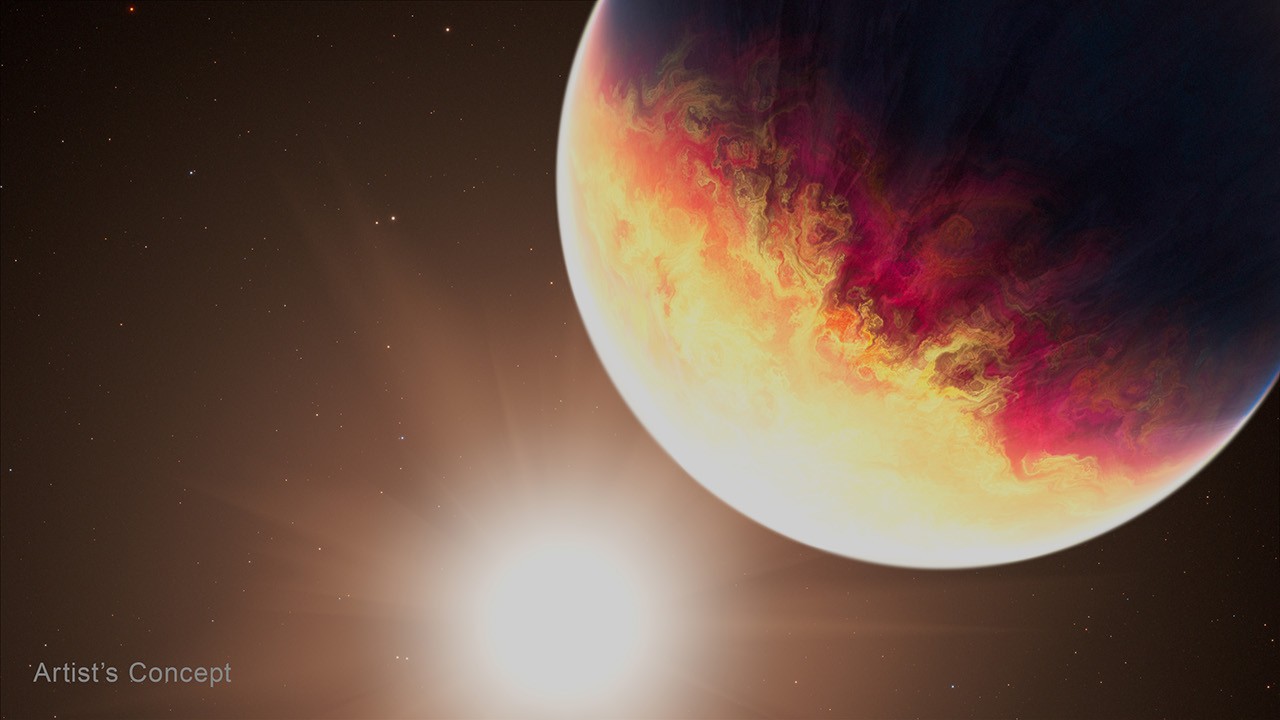
- This artist’s concept shows exoplanet HD 80606 b being “roasted” as its orbit approaches periastron, the point at which it is closest to its host star, which is similar to our Sun.Artwork: NASA, ESA, CSA, Joseph Olmsted (STScI)
“Observing a planet like HD 80606 b is actually very efficient because its unusual orbit, with the corresponding swings in temperature and chemical composition, allow us to gather data under varying conditions in just hours and apply those findings to other hot Jupiters or more conventional exoplanets,” said Laura C. Mayorga, co-investigator on the study and an exoplanet astronomer at the Johns Hopkins Applied Physics Laboratory in Laurel, Maryland.
Measurements of temperature and chemical composition were done with spectroscopy, a technique scientists use to break light into its component colors to reveal information about the composition, temperature, motion, and physical properties of objects in space. The team used Webb’s MIRI (Mid-Infrared Instrument) for an extended observation of HD 80606 b before, during, and after its periastron, or closest pass by its star. During periastron, the planet also passed behind the star from Webb’s perspective in what’s known as a secondary eclipse. The observation was years in the planning, as scheduling the time to catch the planet at this point was complex given its extremely elliptical 111-day orbit, and Webb’s own restrictions on where it can look during specific times of the year, based on Earth’s position in orbit around the Sun.
Researchers say they have only begun to peel back the layers of an incredibly rich dataset, but they can clearly see a dramatic shift in the exoplanet’s temperature. “Webb has shown that the planet’s increase in temperature was even more extreme than we anticipated based on Spitzer data,” said Kataria.
In fact, the planet had already been dubbed the “roasted exoplanet” and even got its own poster in NASA’s popular series. NASA’s now-retired Spitzer Space Telescope laid the groundwork of infrared observations of HD 80606 b, showing that more detailed spectroscopic data from Webb would be especially compelling.
“Spitzer did amazing work on this exoplanet, and now Webb is building on that legacy by enabling us to drill down to distinguish specific chemical signatures like methane and carbon dioxide, which is just amazing progress,” said Ryan Challener, co-author and research associate at the Cornell Center for Astrophysics and Planetary Science. “There’s so much to learn from this one dataset here — we really are just getting started deciphering what Webb has to tell us.”
The James Webb Space Telescope is the world’s premier space science observatory. Webb is solving mysteries in our solar system, looking beyond to distant worlds around other stars, and probing the mysterious structures and origins of our universe and our place in it. Webb is an international program led by NASA with its partners, ESA (European Space Agency) and CSA (Canadian Space Agency).
For more information on Webb, visit:
Downloads & Related Information
The following sections contain links to download this article's images and videos in all available resolutions followed by related information links, media contacts, and if available, research paper and Spanish translation links.
Related Images & Videos
HD 80606 b (Artist's Concept)
This artist’s concept shows exoplanet HD 80606 b being “roasted” as its orbit approaches periastron, the point at which it is closest to its host star, which is similar to our Sun.
Related Links
Este Artículo en Español - "Telescopio Webb de la NASA Detecta un Exoplaneto Asandose"
Read: Webb’s Impact on Exoplanet Research
Watch: How to Study Exoplanets: Webb and Challenges
Explore: Eyes on Exoplanets
Print: The Roasted Exoplanet Poster
More Webb: News | Images | Science | Home Page
Share
Details
Last Updated Jun 16, 2026 LocationNASA Goddard Space Flight Center Contact MediaLaura Betz
NASA’s Goddard Space Flight Center
Greenbelt, Maryland
laura.e.betz@nasa.govLeah Ramsay
Space Telescope Science Institute
Baltimore, MarylandHannah Braun
Space Telescope Science Institute
Baltimore, MarylandRelated Terms
- James Webb Space Telescope (JWST)
- Astrophysics
- Exoplanets
- Goddard Space Flight Center
- Science & Research
- The Universe
Related Links and Documents
- Este Artículo en Español – “Telescopio Webb de la NASA Detecta un Exoplaneto Asandose”
- HD 80606 b in NASA Exoplanet Catalog
- Roasted Exoplanet poster
- “Hot Jupiter” exoplanets
Discover More Topics From Webb
James Webb Space Telescope
Webb is the premier observatory of the next decade, serving thousands of astronomers worldwide. It studies every phase in the…
Science Overview
Exoplanets
Webb Image Galleries