- A positionless defense: The Patriots consistently had players in the front seven who could have qualified for multiple positions, allowing the best seven players over the last 20 years to make the roster.
- Versatility defines the defensive front seven: Bill Belichick's scheme flexibility allowed players such as Dont'a Hightower, Jamie Collins Sr., Rob Ninkovich and Trey Flowers to thrive in multiple roles, leading to a positionless defensive unit.
As part of PFF's celebration of 20 years of NFL data, we're building an All-Star team for every franchise, highlighting the best players at each position from the PFF era. This installment turns to theNew England Patriots.
PFF's database dates back to the 2006 NFL season, providing a unique lens for evaluating and comparing players across eras. More details on the methodology used to construct these teams are available at the bottom of the page.
Offense
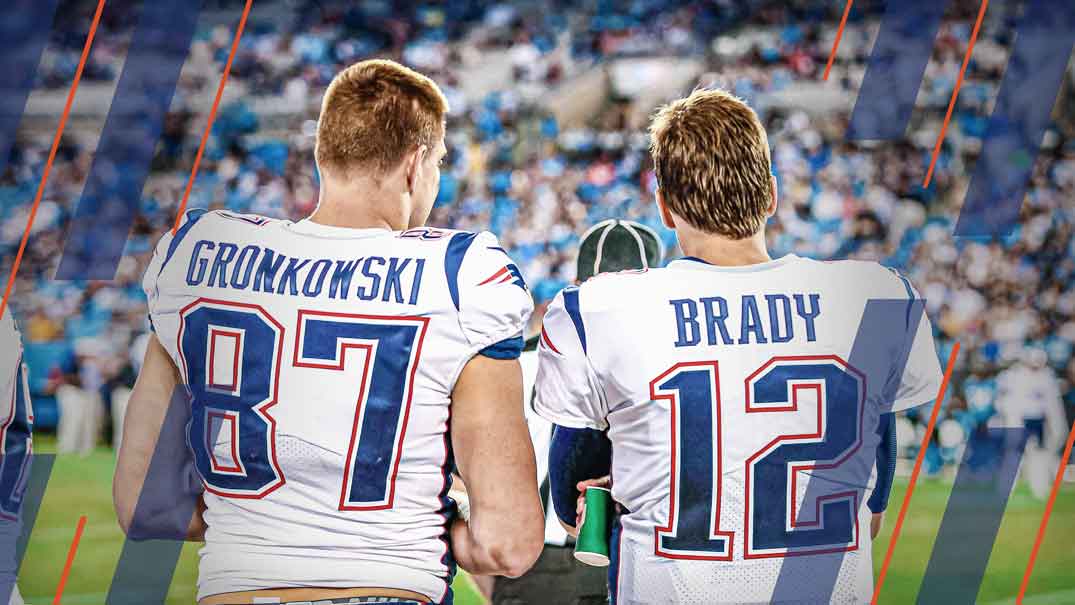
- QB: Tom Brady (2006-2019)
- HB: Rhamondre Stevenson (2021-2025)
- WR: Julian Edelman (2009-2020)
- WR: Randy Moss (2007-2010)
- Slot WR: Wes Welker (2007-2012)
- TE: Rob Gronkowski (2010-2018)
- TE: Hunter Henry (2021-2025)
- LT: Matt Light (2006-2011)
- LG: Logan Mankins (2006-2013)
- C: David Andrews (2015-2024)
- RG: Shaq Mason (2015-2021)
- RT: Mike Onwenu (2020-2025)
The Patriots won three Super Bowls and appeared in seven during the PFF era, making them the NFL's most accomplished franchise of the last 20 years. As a result, several selections were obvious, including Hall of Fame wide receiver Randy Moss and likely future Hall of Famers Tom Brady, Rob Gronkowski and Logan Mankins. The franchise's sustained success also created several highly competitive position battles.
The offensive line was especially difficult to assemble, as New England consistently developed long-term starters. Fourteen linemen played at least 3,500 snaps while earning a PFF offensive grade of 78.0 or higher. The threshold for making the starting lineup was roughly 5,800 snaps and an 81.0 grade or better. In fact, a second-team offensive line of Nate Solder, Joe Thuney, Dan Koppen, Stephen Neal and Sebastian Vollmer would compare favorably with many franchises' starting units.
Running back was similarly competitive, albeit for a different reason. New England frequently relied on three-man backfield rotations and rarely featured the same players for extended periods. Fourteen running backs logged at least 900 snaps during the PFF era, yet none reached 3,500. Only Kevin Faulk, James White and Rhamondre Stevenson surpassed 1,500 snaps. Stevenson was the best pure runner of the group, White was the most productive receiver and Faulk was arguably the most complete player. Ultimately, Stevenson's superior overall grade, combined with a workload greater than Faulk and White combined, earned him the spot.
Defense
- DI: Ty Warren (2006-2009)
- DI: Trey Flowers (2015-2018)
- NT: Vince Wilfork (2006-2014)
- ED: Rob Ninkovich (2009-2016)
- ED: Kyle Van Noy (2016-2021)
- LB: Dont’a Hightower (2012-2021)
- LB: Jamie Collins Sr. (2013-2016, 2019-2022)
- CB: Stephon Gilmore (2017-2020)
- CB: Malcolm Butler (2014-2017)
- Slot CB: Jonathan Jones (2016-2024)
- S: Devin McCourty (2010-2022)
- S: Patrick Chung (2009-2019)
The Patriots' defense presented an interesting challenge when assembling this roster. Bill Belichick regularly shifted between 4-3 and 3-4 fronts, leaving several players straddling traditional positional boundaries. Dont'a Hightower and Jamie Collins rushed the passer more often than most off-ball linebackers, while Rob Ninkovich dropped into coverage more frequently than a typical edge defender. Trey Flowers also complicated matters, spending significant time both on the edge and along the interior early in his career while grading better than most true defensive tackles. In the end, the front seven simply consisted of the seven highest-graded players by this methodology.
It's also worth remembering that the PFF era began in 2006, after the start of New England's first great defensive run. Ty Law and Willie McGinest were already gone when the era began, while Richard Seymour, Mike Vrabel, Tedy Bruschi, Asante Samuel and Rodney Harrison all departed by 2008. Several of those players performed well during their limited time in the PFF era, but they struggled to compete with players who accumulated far higher snap counts.
The closest position battles came down to Kyle Van Noy versus Chandler Jones for the final front-seven spot and Malcolm Butler, Asante Samuel, J.C. Jackson and Christian Gonzalez for the last cornerback position.
Methodology
Selections were based on normalized PFF grades adjusted by season. To balance peak performance and longevity, only a player's five best seasons with a franchise from 2006-25 were considered. Any season with an overall PFF grade below 60.0 was excluded, ensuring that strong years helped a player's case while weaker seasons were not held against him. Postseason play was included, though all seasons were capped at a 16-game equivalent to maintain consistency across eras. At each position, the player with the highest score under this methodology earned the spot.
Each team consists of 12 offensive and 12 defensive players. Because 11 personnel and nickel defense were the league's most common alignments over the past two decades, those personnel groupings served as the foundation for every roster. Teams received either a second tight end or a fullback, depending on whether they used more 12- or 21-personnel. Defensively, teams received either a third interior defender or a third linebacker depending on whether they primarily operated from a 3-4 or 4-3 front.
Players who logged significant snaps at multiple positions during their tenure with a franchise were eligible at either spot. In most cases, those players were assigned to the position where they provided the greatest value, though their versatility occasionally influenced the final roster construction.
Unlike some All-Pro teams that group offensive linemen by position type, these rosters were built according to where players actually lined up. If a team's two best tackles both played exclusively on the left side, only the top left tackle was selected. One of the three wide receivers and one of the five defensive backs was also required to have significant slot experience. In a 4-3 defense, one linebacker needed experience at the Sam linebacker position, while in a 3-4 defense, one defensive tackle needed experience at nose tackle.
When multiple players are listed at the same position, the first name represents the top selection. Players designated as slot wide receiver, slot cornerback, nose tackle or Sam linebacker were selected specifically for those roles rather than as the third-best player within their broader position group.